-
 [email protected]
-
 +66-31240888



 English
 Español
 ไทย
ไทยBagasse Tray Wholesale: How Bulk Buyers Cut Cost with Carton and Container Planning
Bagasse trays look cheap per piece and can still be expensive per delivered tray. The difference is almost never the material or the mould. It is the carton, the case pack and the container plan — three numbers that sit on the supplier’s packing sheet and rarely on the price list.
Quick Summary: Cutting Real Cost on Wholesale Bagasse Trays
- Verify the item code: two trays that look the same can differ in size, weight and case pack, and those differences decide the delivered cost.
- Verify the case pack: pieces per carton and carton volume drive how much you pay per piece to move the goods.
- Verify the carton dimensions: a carton that is slightly too deep wastes container space on every shipment you ever make.
- Verify the container loading: ask for the cartons and pieces a 40HQ actually carries for that item code, not a generic figure.
- Verify the packed weight: trays are bulky but light, so volume — not weight — usually decides what fits in the container.
- Verify the comparison basis: compare cost per piece delivered, not price per piece ex works.

For bagasse trays, the packing sheet decides the delivered cost: case pack and carton volume turn a good unit price into a good or a bad landed cost.
This guide uses the actual carton data of a molded fiber tray range, published item by item, so buyers can see how much the same production base changes per piece once the carton and the container are taken into account.
Core buyer principle: the tray specification is the mould; the carton specification is the cost. Buyers who lock the first and negotiate only the second are negotiating half the deal.
What Actually Drives the Delivered Cost per Tray
| Cost driver | Where it is recorded | Why it matters more than it looks |
|---|---|---|
| Item size and weight | Product specification | Sets the material cost and the packed weight |
| Pieces per carton | Packing specification | Decides handling cost per piece and how many cartons you receive |
| Carton dimensions | Packing specification | Decides how much air you ship and pay for |
| Carton volume (CBM) | Packing specification | The single number that converts to container cost |
| Container loading | Loading plan | Turns CBM into cartons and pieces per shipment |
1. Is the Tray Locked to an Item Code?
Wholesale tray ranges are dense: many sizes sit within a few millimetres of each other, and the difference is commercial rather than cosmetic.
What should buyers verify?
- Confirm the item code, the outside dimensions in millimetres and the unit weight.
- Confirm the compartments and the shape, because a 5-compartment tray and a plain tray of similar size pack differently.
- Confirm the material and any coating, and whether the same code is produced at both production bases.
- Confirm which items in the range are actually stocked and which are made to order.
- Record the item code on every comparison sheet.
Buyer red flag: a quotation expressed in price per kilogram with no item codes — it cannot be tied back to a packing specification, so the delivered cost is unknown.
How Zhong Xin Ecoware Supports This
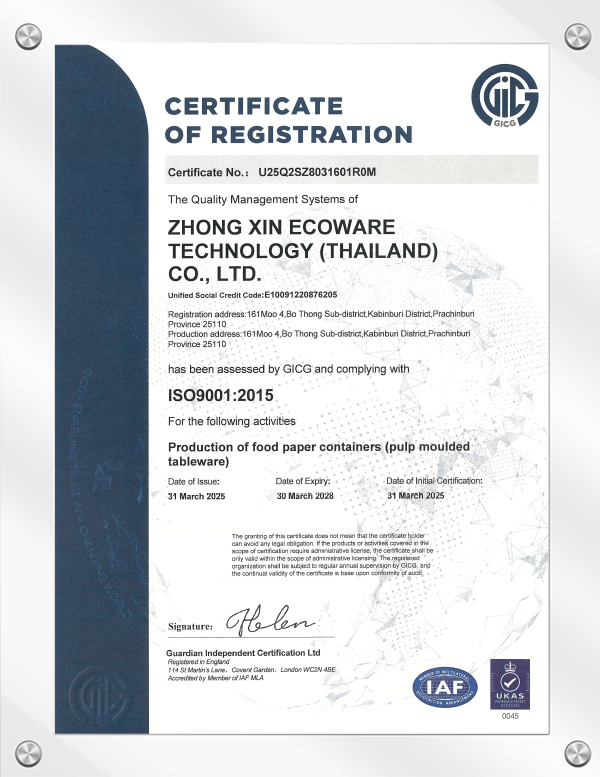
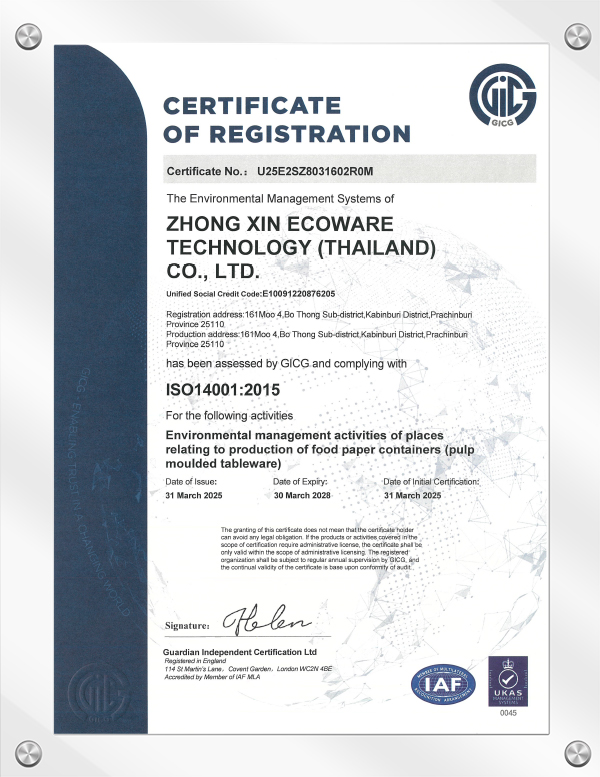
Zhong Xin Ecoware Technology (Thailand) Co., Ltd. quotes molded fiber bagasse trays by item code, with outside dimensions and unit weight stated, from production bases in China and Thailand.
Evidence buyers can request: item code list with dimensions and weights, product specification, production site declaration.
2. Does the Carton Match the Tray?
Cartons are often standardised across a range to simplify purchasing, and the result is that several items ship in a carton that suits none of them perfectly.
What should buyers verify?
- Confirm the carton length, width and height for the item code, not for the product family.
- Confirm how the trays are nested or bagged inside the carton, and whether an inner bag is used.
- Confirm the number of pieces per bag and bags per carton.
- Confirm the packed carton weight, and whether it is within the handling limit for your warehouse.
- Confirm the carton board grade and whether it survives a full container stack.
Buyer red flag: a carton height chosen for a different item, which leaves part of every carton empty on every shipment.
How Zhong Xin Ecoware Supports This
Packing data is issued per item code, showing pieces per bag, bags per carton, carton dimensions and carton volume, so the carton can be checked against the tray rather than assumed from the range.
Evidence buyers can request: packing specification per item code, carton dimensions, packed weight, carton board specification.
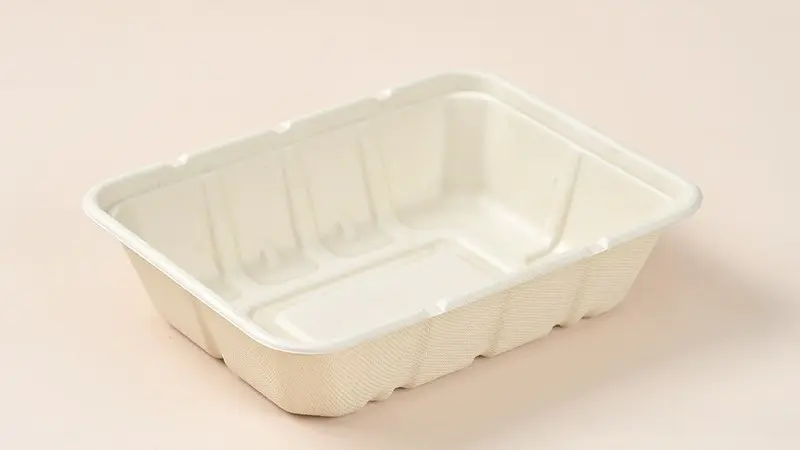
3. Why Two Similar Trays Load Differently
A wider tray with a shallower profile can be nested deeper, while a narrower tray with a higher rim cannot. The carton volume per piece can differ by more than a third.
What should buyers verify?
- Compare carton volume per piece, not carton volume.
- Compare the cartons required for the same number of pieces on each of the items you are considering.
- Confirm whether nesting or stacking is used, because it changes the usable volume.
- Confirm whether the trays are supplied in bags, which adds volume but protects the surface.
- Record the comparison in the units your own warehouse handles.
Buyer red flag: choosing a tray on unit weight alone, when the lighter tray needs more container space than the heavier one.
How Zhong Xin Ecoware Supports This
Because carton volume is published per item code, buyers can compare carton volume per piece across the range and see which item gives the better container utilisation before the order is placed.
Evidence buyers can request: carton volume per item code, pieces per carton, comparison sheet for a shortlist of item codes.
4. What a 40HQ Actually Carries
The table below uses the published packing data of the molded fiber tray range. The container figures are volume-based estimates for a 40HQ using an assumed usable volume of about 68 CBM, which allows for loading gaps and for the difference between palletised and floor-loaded shipments.
| Size (mm) | Weight | Pieces / Carton | CBM / Carton | Cartons per 40HQ* | Pieces per 40HQ* |
|---|---|---|---|---|---|
| 164*89*21 | 10 g | 500 | 0.0198 | 3,437 | 1,718,500 |
| 170*115*25 | 10 g | 500 | 0.0143 | 4,769 | 2,384,500 |
| 176*132*30 | 11 g | 500 | 0.0168 | 4,039 | 2,019,500 |
| 185*128*21 | 14 g | 500 | 0.0306 | 2,224 | 1,112,000 |
| 211*98*20 | 14 g | 300 | 0.0189 | 3,594 | 1,078,200 |
| 225*165*25 | 21 g | 500 | 0.0368 | 1,850 | 925,000 |
| 231*194*43 | 32 g | 300 | 0.0423 | 1,608 | 482,400 |
| 240*180*30 | 29 g | 250 | 0.0466 | 1,459 | 364,750 |
| 260*115*30 | 18 g | 500 | 0.0282 | 2,408 | 1,204,000 |
| 260*210*25 | 24 g | 500 | 0.0482 | 1,412 | 706,000 |
| 280*220*45 | 33 g | 300 | 0.0475 | 1,432 | 429,600 |
| 281*221*45 | 48 g | 300 | 0.0655 | 1,038 | 311,400 |
| 317*216*24 | 30 g | 500 | 0.0651 | 1,044 | 522,000 |
| 321*221*31 | 38 g | 250 | 0.0370 | 1,837 | 459,250 |
*Volume-based estimate for a 40HQ at about 68 CBM usable. Actual loading depends on palletisation, stacking and the loading plan confirmed with the packing specification for the item code.
Read the table this way: the lightest item carries more than seven times as many pieces in one container as the heaviest item on the list. If you compare them on price per piece alone, you are comparing two completely different shipments.
What should buyers verify?
- Confirm cartons and pieces per container for the exact item code, not for the range.
- Confirm whether the shipment will be floor loaded or palletised, because pallets reduce usable volume.
- Confirm the maximum stack height allowed by the carton board and your warehouse.
- Confirm whether a mixed container is possible and how it changes the loading.
- Confirm the loading figure stated in the quotation matches the packing specification.
Buyer red flag: a container estimate carried over from one item code to another because the trays “look similar”.
How Zhong Xin Ecoware Supports This
A loading proposal is prepared per order, stating cartons, pieces and the container type against the item codes ordered, so the quotation and the packing specification carry the same numbers.
Evidence buyers can request: loading proposal, packing specification, cartons and pieces per container, palletisation note.
5. Where Wholesale Buyers Lose Money on a Low Unit Price
A low price per piece is not a saving if the carton is inefficient or the loading is optimistic. Three losses recur.
What should buyers verify?
- Lost container space: paying freight for air because the carton is deeper than the tray needs.
- Over-shipped cartons: a small case pack means more cartons, more handling and more packaging cost per piece.
- Optimistic loading: a quotation built on a theoretical maximum that cannot be achieved with the actual stow.
- Mixed pallet stacks: items that cannot share a pallet efficiently increase handling without adding value.
- Reorder mismatch: a second order packed differently from the first, changing your storage and handling cost.
Buyer red flag: a supplier who cannot state how many cartons fit a container for the specific item being quoted.
How Zhong Xin Ecoware Supports This
Because packing data is held per item code, the same figures can be reissued on reorder, so the second shipment is planned on the same basis as the first.
Evidence buyers can request: packing specification reissued per order, loading proposal, case pack confirmation, carton dimension record.

6. Comparing Trays on Delivered Cost per Piece
The comparison only becomes meaningful once every candidate is expressed as cost per piece delivered to your warehouse.
What should buyers verify?
- Start from the price per carton, not the price per piece, so the case pack is built into the number.
- Add freight per carton and divide by pieces per carton to get freight per piece.
- Add destination charges, inland delivery and any storage per carton on the same basis.
- Compare items on the same order quantity, because container steps change the average.
- Re-run the comparison whenever the pack format or the item code changes.
Buyer red flag: a comparison spreadsheet with one column in price per piece and another in price per carton — the two are not comparable until converted.
How Zhong Xin Ecoware Supports This
Quotations are issued per item code with the case pack and carton volume stated, so the buyer can convert every offer to cost per piece delivered on a consistent basis.
Evidence buyers can request: quotation per carton and per piece, case pack, carton volume, reference loading.
7. Locking the Specification Before the Reorder
The hardest part of wholesale tray supply is not the first order. It is the fifth, when the carton has quietly changed and the warehouse discovers it at the unloading dock.
What should buyers verify?
- Confirm the packing specification is attached to the purchase order, not only to the quotation.
- Confirm who is notified if a carton dimension or case pack changes.
- Confirm that a change is proposed before it is applied, with the loading impact stated.
- Confirm an inspection point for carton dimensions and case pack on production.
- Confirm the item codes remain unchanged across the program.
Buyer red flag: a reorder delivered in a carton of different dimensions with no prior notice.
How Zhong Xin Ecoware Supports This
The packing specification is issued with the order documentation and buyers are informed if the packing basis for an item code is revised, so that the loading plan and the warehouse expectation stay aligned.
Evidence buyers can request: packing specification on the order, revision notice practice, carton dimension check record.
Get a Quote for Your Next Order
Zhong Xin Ecoware Technology (Thailand) Co., Ltd. supplies molded fiber bagasse trays and tableware for wholesale, distribution and private-label programs from production bases in China and Thailand. Send your item list and target quantity to info@fiber-product.com for a quotation with the packing specification and a loading proposal.
Note: container figures in this guide are volume-based estimates for planning purposes. Confirm the actual loading with the packing specification for your item code and with your freight forwarder before committing to a shipment.
Related Buyer Guides
- FOB, CIF or DDP? Incoterms for bagasse tableware buyers
- How to prepare a bagasse tableware import: 10 readiness checks
- US vs EU bagasse tableware imports: 8 documentation checks
- Browse biodegradable trays
- Browse biodegradable food packaging
About Zhong Xin Ecoware
Zhong Xin Ecoware Technology (Thailand) Co., Ltd. supplies bagasse and molded fiber food packaging to importers, distributors and foodservice brands. For MOQ, pricing, samples and certification files, contact info@fiber-product.com.
Last updated: 9 October 2026.



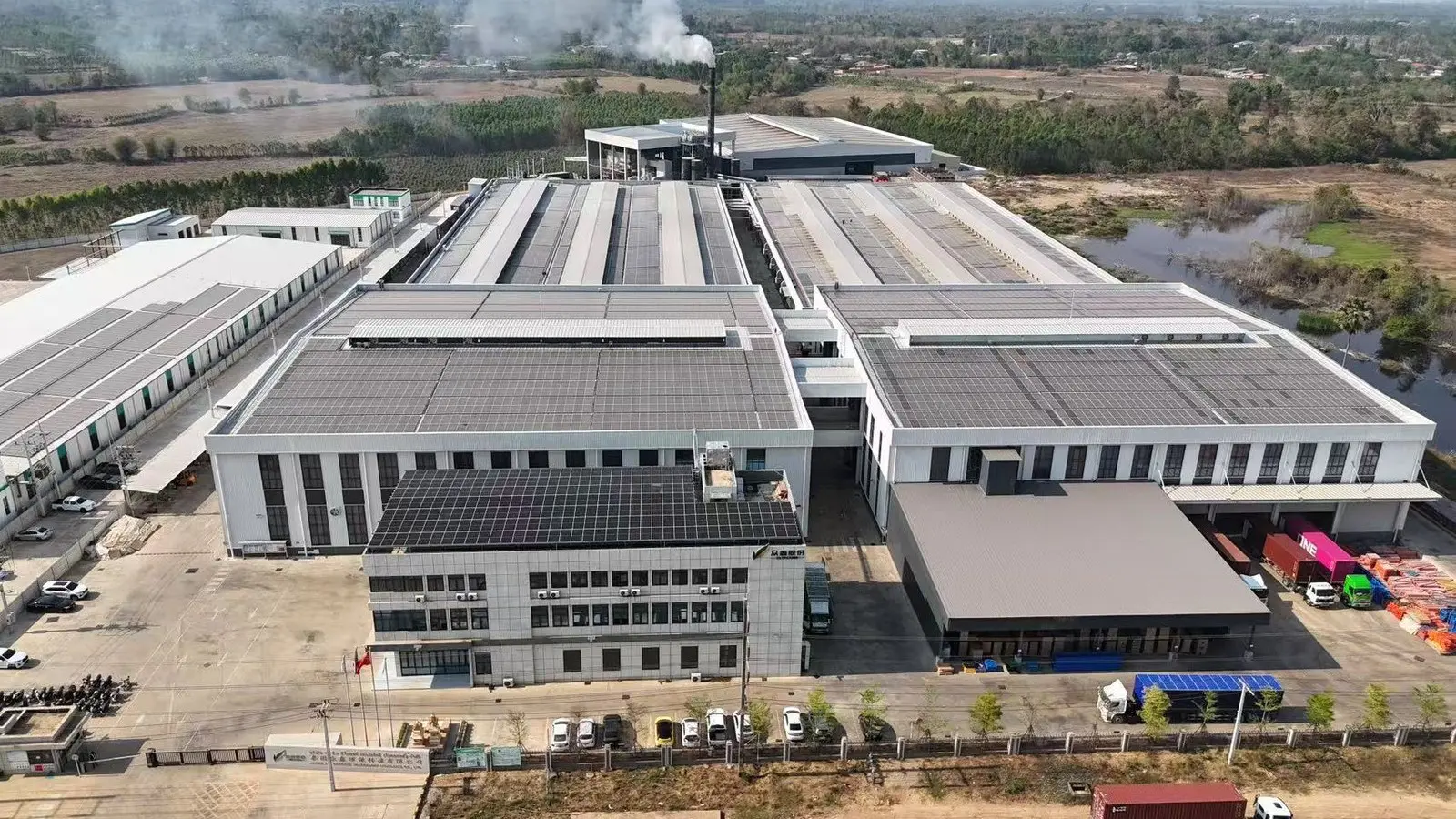
Zhong Xin Ecoware(Thailand) was registered on November 1, 2023, and officially began construction of the factory building in June 2024. At present, the first phase workshop of the factory has been fully completed and put into use. The second phase of the factory is being constructed intensively.
The landing and development of Zhong Xin in Thailand has brought a large amount of initial investment for land, factories, etc., and continuous operational investment for continuous equipment updates, technological upgrades, and capacity expansion.
Zhong Xin Ecoware(Thailand) has directly and indirectly created thousands of job opportunities, increased government revenue, promoted local economic development, cultivated local supply chains, provided systematic training for employees, improved the quality of local human capital, injected vitality into the local economy, enhanced industrial competitiveness, and ultimately improved residents' living standards.
Zhong Xin Ecoware(Thailand) actively collaborates with local pulp mills to explore new cooperation models for developing new products, improving production capacity and quality. At the same time, relying on Zhongxin's advanced production technology, process flow, management experience, and quality control system, it promotes the development of this industry in Thailand.

-
-
 +66-31240888
 -
 161 Village No. 4, Bo Thong Subdistrict Kabin Buri District Prachinburi Province 25110
-
Bagasse Tray Wholesale: How Bulk Buyers Cut Cost with Carton and Container Planning
Oct 09,2026
-
What Should a Bagasse Manufacturer Include in a Bulk Order Quote
Oct 09,2026
-
FOB, CIF or DDP? Incoterms for Bagasse Tableware Buyers Shipping from Thailand
Oct 06,2026
-
Packaging or Food Contact? Which EU Regime Applies to Bagasse Cups, Bowls, Plates and Cutlery
Oct 06,2026
-
Compostable Cutlery Sets for Private Label: 7 Sourcing Checks for Retail and Foodservice Buyers
Oct 06,2026
-
US vs EU Bagasse Tableware Imports: 8 Documentation and Compliance Checks Buyers Should Run
Oct 06,2026
-
How to Prepare a Bagasse Tableware Import: 10 Readiness Checks for US and EU Buyers
Oct 06,2026
-
Beyond Plates: Which Foods Suit Bagasse Tableware
Oct 02,2026
-
New Bagasse Tableware Lineup for 2026: What Is New and Where to See It
Sep 28,2026
-
How to Select Bagasse Clamshells for Burgers, Rice Meals and Fried Food
Sep 28,2026
-
Microwave Reheating: Is a Bagasse Lunch Box Suitable
Sep 25,2026
-
9 Inch Pizza Plates and Bagasse Pizza Boards: A Sourcing Guide for US and Canadian Distributors
Sep 19,2026
Copyright © 2025 Zhong Xin Ecoware Technology ( Thailand ) CO., LTD.
All Rights Reserved.

Biodegradable Disposable Bagasse Tableware Manufacturer