-
 [email protected]
-
 +66-31240888



 English
 Español
 ไทย
ไทยHow to Prepare a Bagasse Tableware Import: 10 Readiness Checks for US and EU Buyers
Preparing a bagasse tableware import is not a single document or a single check. It is a sequence: lock the specification, match the compliance file to the exact SKU and destination market, confirm the carton and loading plan, protect the load in transit, inspect before shipment, prepare the entry file, and agree how the goods will be checked and claimed on arrival. Buyers who skip a stage usually discover it later as a shortage, a broken edge, a customs question or a rejected label.
Quick Summary: How to Prepare a Bagasse Tableware Import
- Verify the specification: item code, unit weight, dimensions, colour and lid compatibility should be in writing before the order is placed.
- Verify the compliance file: food-contact, PFAS-related and compostability evidence must name the exact product and the market where the claim will be used.
- Verify the carton and loading plan: case quantity, carton dimensions and container loading should be confirmed against the official packing data, not estimated.
- Verify the transit protection: humidity, stacking pressure and handling are the most common causes of edge damage and warping on molded fiber.
- Verify the inspection plan: agree the AQL acceptance criteria and the inspection point before production ends, not after the container is sealed.
- Verify the arrival process: decide who checks what on arrival, within how many days, and how a claim is raised.
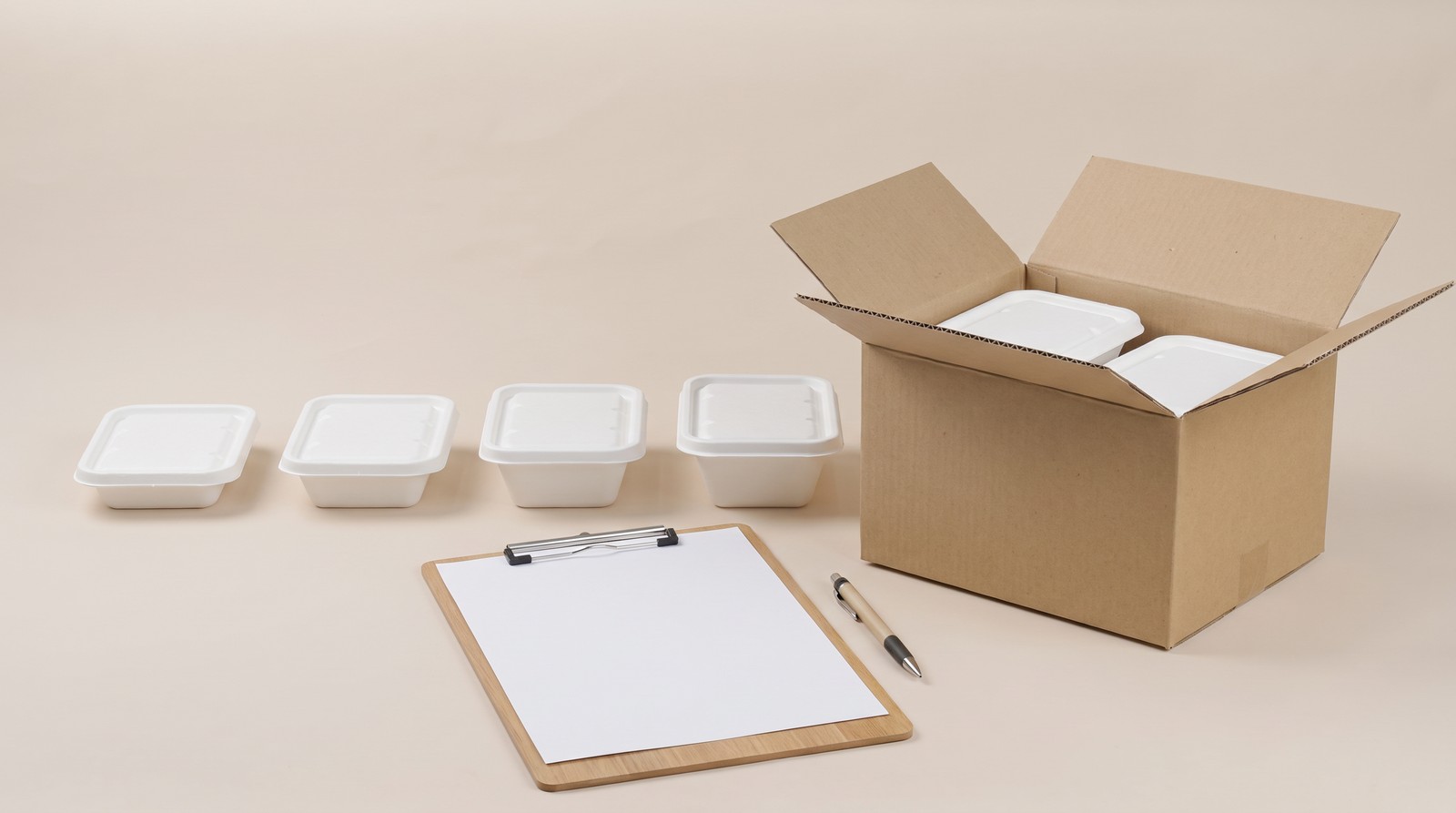
A bagasse tableware import is prepared in stages: specification, compliance file, carton and loading plan, transit protection, pre-shipment inspection and arrival checks.
Molded fiber tableware is a low-value, high-volume product. The margin sits in the details: whether the case pack matches the loading plan, whether the compliance file covers the coating as well as the fibre, and whether the pallet arrives with the edges intact. A price that looks competitive on a sample can still produce a poor landed cost if the loading or the inspection plan is wrong.
Core buyer principle: readiness is a sequence, not a form. Each stage depends on the one before it. A compliance file cannot be completed before the specification is locked, and a loading plan cannot be confirmed before the carton specification is agreed.
10 Readiness Checks for a Bagasse Tableware Import
| # | Readiness check | What the buyer is really checking | Typical risk if ignored |
|---|---|---|---|
| 1 | Product specification locked before ordering | Whether every document describes the same SKU | Approved sample and bulk shipment differ |
| 2 | Compliance file matched to SKU and market | Whether the evidence covers this product, coating and destination | Claim questioned or import file incomplete |
| 3 | Carton specification and loading plan confirmed | Whether the case pack supports the program and the container | Poor cube utilisation, short or over shipment |
| 4 | Palletisation and mixed-SKU loading agreed | Whether the load survives handling and stacking | Collapsed corners, mixed-pallet damage |
| 5 | Transit protection specified | Whether humidity and stacking pressure are controlled | Soft edges, warping, mould |
| 6 | Pre-shipment inspection with AQL criteria | Whether bulk output matches the approved sample | Batch-to-batch variation found on arrival |
| 7 | Shipping documents cross-checked | Whether invoice, packing list and bill of lading agree | Customs delay and rework |
| 8 | Classification and destination requirements confirmed | Whether your broker has what they need before arrival | Unexpected duty, hold or inspection fee |
| 9 | Label and artwork approved in writing | Whether the claim wording is settled before printing | Expensive reprint and delayed launch |
| 10 | Arrival inspection and claims process agreed | Whether damage can be documented in time to claim | Loss that cannot be recovered |
1. Is the Product Specification Locked Before the Order Is Placed?
The first question is not "what is your best price?" It is "which SKU are we actually buying, and does every document say the same thing?" Molded fiber products are often ordered by a short description — a nine-inch plate, a 750 ml container — that can map to several different moulds, weights and lid options.
What should buyers verify?
- Confirm the item code, unit weight, outside dimensions and colour for the exact SKU.
- Confirm lid compatibility if the product is supplied with a lid, and whether the lid is the same material.
- Confirm the base fibre and any coating or barrier layer in writing.
- Confirm the approved sample reference and keep a physical and photographic record.
- Confirm the packing specification: pieces per case, case dimensions and case weight.
Buyer red flag: a quotation that describes the product only as "bagasse plate" or "pulp container", with no item code, weight or dimensions, cannot be compared against another supplier and cannot be used to control production.
How Zhong Xin Ecoware Supports This
Zhong Xin Ecoware Technology (Thailand) Co., Ltd. supplies molded fiber bagasse tableware from production bases in China and Thailand, and quotes against a written item code list covering plates, bowls, clamshells, trays, containers and cups. Sample records and dimensional specifications are shared before a bulk order is scheduled.
Evidence buyers can request: item code list, product specification sheet, unit weight and dimensions, approved sample reference, lid compatibility note.
2. Does the Compliance File Match the Exact SKU and the Destination Market?
A certificate list is not a compliance file. What matters is whether the evidence names the product you are importing, the material system it is made from and the market where the claim will be used.
What should buyers verify?
- Confirm which document covers food-contact suitability for the finished article, including the coating or liner.
- Confirm the scope of any PFAS-related declaration: finished article, coating or fibre only.
- Confirm the compostability reference is the one recognised in the destination market.
- Confirm that document names and production sites are consistent with the commercial documents.
- Keep a dated copy of each file in the buyer compliance pack.
Buyer red flag: a document issued for a product family that does not include your SKU, or a certificate that names only the group company and not the production site.
How Zhong Xin Ecoware Supports This
Certification and test documentation is provided per product family and production site, and buyers are told which document covers which product rather than being sent a general list. Where a market requires additional testing, this is agreed before production.
Evidence buyers can request: food-contact documentation, PFAS-related declaration, compostability documentation, certification index by product family.
3. Is the Carton Specification and Loading Plan Confirmed?
Container planning is where an apparently good price is won or lost. Case quantity and carton dimensions determine how many containers a purchase order needs, and whether the load cubes out cleanly.
What should buyers verify?
- Confirm pieces per case and carton dimensions in centimetres, not estimates.
- Calculate loading from the official packing data rather than from sample weight.
- Confirm whether mixed-SKU loading is possible and how the pallet or floor load is built.
- Confirm case marking and whether shipping marks are required.
- Confirm gross and net weight per case for the entry file.
Buyer red flag: a loading figure that appears in a quotation but not in the packing specification — the two documents should agree.
How Zhong Xin Ecoware Supports This
Carton data is published per SKU in the official packing specification. For example, a nine-inch one-compartment clamshell is packed 200 pieces per case at 48 x 36 x 24 cm, and a nine-inch one-compartment tray 200 pieces per case at 56.5 x 24 x 24 cm; a 40 HQ container references approximately 1,490 and 1,900 cases respectively. Figures are reference values and are confirmed against the actual packing list for each order.
Evidence buyers can request: packing specification per item code, carton dimensions and weights, reference container loading, mixed-loading proposal.

4. Are Palletisation and Mixed Loading Agreed?
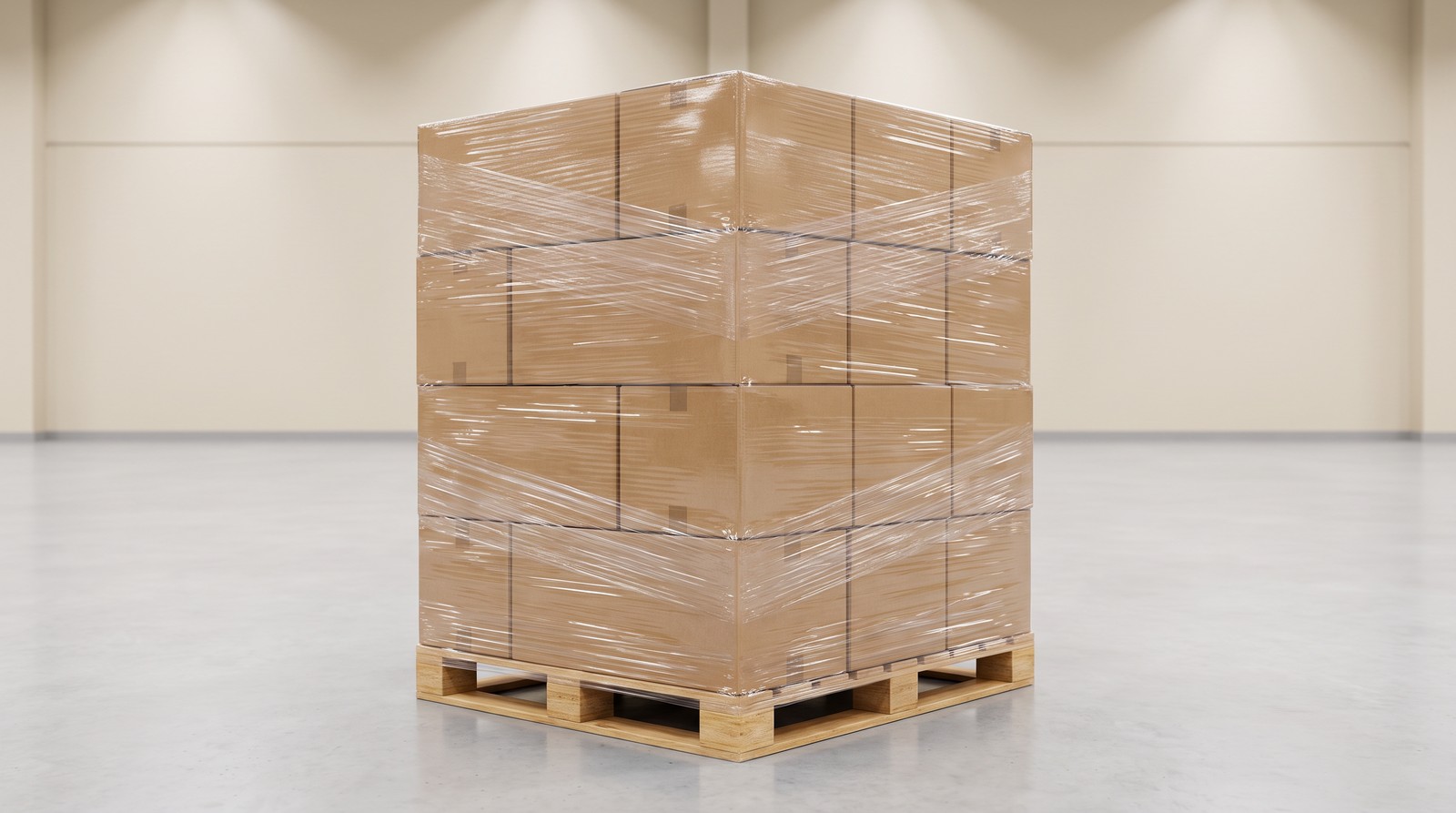
How the load is built decides how much of it arrives undamaged. Molded fiber resists compression reasonably well when it is stacked squarely, and poorly when a pallet is built with overhang or with heavier cases on top of lighter ones.
What should buyers verify?
- Confirm pallet dimensions, height and whether pallets are exchanged or one-way.
- Confirm whether the load is floor-loaded or palletised for the destination.
- Confirm how mixed SKUs are sequenced so that lighter products are not crushed.
- Confirm corner protection where the pallet is strapped.
- Confirm that the loading plan matches the receiving facility, not only the container.
Buyer red flag: a mixed pallet planned without a stack drawing. If no one can describe the layer order, the last layers will carry the load.
How Zhong Xin Ecoware Supports This
Loading proposals are prepared per order, including pallet build for mixed SKUs and the sequence used for floor loading, and are shared with the buyer before shipment for confirmation.
Evidence buyers can request: loading proposal, stack drawing, pallet specification, corner protection method.
5. Is Transit Protection Specified?
Molded fiber is hygroscopic. Over a long sea voyage, humidity and stacking pressure do more damage than rough handling, and the damage appears as soft edges, warping or mould rather than as obvious breakage.
What should buyers verify?
- Confirm whether desiccant or liner bags are used inside the container for humid routes.
- Confirm carton stacking limits and whether the loading plan respects them.
- Confirm shrink wrap or stretch wrap specification for palletised loads.
- Confirm ventilation requirements for the container.
- Confirm the storage conditions expected at destination.
Buyer red flag: cartons loaded to the container roof with no stacking plan and no moisture control on a long, humid route.
How Zhong Xin Ecoware Supports This
Transit protection is agreed per order according to route and season, covering stacking limits, moisture control and wrapping, and is reflected in the loading proposal issued before shipment.
Evidence buyers can request: loading and stacking plan, moisture-control method, wrapping specification, storage guidance.
6. Is There an Inspection Plan With Agreed Acceptance Criteria?
Inspection that happens after the container is sealed is not inspection, it is documentation of a decision already taken. The acceptance criteria should be agreed while production can still be adjusted.
What should buyers verify?
- Agree the AQL level, sample size and the defect classification (critical, major, minor).
- Confirm the inspection point: during production, before packing or before loading.
- Confirm which characteristics are measured: weight, dimensions, edge condition, colour, lid fit.
- Confirm who attends the inspection and how the record is issued.
- Confirm what happens if the lot fails the criteria.
Buyer red flag: a supplier that cannot state a defect classification, or that treats "it looks fine" as an acceptance criterion.
How Zhong Xin Ecoware Supports This
Acceptance criteria are agreed before production and the inspection record is issued against those criteria. Third-party inspection can be arranged at the buyer’s request.
Evidence buyers can request: agreed AQL and defect classification, inspection record, dimensional and weight check results, third-party inspection report when used.

7. Are the Shipping Documents Cross-Checked Before Shipment?
The documents are cheap to fix before the container sails and expensive to fix after it arrives. Most entry problems come from small disagreements between documents, not from the goods themselves.
What should buyers verify?
- Confirm the commercial invoice description, quantity and unit of measure match the packing list.
- Confirm consignee and notify party details on the bill of lading.
- Confirm the certificate of origin is issued where preferential treatment is claimed.
- Confirm shipping marks on the cartons match the documents.
- Confirm the document set is issued in the format your broker expects.
Buyer red flag: an invoice quantity expressed in cases while the packing list is expressed in pieces, with no conversion stated.
How Zhong Xin Ecoware Supports This
Draft documents are shared for buyer confirmation before shipment, and the final set is issued against the confirmed data.
Evidence buyers can request: draft commercial invoice, packing list, bill of lading copy, certificate of origin where applicable.
8. Is Classification and Destination Requirements Confirmed?
Classification and duty treatment are the buyer’s responsibility in most transactions, but they depend on information the supplier holds: material composition, intended use and origin.
What should buyers verify?
- Confirm your broker has the material composition and intended use of the article.
- Confirm the origin that will be declared and whether the production site is eligible for any preferential treatment you intend to claim.
- Confirm whether the destination market requires additional documentation for food-contact articles.
- Confirm any registration obligations that belong to the importer.
- Confirm the classification before the order is placed, not at arrival.
Buyer red flag: assuming that articles from two production bases in different countries share the same origin and duty treatment.
How Zhong Xin Ecoware Supports This
Material composition, intended use and production site are provided for each order so that the buyer’s broker can classify and confirm origin requirements. Classification itself and duty treatment are confirmed by the buyer’s customs broker.
Evidence buyers can request: material composition statement, production site declaration, product description for classification, certificate of origin where applicable.
9. Is the Label and Artwork Approved in Writing Before Printing?
For private label programs, the label is the one item that cannot be corrected later without cost. Wording that is agreed verbally and printed immediately usually ends in a reprint.
What should buyers verify?
- Confirm the exact claim wording in writing, including any certification reference.
- Confirm the artwork version, colour and print position, and sign off a proof.
- Confirm who owns the artwork file and how changes are version-controlled.
- Confirm lead time impact of any wording change after approval.
- Confirm the label matches the claim evidence you hold for that market.
Buyer red flag: printing a compostability or PFAS-free claim that is not covered by the documents in the compliance pack.
How Zhong Xin Ecoware Supports This
Proofs are issued for written approval before printing, and wording is checked against the documentation held for the product so that the printed claim and the evidence file agree.
Evidence buyers can request: approved proof, artwork file, print specification, sample of printed product before bulk printing where feasible.
10. Is the Arrival Inspection and Claims Process Agreed?
The last stage is also the one most often left undocumented. Damage that cannot be evidenced within the carrier’s notice period usually cannot be claimed.
What should buyers verify?
- Confirm who inspects on arrival, and how quickly after discharge.
- Confirm what is recorded: carton count, condition, photographs, container seal and humidity record.
- Confirm the notice period for damage claims against the carrier or insurer.
- Confirm how a supplier-side quality claim is raised and what evidence is required.
- Confirm where the goods will be stored while the inspection is completed.
Buyer red flag: signing for the container without recording its condition, then discovering collapsed cartons two weeks later.
How Zhong Xin Ecoware Supports This
Shipment records including the loading plan and the inspection record are retained so that an arrival question can be traced back to the shipped lot, and buyer-side claims are reviewed against those records.
Evidence buyers can request: loading record, inspection record, packing list for carton-level reconciliation, retained shipping documents.

Get a Quote for Your Next Order
Zhong Xin Ecoware Technology (Thailand) Co., Ltd. supplies molded fiber bagasse tableware for wholesale, distribution and private-label programs from production bases in China and Thailand. Send your item list, target quantities and destination market to info@fiber-product.com for a quotation with the packing specification and the compliance package.
Related Buyer Guides
- Importing bagasse tableware: US vs EU documentation and compliance compared
- Zhong Xin Ecoware certifications: BPI, FDA, LFGB, BRCGS and ISO
- PFAS-free and compostability verification: a buyer’s checklist
- How to verify bagasse tableware supplier certifications in official registries
- Browse biodegradable food packaging
About Zhong Xin Ecoware
Zhong Xin Ecoware Technology (Thailand) Co., Ltd. supplies bagasse and molded fiber food packaging to importers, distributors and foodservice brands. For MOQ, pricing, samples and certification files, contact info@fiber-product.com.
Last updated: 6 October 2026.



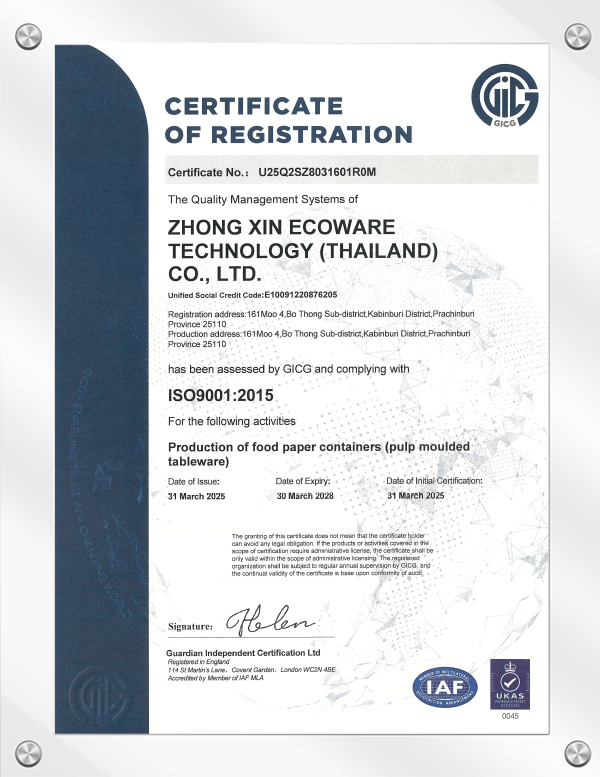
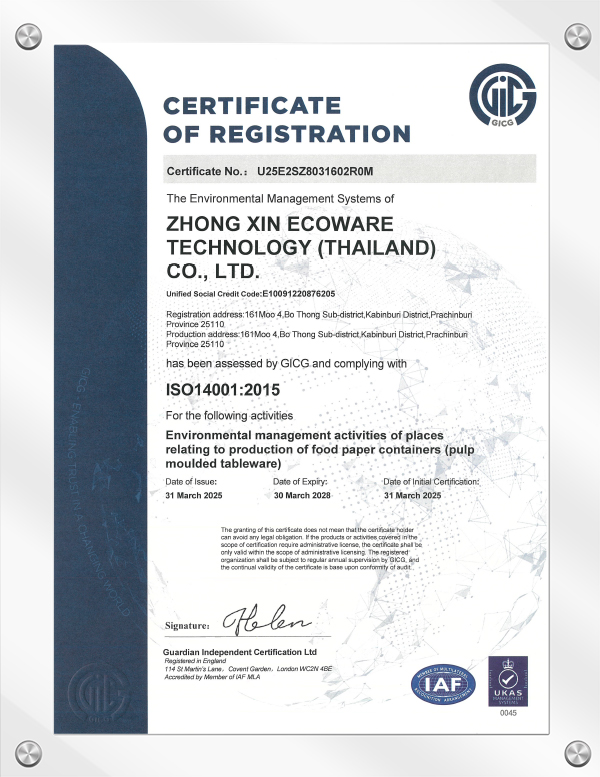
Zhong Xin Ecoware(Thailand) was registered on November 1, 2023, and officially began construction of the factory building in June 2024. At present, the first phase workshop of the factory has been fully completed and put into use. The second phase of the factory is being constructed intensively.
The landing and development of Zhong Xin in Thailand has brought a large amount of initial investment for land, factories, etc., and continuous operational investment for continuous equipment updates, technological upgrades, and capacity expansion.
Zhong Xin Ecoware(Thailand) has directly and indirectly created thousands of job opportunities, increased government revenue, promoted local economic development, cultivated local supply chains, provided systematic training for employees, improved the quality of local human capital, injected vitality into the local economy, enhanced industrial competitiveness, and ultimately improved residents' living standards.
Zhong Xin Ecoware(Thailand) actively collaborates with local pulp mills to explore new cooperation models for developing new products, improving production capacity and quality. At the same time, relying on Zhongxin's advanced production technology, process flow, management experience, and quality control system, it promotes the development of this industry in Thailand.

-
-
 +66-31240888
 -
 161 Village No. 4, Bo Thong Subdistrict Kabin Buri District Prachinburi Province 25110
-
Compostable Cutlery Sets for Private Label: 7 Sourcing Checks for Retail and Foodservice Buyers
Oct 06,2026
-
US vs EU Bagasse Tableware Imports: 8 Documentation and Compliance Checks Buyers Should Run
Oct 06,2026
-
How to Prepare a Bagasse Tableware Import: 10 Readiness Checks for US and EU Buyers
Oct 06,2026
-
Beyond Plates: Which Foods Suit Bagasse Tableware
Oct 02,2026
-
New Bagasse Tableware Lineup for 2026: What Is New and Where to See It
Sep 28,2026
-
How to Select Bagasse Clamshells for Burgers, Rice Meals and Fried Food
Sep 28,2026
-
Microwave Reheating: Is a Bagasse Lunch Box Suitable
Sep 25,2026
-
9 Inch Pizza Plates and Bagasse Pizza Boards: A Sourcing Guide for US and Canadian Distributors
Sep 19,2026
-
PFAS-Free & Compostability Verification: A Buyer's Checklist for Bagasse and Molded Fiber Packaging
Sep 19,2026
-
Bagasse vs PLA vs Molded Fiber: What Distributors Should Stock in 2026
Sep 19,2026
-
Can Sugarcane Plates Handle Hot, Greasy Foods
Sep 18,2026
-
Bagasse Tableware RFQ Template: Get a Comparable Thailand Factory Quote
Sep 14,2026
Copyright © 2025 Zhong Xin Ecoware Technology ( Thailand ) CO., LTD.
All Rights Reserved.

Biodegradable Disposable Bagasse Tableware Manufacturer