-
 [email protected]
-
 +66-31240888



 English
 Español
 ไทย
ไทยPFAS-Free & Compostability Verification: A Buyer's Checklist for Bagasse and Molded Fiber Packaging
Quick Summary: How Do I Verify PFAS-Free and Compostability Claims?
Treat them as two separate proofs. PFAS-free is a chemical-safety claim — verify it with a supplier declaration plus a total fluorine (or total organic fluorine) test report on the finished product, not the raw fiber. Compostability is an end-of-life claim — verify it with a certification scoped to the exact product (BPI / ASTM D6400 in North America; EN 13432 in the EU) and check the official registry listing. A compostability certificate does not prove PFAS-free, and a PFAS declaration does not prove compostability. Never let one document stand in for the other.

Why Buyers Are Auditing These Claims in 2026
Three regulatory shifts have turned supplier documents into a procurement gate:
- EU PPWR (Regulation (EU) 2025/40) applies from 12 August 2026 — food-contact packaging placed on the EU market must stay under PFAS thresholds of 25 ppb (single PFAS), 250 ppb (sum of PFASs) and 50 ppm total fluorine, alongside documentation and EPR duties. EU buyers are re-auditing supplier files now.
- US state restrictions keep expanding — at least a dozen states now restrict PFAS in food packaging, with effective dates ranging from New York (December 31, 2022) to Maine (May 25, 2026) and New Hampshire / New Mexico (January 1, 2027). California's screening threshold of 100 ppm total organic fluorine (AB 1200, in force since January 1, 2023) is the de facto reference many North American buyers apply even outside California.
- Composting programs and retailers are tightening acceptance — certified products with complete documentation are the only reliable way to keep compostable claims defensible, and retail vendor specifications increasingly push PFAS and compostability requirements upstream.
The result: "we are PFAS-free" and "we are certified compostable" are no longer marketing lines. They are documents you can be asked to produce, often per SKU.

Part 1 — The PFAS Verification Checklist
What to request from your supplier:
- A signed declaration of no intentionally added PFAS, covering the exact product you buy.
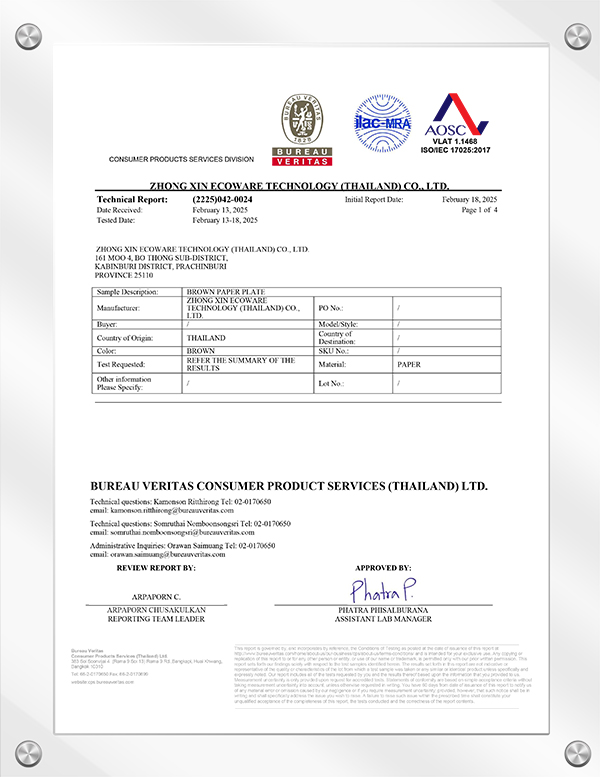
- A total fluorine (TOF) or total organic fluorine (EOF) test report for the finished product — including coating, ink and any barrier layer — not just the raw material.
- Coverage confirmation for every component: base material, coating or barrier, inks, adhesives, lids and films.
Report fields to verify before you accept it:
| Field | Why it matters |
|---|---|
| Lab name and accreditation | The test should come from an accredited third-party laboratory |
| Test method | Total fluorine screening (e.g., combustion ion chromatography) or targeted PFAS analysis (e.g., LC-MS/MS) — know which one you asked for |
| Sample description | Must describe your finished SKU, not "fiber sample" |
| Report date | Recent enough for your program and product revision |
| Reporting limits | A meaningful detection limit; "below limit" should state the limit |
Red flags: raw-material-only reports; generic "PFAS-free" marketing statements without a report; no SKU or sample identification; missing coating coverage; expired reports; resistance to sharing lab details.
Part 2 — Compostability Verification Checklist
Know which standard applies to your market:
| Market | Standard | Certification route |
|---|---|---|
| North America | ASTM D6400 | BPI certification, verifiable in the BPI directory |
| Europe | EN 13432 | OK compost (TÜV Austria), DIN CERTCO, or equivalent |
| International | ISO 17088 | Issuing body varies by program |
| Australia | AS 4736 | ABA certification |
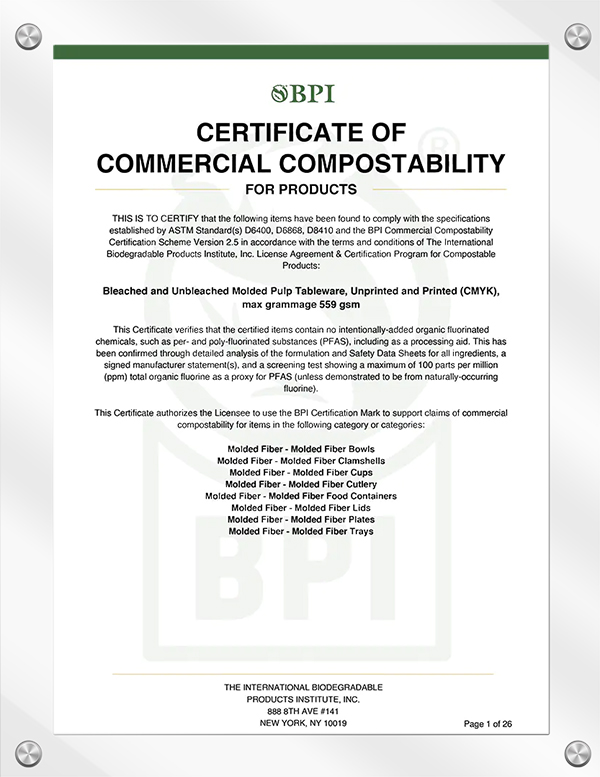
What the standards actually require: under EN 13432, packaging must show ≥90% disintegration within 12 weeks of industrial composting and ≥90% biodegradation within 6 months under laboratory conditions; ASTM D6400 requires ≥90% conversion to CO2 within 180 days. Confirm that your exact SKU — including coating and lid — was part of the tested sample.
What a valid certificate should show:
- Certificate holder and manufacturing site (must match the factory producing your goods)
- Product family and item numbers (does it cover your exact size, color, coating and lid?)
- The standard and certification level (industrial or home compostability)
- Validity dates and the issuing body's mark or registration number
Registry check, step by step:
- Search the company name in the official database (e.g., the BPI directory).
- Confirm the manufacturing site — a group listing is not automatically a site listing.
- Confirm the product family and item numbers cover your SKU, including custom colors and coatings.
- Note the validity period and save a dated screenshot to your vendor file.
- Re-check annually, and after any product change.
Red flags: certificates that cover "material" rather than products; a certificate holder different from the company quoting you; expired listings; custom or modified products without re-test confirmation; "certified" claims with no registry entry.
Part 3 — Food-Contact and Factory Documents: The Other Half of the File
Compostability and PFAS documents do not cover food safety. Complete the file with:
- US: FDA food-contact documentation or test reports matched to the intended use (hot, cold, fatty, acidic, microwave).
- EU / UK: framework-regulation documentation; LFGB reports where the German market requires them.
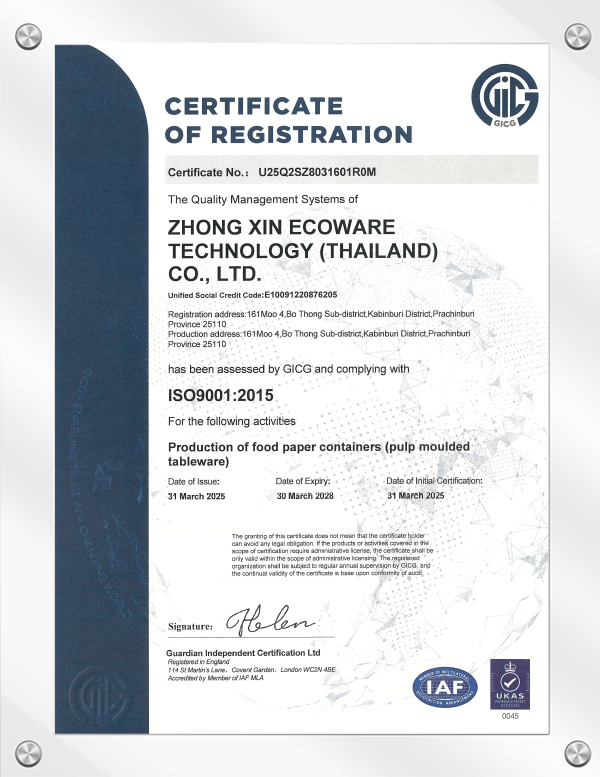
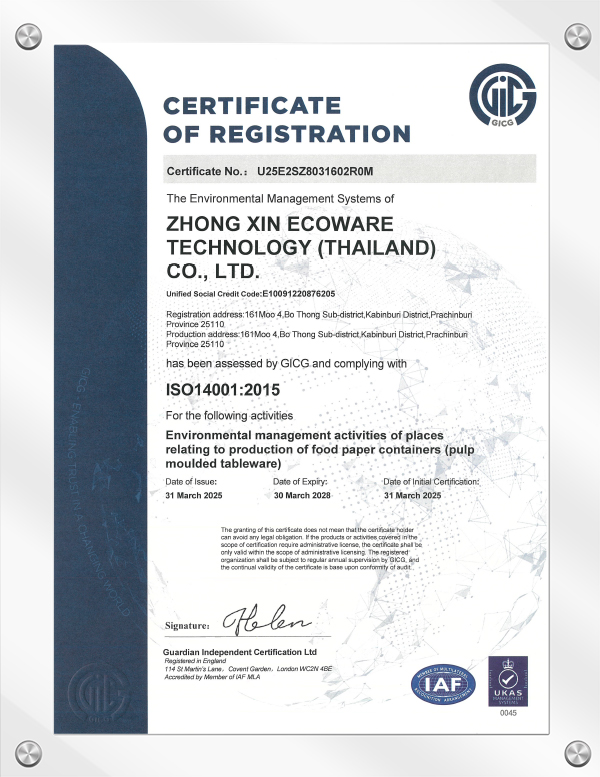
- Factory level: BRCGS Packaging Materials; ISO 9001 / 14001 certificates; social or ethical audit files (SMETA / BSCI) where buyers require them.
The One-Page Document Matrix
| Claim | Document to request | Where to verify | Common pitfall |
|---|---|---|---|
| PFAS-free | Declaration + TOF/EOF report | Lab accreditation and report fields | Raw-fiber-only tests |
| Compostable | BPI / EN 13432 certificate | Official registry listing | Scope mismatch (SKU, coating, lid) |
| Food contact | FDA / EU / LFGB documents | Match to intended use | Using a compostability certificate as food-contact proof |
| Factory quality | BRCGS / ISO / audit reports | Certificate holder and site | Entity mismatch |
| Change control | Statement covering material and coating changes | Contract clause | Silent supplier changes |
Change Control: The Clause Buyers Forget
Ask how your supplier manages changes to fiber blend, coating, barrier or additives — and require notification plus re-test or re-certification triggers in the contract. Many program failures come not from a bad first shipment, but from a silent change months later.
FAQ
Is bagasse tableware automatically PFAS-free?
The raw sugarcane fiber contains no PFAS. However, finished tableware can acquire fluorinated treatments through coatings or processing, so always verify the finished product — not the fiber.
Is a BPI certificate proof that a product is PFAS-free?
No. Compostability and PFAS-free status are separate claims with separate evidence. Ask for the PFAS documents independently.
What is the difference between a total fluorine test and a targeted PFAS test?
A total fluorine test screens all fluorine content in the sample; targeted analysis (e.g., LC-MS/MS) quantifies specific PFAS compounds. Depending on your program, you may be asked for one or both.
Do certificates expire?
Yes — certificates have validity periods, and scope changes when products change. Re-check the registry at least annually and after any material or coating change.
Our supplier offers one certificate for their whole catalog. Is that enough?
Only if the product family and item numbers on the certificate explicitly include your SKU — including color, coating and lid. Custom or modified products usually need separate confirmation.
Sources
- BPI Certified Products Directory
- U.S. FDA — Food Contact Substances program
- European Commission — packaging and PPWR context
- Maine DEP — Toxics in Food Packaging Program
- Standards referenced: ASTM D6400; EN 13432; ISO 17088; AS 4736
About Zhong Xin Ecoware (Thailand)
Zhong Xin Ecoware Technology (Thailand) Co., Ltd. supplies bagasse and molded fiber packaging to importers, distributors and private-label programs, and can provide a documentation pack matched to the exact product and destination market — including BPI listings, FDA / LFGB-related food-contact files, PFAS and total fluorine reports where applicable, BRCGS Packaging Materials and ISO certificates. Buyers are welcome to verify our listings in the official registries and to request product-specific certificates and test reports during supplier qualification.
More for buyers:
- Bagasse vs PLA vs Molded Fiber: What Distributors Should Stock in 2026
- How to Verify Supplier Certifications: Official Registries Only
- MOQ, Samples & Lead Times: How to Order from an Asian Bagasse Factory
- Zhong Xin Ecoware Certifications: BPI, FDA, LFGB, BRCGS, ISO
- Documentation pack & wholesale inquiries: info@fiber-product.com
- Website: www.zxpackingthailand.com
Last updated: September 19, 2026. Regulatory citations reflect public sources as of this date; we refresh this page as state and EU rules evolve.



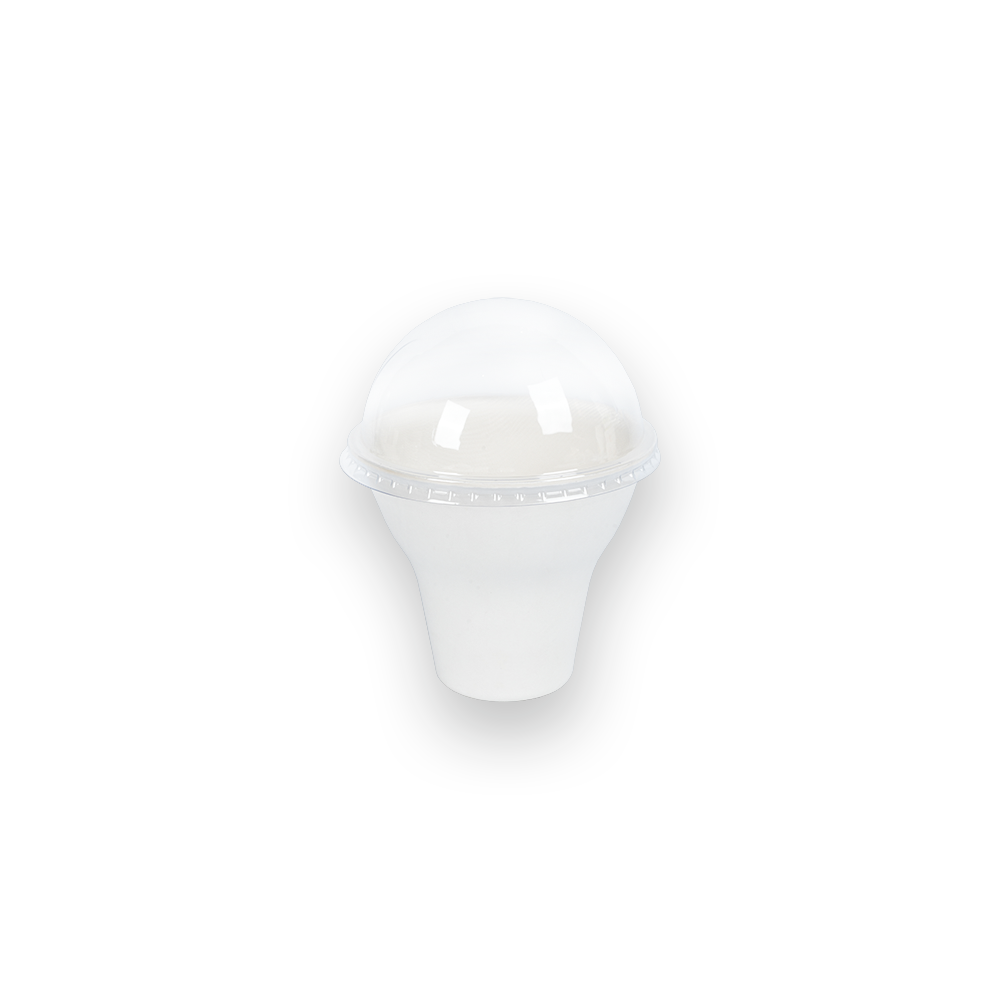
Zhong Xin Ecoware(Thailand) was registered on November 1, 2023, and officially began construction of the factory building in June 2024. At present, the first phase workshop of the factory has been fully completed and put into use. The second phase of the factory is being constructed intensively.
The landing and development of Zhong Xin in Thailand has brought a large amount of initial investment for land, factories, etc., and continuous operational investment for continuous equipment updates, technological upgrades, and capacity expansion.
Zhong Xin Ecoware(Thailand) has directly and indirectly created thousands of job opportunities, increased government revenue, promoted local economic development, cultivated local supply chains, provided systematic training for employees, improved the quality of local human capital, injected vitality into the local economy, enhanced industrial competitiveness, and ultimately improved residents' living standards.
Zhong Xin Ecoware(Thailand) actively collaborates with local pulp mills to explore new cooperation models for developing new products, improving production capacity and quality. At the same time, relying on Zhongxin's advanced production technology, process flow, management experience, and quality control system, it promotes the development of this industry in Thailand.

-
-
 +66-31240888
 -
 161 Village No. 4, Bo Thong Subdistrict Kabin Buri District Prachinburi Province 25110
-
Can Paper Packaging Meet Retail Shelf and Branding Requirements
Oct 23,2026
-
Bagasse Cups and Cup Lids: A Sourcing Guide for Foodservice and Takeaway Buyers
Oct 20,2026
-
How to Find Zhong Xin at the 140th Canton Fair: A Visitor Navigation Guide
Oct 16,2026
-
Thailand vs China Bagasse Tableware: 8 Comparisons Buyers Should Verify
Oct 16,2026
-
Will Takeout Containers Fit Your Existing Lids and Delivery Workflow
Oct 16,2026
-
What Is Bagasse Tableware? A 2026 Buyer Guide to Material, Performance and Documents
Oct 13,2026
-
Bagasse Tray Wholesale: How Bulk Buyers Cut Cost with Carton and Container Planning
Oct 09,2026
-
What Should a Bagasse Manufacturer Include in a Bulk Order Quote
Oct 09,2026
-
FOB, CIF or DDP? Incoterms for Bagasse Tableware Buyers Shipping from Thailand
Oct 06,2026
-
Packaging or Food Contact? Which EU Regime Applies to Bagasse Cups, Bowls, Plates and Cutlery
Oct 06,2026
-
Compostable Cutlery Sets for Private Label: 7 Sourcing Checks for Retail and Foodservice Buyers
Oct 06,2026
-
US vs EU Bagasse Tableware Imports: 8 Documentation and Compliance Checks Buyers Should Run
Oct 06,2026
Copyright © 2025 Zhong Xin Ecoware Technology ( Thailand ) CO., LTD.
All Rights Reserved.

Biodegradable Disposable Bagasse Tableware Manufacturer