-
 [email protected]
-
 +66-31240888



 English
 Español
 ไทย
ไทยPackaging or Food Contact? Which EU Regime Applies to Bagasse Cups, Bowls, Plates and Cutlery
Most EU compliance questions about bagasse tableware arrive as one question and are actually two. Buyers ask "what do I need to declare for cups, bowls, plates and cutlery?" and the honest answer is: it depends on whether the item is being treated as packaging, as a food-contact article, or as both. Getting that boundary right decides which documents a supplier must provide, who signs them, and what has to appear on the label.
Quick Summary: Which Regime Applies to Bagasse Tableware in the EU
- Verify what the item is: a plate, bowl, cup or cutlery piece used at the table is a food-contact article; a container that holds food for sale can be packaging as well.
- Verify the food-contact file: the framework for materials and articles intended to come into contact with food expects a declaration of compliance with supporting data.
- Verify the packaging file: where the item is packaging placed on the EU market, packaging rules and their conformity documentation apply on top.
- Verify who signs what: the supplier supports the material and product evidence, while the importer or brand owner usually carries the market-facing obligation.
- Verify the label per regime: food-contact and packaging labelling expectations are not the same, and one label often has to satisfy both.
- Verify the boundary in writing: the single most useful document in a mixed-range order is a written statement of which regime applies to which item code.
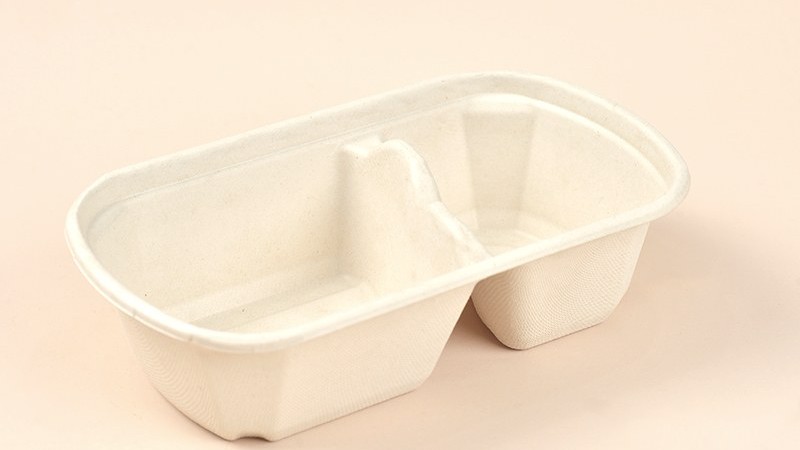
Bagasse tableware sits across two EU regimes: food-contact rules follow the article, packaging rules follow the packaging, and a food container can be subject to both at once.
This is where many supplier packs are weakest. A folder of certificates is sent for a mixed order and no one states which document covers which item, or which regime the item falls under. The buyer then discovers the gap during an audit, a customer questionnaire or a customs query — the three moments where it is most expensive.
Core buyer principle: establish the regime before assembling the file. An item that is only a food-contact article and an item that is also packaging need different documentation, different labelling and, in many cases, a different person signing.
Regime by Product Group: A Buyer’s Map
| Product group | Regime that normally applies | Who carries the market-facing duty | What the buyer should hold |
|---|---|---|---|
| Plates, bowls, cups used for serving | Food-contact regime | Importer / brand owner | Declaration of compliance for the material, support data, item mapping |
| Cutlery and cutlery sets | Food-contact regime | Importer / brand owner | Declaration of compliance per material, wrap assessment where wrapped |
| Clamshells, containers, takeaway boxes that hold food for sale | Food-contact and packaging | Importer / brand owner | Both files, plus a written note on which obligation attaches to which |
| Outer cartons, retail boxes, wraps supplied with the product | Packaging | Importer / brand owner | Packaging conformity documentation and labelling check |
| Lids, liners, inserts in contact with food | Food-contact regime | Importer / brand owner | Declaration covering the lid or liner, not only the base item |
1. Is the Item Packaging, a Food-Contact Article, or Both?
The question is functional, not material. The same bagasse pulp can become a plate that is only ever a food-contact article, or a container that is also packaging because it holds food for sale.
What should buyers verify?
- Describe how the item is used in the buyer’s own channel: served at the table, or filled with food and sold.
- Confirm whether the item is placed on the market as packaging for food, as a reusable article, or as both.
- Confirm whether any outer carton, retail box or wrap is supplied with the product and therefore sits in the packaging regime.
- Confirm the composition of the item, including any coating, liner or lining.
- Record the conclusion in writing and attach it to the item code.
Buyer red flag: an order file that lists regimes by product family rather than by item code. A range almost always contains items on both sides of the boundary.
How Zhong Xin Ecoware Supports This
Zhong Xin Ecoware Technology (Thailand) Co., Ltd. supplies molded fiber bagasse tableware from production bases in China and Thailand, with items described by item code, material composition and intended use so that buyers can classify each article correctly before assembling a file.
Evidence buyers can request: item code list, material composition statement, intended use description, production site declaration.
2. Which Declaration Applies to a Food-Contact Article?
For materials and articles intended to come into contact with food, the EU framework expects a declaration of compliance supported by the underlying data — not a certificate pack.
What should buyers verify?
- Confirm a declaration of compliance exists for the material and the article, and that it names them rather than the group.
- Confirm the supporting data behind the declaration and how it was generated.
- Confirm the declaration covers the coating, liner or any layer in contact with food.
- Confirm the contact conditions the declaration assumes, and whether they match the buyer’s real use.
- Confirm the declaration is dated, referenced and traceable to the production site.
Buyer red flag: a general food-safety certificate presented as a declaration of compliance, with no supporting data and no named article.
How Zhong Xin Ecoware Supports This
Food-contact documentation is provided per product family and production site with the material system and intended use stated, so that the buyer can match a declaration to the article and to the contact conditions it will actually be used under.
Evidence buyers can request: declaration of compliance by product family, material composition statement, supporting test documentation, production site declaration.
3. What Changes When the Item Is Also Packaging?
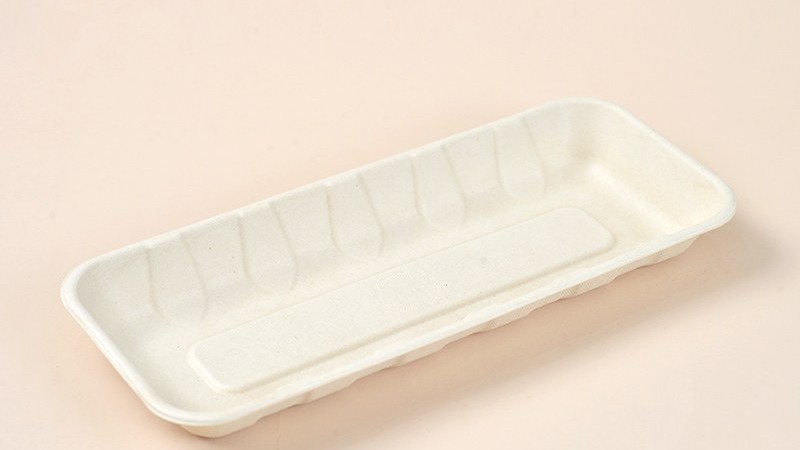
When the item holds food and is placed on the market with it, packaging rules apply on top of the food-contact file. This is the case that catches buyers out, because the supplier’s documentation often stops at the food-contact question.
What should buyers verify?
- Confirm which packaging requirements the buyer intends to rely on, and confirm the current expectations directly with the buyer’s compliance adviser or the competent authority.
- Confirm who produces the packaging conformity documentation: the supplier supports it, the importer or brand owner places the item on the market.
- Confirm the labelling elements expected for packaging, separately from the food-contact labelling.
- Confirm whether the item can realistically be reused or refilled in the buyer’s channel, because that changes how the packaging file is written.
- Confirm the boundary in writing for each item code so that no obligation is assumed twice or missed once.
Buyer red flag: assuming that a packaging declaration covers the food-contact side, or that a food-contact file covers the packaging obligations.
How Zhong Xin Ecoware Supports This
Because the same item can sit in two regimes, buyers are given the material and product facts per item code and told which supporting documents exist, so that the packaging and food-contact files can be built separately and cross-referenced rather than conflated.
Evidence buyers can request: item-level document map, material composition, packaging specification, reliability of reuse claim statement in writing.
4. Who Signs What?
Documentation fails most often not because a document is missing but because everyone assumed someone else had signed it.
What should buyers verify?
- Supplier side: the material, product and site facts, and the supporting test documentation.
- Importer or brand-owner side: the market-facing declaration and the technical file that must be available on request.
- Both sides: the mapping between item code, document and regime.
- Distribution side: any local registration duty that attaches to the importer or producer responsibility scheme.
- Review side: a named owner and a review interval for the whole pack.
Buyer red flag: a document pack with no named owner on the buyer side and no date of last review.
How Zhong Xin Ecoware Supports This
Documentation is supplied with product family and site references so the buyer can complete the market-facing parts, and buyers are told when documentation for a product family is renewed so the file can be refreshed.
Evidence buyers can request: certification index by product family, revision dates, renewal notification practice, item-level document map.
5. What Belongs on the Label?
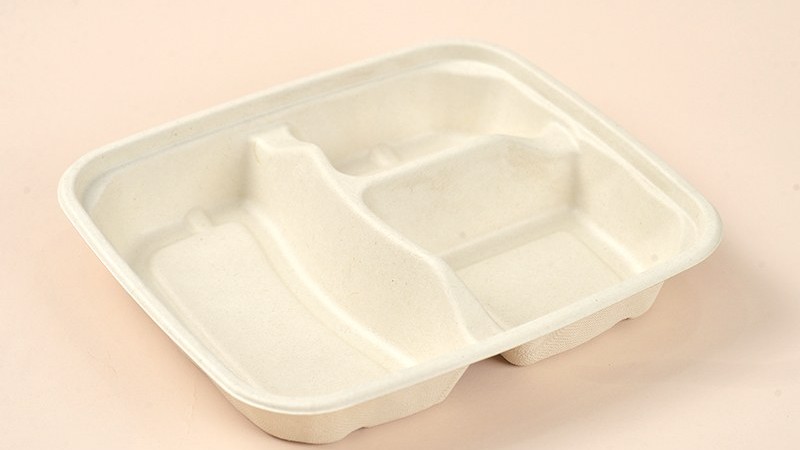
One printed label frequently has to satisfy two regimes, which is why label approval should follow the regime decision rather than precede it.
What should buyers verify?
- Confirm the material identification expected for the article and, separately, for the packaging element.
- Confirm any sorting or disposal marking expected for packaging in the destination market.
- Confirm whether a compostability or recyclability claim is permitted for this item, and the exact wording the evidence supports.
- Confirm the identity of the responsible economic operator where the market expects it.
- Confirm barcodes, lot codes and country-of-origin marks for the retail pack.
Buyer red flag: printing a disposal or compostability claim that the documentation for that item does not support, or that applies to a different market.
How Zhong Xin Ecoware Supports This
Proofs are issued for written approval before printing, and claim wording is checked against the documentation held for the item so that the printed statement and the file agree.
Evidence buyers can request: approved proof, artwork file, claim-to-evidence mapping, print specification.
6. How Should the File Be Assembled and Kept Current?
The regime boundary is stable; the documents behind it are not. Certificates are renewed, materials are reformulated and market expectations move.
What should buyers verify?
- Index the file by item code and by regime, not by document type.
- Record an issue date and a review date for each document.
- Withdraw superseded versions so that the current answer is unambiguous.
- Re-check the regime decision whenever a product is used in a new channel.
- Keep the supplier’s item-level document map alongside the buyer’s own declaration.
Buyer red flag: a compliance pack indexed by supplier name, where finding the document for one item code takes longer than answering the customer.
How Zhong Xin Ecoware Supports This
Documentation is organised by product family and site, with revision information available, so buyers can build an item-code index and refresh it when documents are renewed.
Evidence buyers can request: certification index, revision dates, product family mapping, site references.
Get a Quote for Your Next Order
Zhong Xin Ecoware Technology (Thailand) Co., Ltd. supplies molded fiber bagasse tableware for wholesale, distribution and private-label programs from production bases in China and Thailand. Send your item list, intended use and destination market to info@fiber-product.com for a quotation with the documentation package.
Note: this guide describes how buyers can organise their own files. It is not legal advice. Confirm the current requirements and their scope with your compliance adviser or the relevant competent authority before relying on any document.
Related Buyer Guides
- US vs EU bagasse tableware imports: 8 documentation checks
- How to prepare a bagasse tableware import: 10 readiness checks
- Compostable cutlery sets for private label: 7 sourcing checks
- PFAS-free and compostability verification: a buyer’s checklist
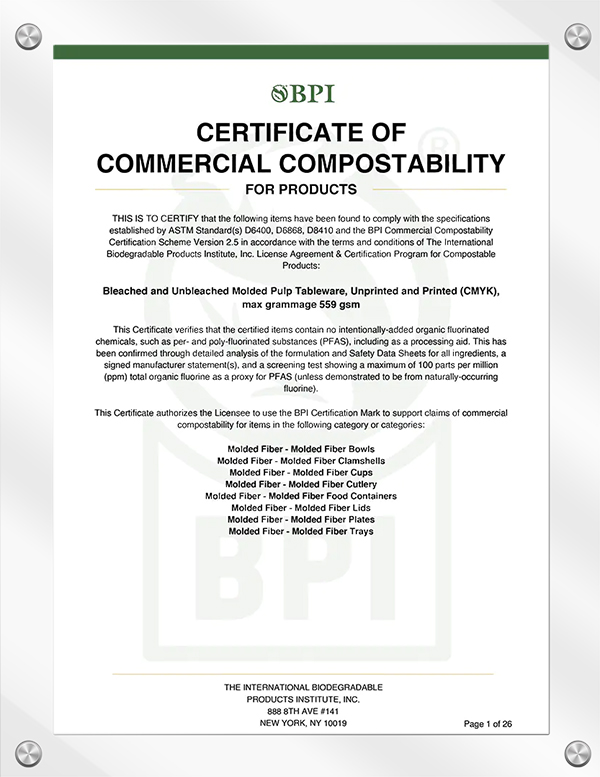
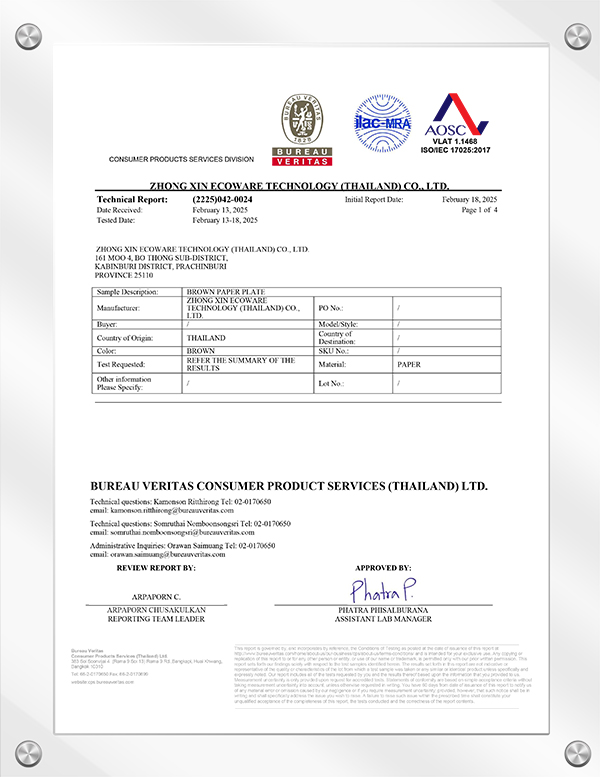
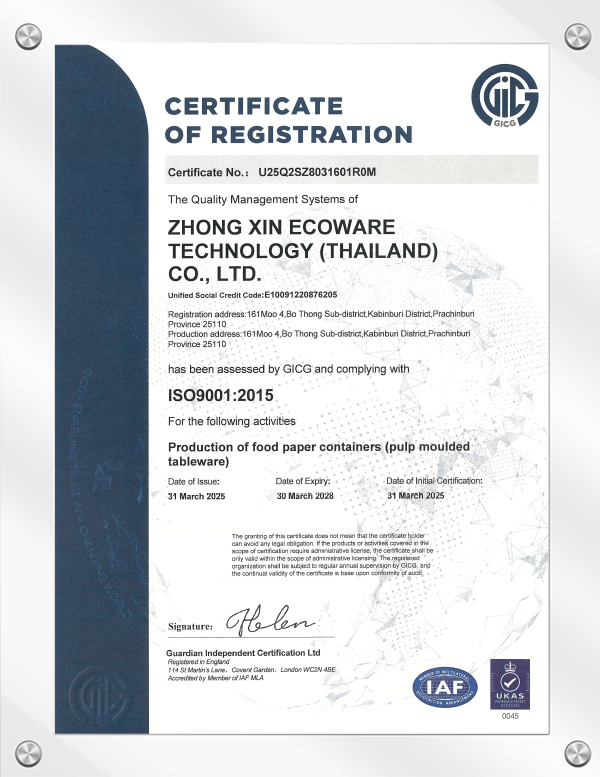
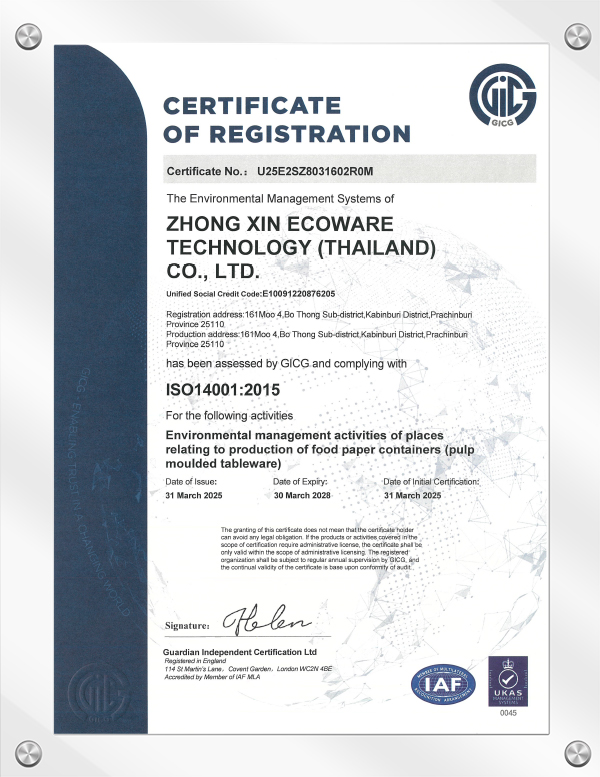
- Zhong Xin Ecoware certifications: BPI, FDA, LFGB, BRCGS and ISO
About Zhong Xin Ecoware
Zhong Xin Ecoware Technology (Thailand) Co., Ltd. supplies bagasse and molded fiber food packaging to importers, distributors and foodservice brands. For MOQ, pricing, samples and certification files, contact info@fiber-product.com.
Last updated: 6 October 2026.



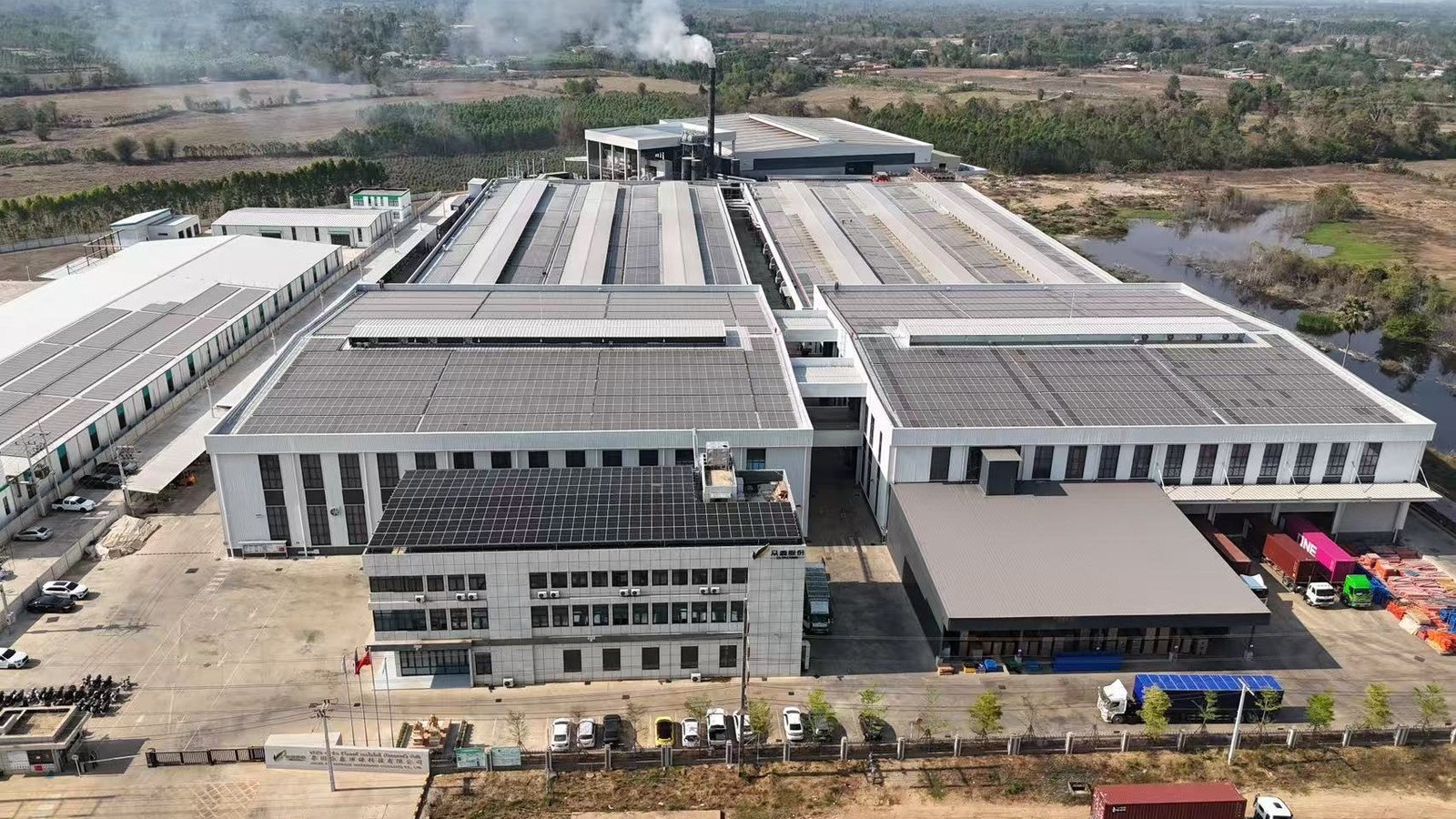
Zhong Xin Ecoware(Thailand) was registered on November 1, 2023, and officially began construction of the factory building in June 2024. At present, the first phase workshop of the factory has been fully completed and put into use. The second phase of the factory is being constructed intensively.
The landing and development of Zhong Xin in Thailand has brought a large amount of initial investment for land, factories, etc., and continuous operational investment for continuous equipment updates, technological upgrades, and capacity expansion.
Zhong Xin Ecoware(Thailand) has directly and indirectly created thousands of job opportunities, increased government revenue, promoted local economic development, cultivated local supply chains, provided systematic training for employees, improved the quality of local human capital, injected vitality into the local economy, enhanced industrial competitiveness, and ultimately improved residents' living standards.
Zhong Xin Ecoware(Thailand) actively collaborates with local pulp mills to explore new cooperation models for developing new products, improving production capacity and quality. At the same time, relying on Zhongxin's advanced production technology, process flow, management experience, and quality control system, it promotes the development of this industry in Thailand.

-
-
 +66-31240888
 -
 161 Village No. 4, Bo Thong Subdistrict Kabin Buri District Prachinburi Province 25110
-
Compostable Cutlery Sets for Private Label: 7 Sourcing Checks for Retail and Foodservice Buyers
Oct 06,2026
-
US vs EU Bagasse Tableware Imports: 8 Documentation and Compliance Checks Buyers Should Run
Oct 06,2026
-
How to Prepare a Bagasse Tableware Import: 10 Readiness Checks for US and EU Buyers
Oct 06,2026
-
Beyond Plates: Which Foods Suit Bagasse Tableware
Oct 02,2026
-
New Bagasse Tableware Lineup for 2026: What Is New and Where to See It
Sep 28,2026
-
How to Select Bagasse Clamshells for Burgers, Rice Meals and Fried Food
Sep 28,2026
-
Microwave Reheating: Is a Bagasse Lunch Box Suitable
Sep 25,2026
-
9 Inch Pizza Plates and Bagasse Pizza Boards: A Sourcing Guide for US and Canadian Distributors
Sep 19,2026
-
PFAS-Free & Compostability Verification: A Buyer's Checklist for Bagasse and Molded Fiber Packaging
Sep 19,2026
-
Bagasse vs PLA vs Molded Fiber: What Distributors Should Stock in 2026
Sep 19,2026
-
Can Sugarcane Plates Handle Hot, Greasy Foods
Sep 18,2026
-
Bagasse Tableware RFQ Template: Get a Comparable Thailand Factory Quote
Sep 14,2026
Copyright © 2025 Zhong Xin Ecoware Technology ( Thailand ) CO., LTD.
All Rights Reserved.

Biodegradable Disposable Bagasse Tableware Manufacturer