-
 [email protected]
-
 +66-31240888


 English
 Español
 ไทย
How to Prove PFAS-Free Bagasse Tableware: Total Fluorine and Targeted PFAS
PFAS-free is now a standard line on compostable tableware pages, but EU and US buyers are being asked to prove it, not repeat it. Three numbers and one document set decide whether a bagasse SKU holds up under review.
Short answer: Proving PFAS-free means matching three numbers to your destination market. Under EU PPWR Article 5, food-contact packaging must stay below 25 ppb for any individual PFAS, 250 ppb for the sum of targeted PFAS, and 50 ppm for total PFAS including polymeric forms; if total fluorine exceeds 50 mg/kg, the supplier must show how much of that fluorine is not PFAS. BPI applies a separate rule: no intentionally added fluorinated chemicals, and no more than 100 ppm total fluorine.
Why a PFAS-free line on a product page proves nothing
Grease resistance in molded fiber tableware historically came from fluorochemical treatment. Most suppliers have since reformulated, but a claim on a website can describe the incoming raw material, the coating, or a single test batch rather than the finished SKU you will receive. A usable claim names four things: the test method, the laboratory, the exact SKU and grammage tested, and the threshold it was measured against.
Without those four, "PFAS-free" is a marketing sentence. With them, it becomes a document your customer, your retailer or a customs officer can check.
Two tests answer two different questions
Buyers often ask for "a PFAS test" and receive a report that answers only half the question. The two common routes measure different things.
Total fluorine screening burns the sample and measures all fluorine, using combustion ion chromatography methods such as EN 14582 or ASTM D7359. It catches fluorinated compounds whether or not they are on any target list, including polymeric PFAS, which is why regulators use it as a first gate. Its weakness is that it cannot tell you which compound is present, and some non-PFAS fluorine sources in mineral fillers or pigments can push the number up.
Targeted PFAS analysis uses LC-MS/MS against a defined list of compounds. It identifies and quantifies individual substances, but only the ones on the list; an unlisted fluorochemical passes silently.
In practice the two are used in sequence: screen with total fluorine, and if the result is above the regulatory trigger, speciate to show how much of that fluorine belongs to PFAS.
| Question | Total fluorine screening | Targeted PFAS analysis |
|---|---|---|
| What it measures | All fluorine in the sample, converted to a concentration | Named PFAS compounds, individually and as a sum |
| Typical method | Combustion ion chromatography (e.g. EN 14582, ASTM D7359) | LC-MS/MS against a defined compound list |
| Catches unknown or polymeric PFAS | Yes, as fluorine | No, only listed compounds |
| Identifies the substance | No | Yes |
| Where regulators use it | First gate and screening threshold | Confirmation and limit comparison |
| Typical reference point | EU PPWR trigger at 50 mg/kg total fluorine | EU PPWR limits of 25 ppb each and 250 ppb sum |
What EU PPWR Article 5 requires
Regulation (EU) 2025/40 on packaging and packaging waste sets PFAS limits for food-contact packaging placed on the EU market, wherever it is manufactured. Article 5 works with three thresholds: 25 ppb for any individual PFAS, 250 ppb for the sum of targeted PFAS, and 50 ppm for PFAS including polymeric PFAS.
There is a fourth number that decides how much testing you need. If total fluorine exceeds 50 mg/kg, the supplier has to provide evidence separating fluorine that comes from PFAS from fluorine that comes from other sources. That is why a total fluorine screen is usually the first document requested, not the last.
The same article also sets a combined limit of 100 mg/kg for lead, cadmium, mercury and hexavalent chromium, which is why a PPWR test report usually covers metals and PFAS in one document.
What US state rules require
The United States has no single federal PFAS ban for food packaging. Rules are set state by state, and they differ in scope, thresholds and timing, so the destination state decides the document set.
Maine is a current example: its ban on intentionally added PFAS in certain food packaging took effect on 25 May 2026, which means packaging shipped into the state now needs a compliance position rather than a future plan. Other states have adopted reporting obligations, certificates of compliance, or bans that phase in by product category.
Separately, BPI has applied its own fluorinated-chemicals rule to certified compostable products since 1 January 2020: safety data sheets for all ingredients, a test result from a BPI-approved laboratory showing no more than 100 ppm total fluorine, and a signed statement that no fluorinated chemicals were intentionally added.
What our certificates actually say
Scope matters more than the certificate number. Here is what the documents cover today.
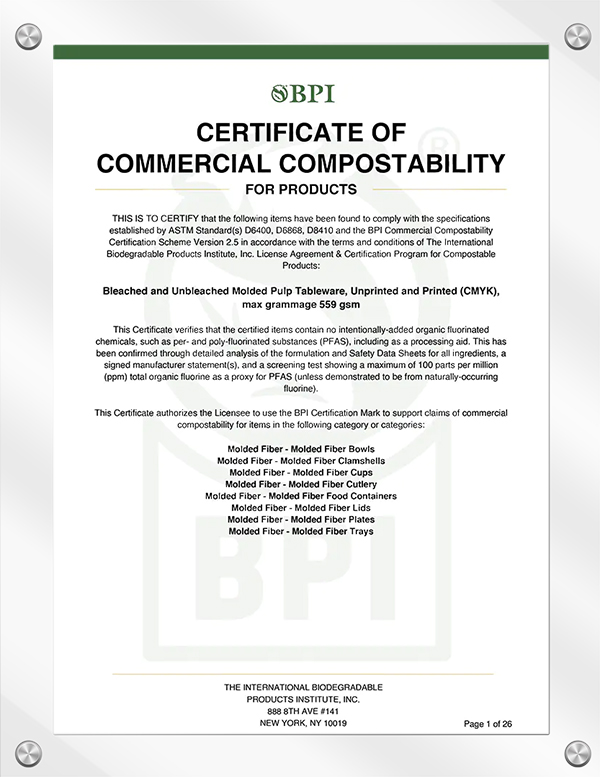
Thailand plant, BPI certificate 10529982-1 (valid to 31 March 2028): molded-fiber plates, trays, bowls, clamshells and related items, maximum 559 g/m2, no intentionally added PFAS, and total organic fluorine of 100 ppm or less within that scope. If your SKU, colour or coating is not in the listed scope, the certificate does not speak for it.
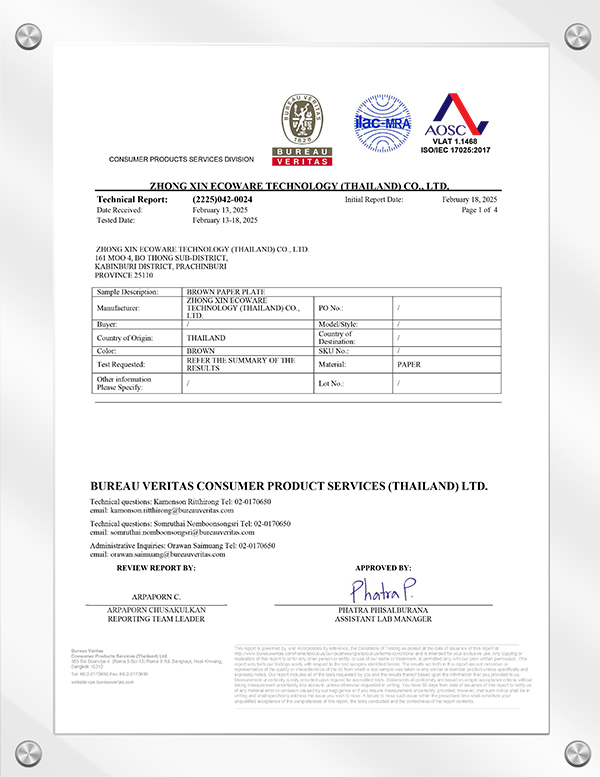
Group PPWR/PFAS report 178246344a 001: samples taken in June 2026, PFAS restriction passed, and lead, cadmium, mercury and hexavalent chromium passed. This report is held by the group entity, not by the Thailand plant, so it supports the material system that was tested. Ask for a statement that your exact Thailand SKU, colour and coating fall inside the tested scope before you rely on it in a customer declaration.
One scope point is worth checking: BPI 10529982-1 includes molded-fiber cups, and the Thailand plant produces molded pulp cups. Confirm the exact cup model, grammage and colour against the certificate before you quote.
The document set to request before you sign
| Document | What it proves | What to check |
|---|---|---|
| Safety data sheets for all ingredients | No fluorinated chemical in the formulation | Supplier names and dates match the material actually used |
| Total fluorine report | The finished product is below the screening threshold | Method, laboratory, sample identity, result in mg/kg |
| Targeted PFAS report | Listed compounds are below 25 ppb each and 250 ppb in sum | Compound list, limit of quantification, sample SKU |
| Signed no-intentionally-added declaration | The manufacturer commits to the formulation | Signed by the manufacturing site, not a trading office |
| Certificate with SKU scope | Which products are covered and until when | Entity name, product list, grammage limit, expiry date |
| Declaration of conformity | The packaging meets the destination market's rules | Regulation cited, threshold used, responsible entity in the EU or US |
Reading a test report in five minutes
Check the laboratory and its accreditation first, then the method and its version, then the limit of quantification against the regulatory threshold. A result reported as "not detected" is only meaningful if the detection limit sits well below 25 ppb.
Next, confirm the sample: SKU code, colour, coating, grammage and production date. A report on a white uncoated plate does not cover a printed or coated item. Finally, check which threshold the verdict refers to. A pass against BPI's 100 ppm total fluorine rule is not the same as a pass against the EU's 50 mg/kg trigger plus 25 ppb and 250 ppb limits, and neither one is a US state compliance statement.
FAQ
Is bagasse tableware naturally PFAS-free?
The fiber itself contains no PFAS. Risk enters through grease-barrier coatings, release agents and recycled content. Uncoated molded fiber is normally the lowest-risk construction, but the finished SKU still needs a total fluorine screen if you are making a claim.
What is the difference between total fluorine and PFAS testing?
Total fluorine measures all fluorine in the sample and catches both listed and unlisted fluorinated substances, including polymers. Targeted PFAS analysis identifies specific compounds by LC-MS/MS but only those on its list. Regulators use the first as a gate and the second to confirm which substances are present.
Does BPI certification mean the product meets EU PPWR?
No. BPI certification covers compostability under ASTM standards plus its own fluorinated-chemicals rule of 100 ppm total fluorine. PPWR Article 5 uses different thresholds, including 25 ppb for individual PFAS and 250 ppb for the sum, and applies to packaging placed on the EU market. The two documents are complementary, not interchangeable.
Can a supplier claim PFAS-free without a test report?
It can write the claim, but it cannot support it. EU and US buyers increasingly ask for the report, the method and the SKU scope, and a claim without those documents is difficult to defend in a customer audit or a customs query.
Which documents should I keep for retail and customs?
Keep the full set together: ingredient safety data sheets, the total fluorine report, the targeted PFAS report, the signed declaration, the certificate with SKU scope and the declaration of conformity. Store them per SKU rather than per supplier, because scope questions are usually about one item, one colour or one coating.
Sources
- Fluorinated Chemicals — Biodegradable Products Institute, rules in effect since 1 January 2020 (accessed 2026-11-13)
- PPWR Has Arrived: What Does It Mean for the Analysis of Food Packaging Contaminants? — Thermo Fisher Scientific, published 6 November 2026 (accessed 2026-11-13)
- Regulation (EU) 2025/40 on packaging and packaging waste — EUR-Lex (accessed 2026-11-13)
- Maine PFAS Packaging Ban Takes Effect — PRINTING United Alliance, 2 July 2026 (accessed 2026-11-13)
- BPI company listing — Zhong Xin Ecoware Technology (Thailand) Co., Ltd. — Biodegradable Products Institute (accessed 2026-11-13)
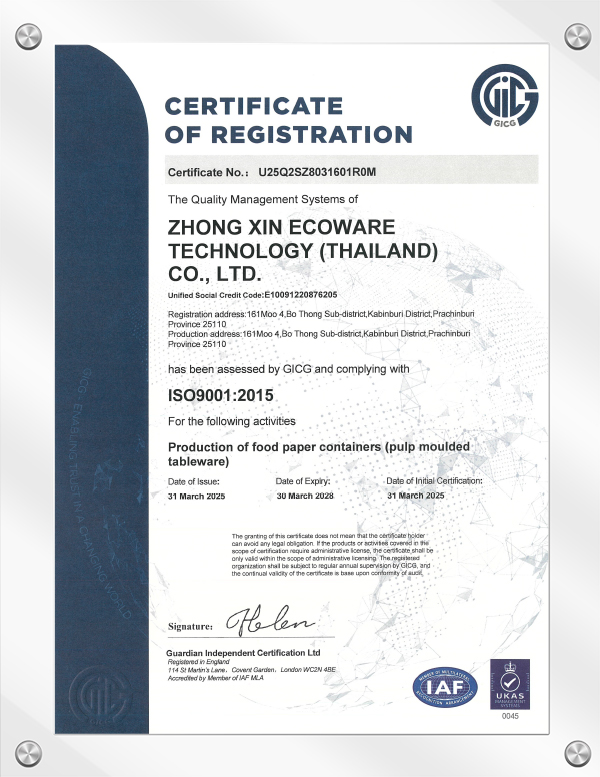
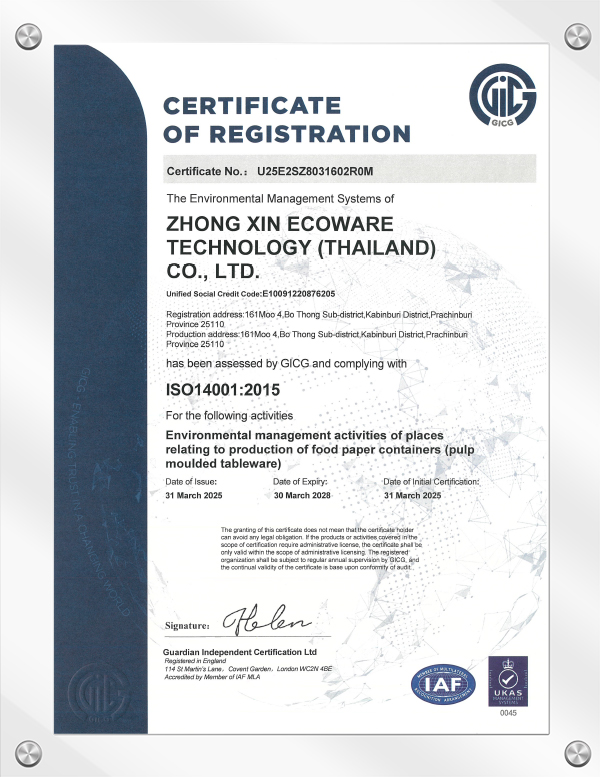
Zhong Xin Ecoware Technology (Thailand) Co., Ltd. supplies bagasse and molded fiber food packaging to importers, distributors and foodservice brands. For PFAS documentation, MOQ, pricing, samples and lead time, email info@fiber-product.com or use the contact form.

Zhong Xin Ecoware(Thailand) was registered on November 1, 2023, and officially began construction of the factory building in June 2024. At present, the first phase workshop of the factory has been fully completed and put into use. The second phase of the factory is being constructed intensively.
The landing and development of Zhong Xin in Thailand has brought a large amount of initial investment for land, factories, etc., and continuous operational investment for continuous equipment updates, technological upgrades, and capacity expansion.
Zhong Xin Ecoware(Thailand) has directly and indirectly created thousands of job opportunities, increased government revenue, promoted local economic development, cultivated local supply chains, provided systematic training for employees, improved the quality of local human capital, injected vitality into the local economy, enhanced industrial competitiveness, and ultimately improved residents' living standards.
Zhong Xin Ecoware(Thailand) actively collaborates with local pulp mills to explore new cooperation models for developing new products, improving production capacity and quality. At the same time, relying on Zhongxin's advanced production technology, process flow, management experience, and quality control system, it promotes the development of this industry in Thailand.

-
-
 +66-31240888
-
 161 Village No. 4, Bo Thong Subdistrict Kabin Buri District Prachinburi Province 25110
-
How Does Packaging Design Affect Tableware Shipping and Storage Costs
Nov 20,2026
-
What GSM Paper Bag Do You Need? 50, 60 and 110 g/m2 Explained
Nov 17,2026
-
Kraft SOS Bags vs Flat Merchandise Bags: Which for Takeaway and Retail
Nov 16,2026
-
Certifications and Compliance Documents for Bagasse and Molded-Fiber Packaging
Nov 14,2026
-
PFAS-Free Bagasse and Molded-Fiber Food Packaging
Nov 14,2026
-
How to Prove PFAS-Free Bagasse Tableware: Total Fluorine and Targeted PFAS
Nov 13,2026
-
Are Sugarcane-Based Packaging Claims Backed by Verifiable Certifications
Nov 13,2026
-
Are Bagasse Food Containers Safe for Hot Food and Takeout?
Nov 06,2026
-
Leakage and Heat Resistance: What Should Catering Buyers Test Before Ordering
Nov 06,2026
-
Can Compostable Packaging Go in the Compost Bin? Certification vs Facility Acceptance
Oct 31,2026
-
10-Inch Bagasse Plates: A Heavy-Duty Plate Sourcing Guide
Oct 31,2026
-
32oz Bagasse Bowls and PET Lids: A Sourcing Guide for Foodservice Buyers
Oct 31,2026
Copyright © 2025 Zhong Xin Ecoware Technology ( Thailand ) CO., LTD.
All Rights Reserved.

Biodegradable Disposable Bagasse Tableware Manufacturer