-
 [email protected]
-
 +66-31240888



 English
 Español
 ไทย
How Does Packaging Design Affect Tableware Shipping and Storage Costs
For tableware importers and wholesale distributors, the purchase price of each item is only part of the total procurement cost. Packaging dimensions, carton capacity, stacking methods, and shipping arrangements can all influence the final landed cost. Even a small difference in carton height or packing density may affect how many products fit into a shipping container and how much warehouse space an order occupies.
At Zhong Xin Ecoware, we understand that packaging is not simply an outer layer protecting disposable tableware. It is also an important part of logistics planning. Buyers sourcing tableware packaging should evaluate product protection, carton dimensions, storage requirements, and transportation efficiency together before confirming bulk orders.
1. Why Does Packaging Design Influence Total Procurement Costs?
Packaging affects several stages of the supply chain, from factory packing to warehouse storage and final delivery. Poorly planned packaging may increase freight expenses, consume additional storage capacity, or create unnecessary product damage during transportation.
Key cost factors include:
- Carton volume: Larger cartons occupy more shipping and warehouse space.
- Packing density: The number of pieces per carton affects total shipment volume.
- Material consumption: Excessive cardboard, dividers, and protective materials increase packaging expenses.
- Product protection: Insufficient protection may increase damage and replacement costs.
- Handling requirements: Carton weight and dimensions influence loading, unloading, and warehouse operations.
Our recommendation is to evaluate packaging as part of the complete shipment rather than comparing suppliers solely by individual product prices.
2. Product Dimensions and Nesting Design Affect Carton Capacity
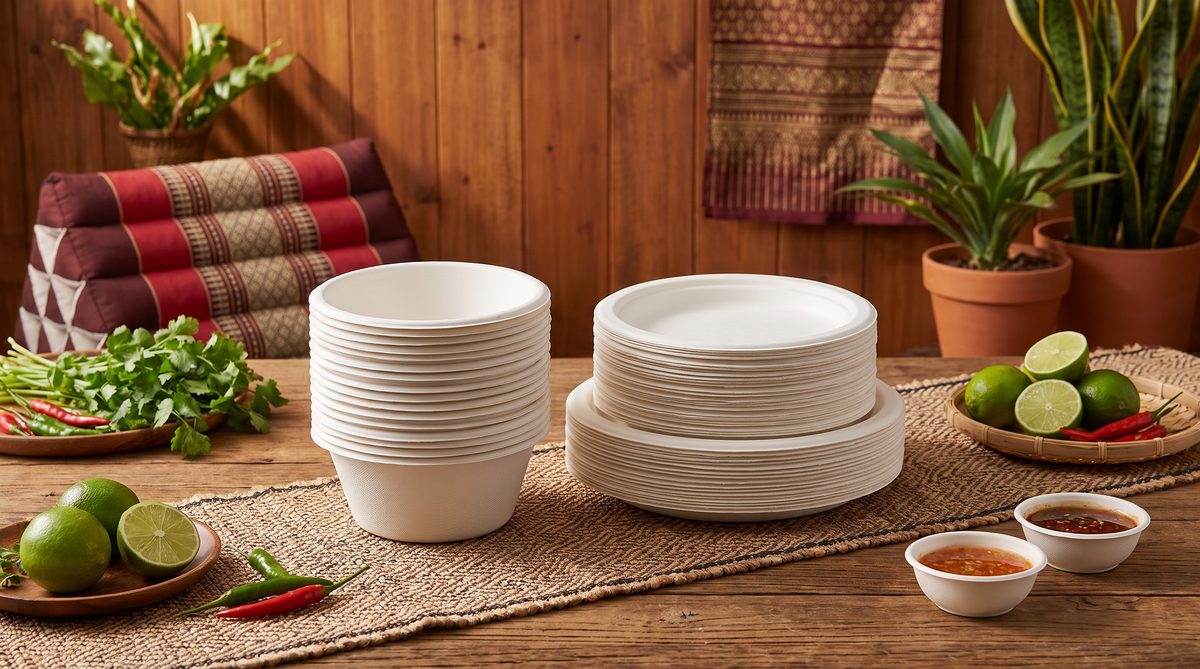
The physical shape of disposable plates, bowls, trays, and food containers determines how efficiently they can be arranged inside a carton. Products with compatible shapes may be nested together, reducing unused space between individual pieces.
2.1 Consider Stackability Before Finalizing Packaging
Stackability is particularly important for molded fiber and paper-based tableware. Several design details influence the final stacking height:
- Rim diameter and overall product dimensions.
- Sidewall angle and product depth.
- Base structure and raised support sections.
- Space required between nested products.
- Ease of separating individual pieces during use.
Efficient nesting allows more products to fit into a carton without excessive compression. However, tightly stacked products may become difficult to separate or may experience deformation. Packaging development should balance compact storage with convenient product handling.
2.2 Confirm Carton Dimensions and Packing Quantity
Buyers should request actual carton measurements instead of estimating packaging requirements from individual product dimensions.
| Packaging Detail | Information to Confirm | Cost Consideration |
| Product dimensions | Length, width, height, or diameter | Determines available packing space |
| Pieces per inner pack | Quantity and arrangement | Affects handling and retail packaging |
| Master carton quantity | Total pieces per carton | Influences carton count per order |
| Carton dimensions | External length × width × height | Determines shipping volume |
| Gross weight | Product and packaging weight combined | Affects handling and weight-based freight |
3. How Carton Design Changes International Shipping Expenses
International freight calculations may consider actual shipment weight, dimensional weight, cargo volume, or a combination of these factors, depending on the transportation method and carrier terms.
Lightweight disposable tableware can occupy considerable space relative to its actual weight. This makes carton dimensions especially important for importers purchasing large quantities.
3.1 Calculate Carton Volume
A basic carton volume calculation helps buyers compare different packaging configurations.
Carton Volume (m³) = Length (cm) × Width (cm) × Height (cm) ÷ 1,000,000
For example, consider two hypothetical carton designs:
| Detail | Carton A | Carton B |
| Dimensions | 50 × 40 × 40 cm | 50 × 40 × 35 cm |
| Carton Volume | 0.080 m³ | 0.070 m³ |
| Volume Difference | Reference | 12.5% lower |
Assuming the same product quantity and adequate protection, Carton B occupies less shipping volume. Across a large shipment, this difference may affect the total number of cartons or the available container capacity.
However, smaller cartons are not automatically more economical. Buyers should also consider material costs, stacking strength, handling weight, and the possibility of increased carton quantities.
4. Warehouse Storage Depends on Carton Shape and Stackability
Storage expenses are another consideration for importers and distributors. Large quantities of disposable tableware may remain in warehouses before being distributed to restaurants, catering companies, or retailers.
Packaging design can influence storage efficiency in several ways:
- Uniform carton dimensions: Standardized outer sizes make shelf and pallet arrangements easier to plan.
- Stable stacking: Consistent carton shapes help distribute vertical loads during storage.
- Appropriate carton weight: Manageable weights support safer manual handling.
- Clear product identification: Labels and SKU information simplify stock counting and order preparation.
- Moisture protection: Suitable storage and packaging conditions help maintain carton integrity.
Buyers should also confirm the ideal recommended stacking height based on carton strength, warehouse conditions, and storage duration. Excessive stacking pressure may deform lower cartons and damage the tableware inside.
5. Balance Protective Packaging with Material Costs
Reducing packaging materials can help control purchasing expenses, but removing too much protection may create problems during international transportation. Paper plates, molded fiber bowls, and other disposable products can experience edge damage, deformation, or surface defects during handling.
At Zhong Xin Ecoware, we recommend evaluating protective packaging according to the product structure and shipping route.
Practical Packaging Considerations
- Use suitable inner bags or wrapping materials to protect products from dust and moisture.
- Consider cardboard dividers for products that require separation.
- Check whether carton walls provide sufficient compression resistance.
- Avoid excessive empty space that allows products to move during transportation.
- Evaluate carton performance through sample packing and distribution testing.
The objective is to establish a packaging structure that protects the goods while keeping material consumption and shipment volume under control.
6. What Should Buyers Discuss with Tableware Suppliers?
Packaging requirements should be confirmed during the quotation and sample approval stages. This helps purchasing teams compare offers using consistent logistics information.
We suggest discussing the following details with our team:
| Discussion Area | Questions to Clarify |
| Product configuration | What are the dimensions, material, and pieces per set? |
| Carton arrangement | How many pieces can be packed into each master carton? |
| Shipping specifications | What are the carton volume, gross weight, and loading assumptions? |
| Storage requirements | What stacking conditions and storage environment are recommended? |
| Customization | Can carton dimensions, labels, and printing be adjusted? |
| Product protection | What measures are used to reduce deformation and transportation damage? |
Include Packaging Efficiency in Every Purchasing Calculation
Packaging design influences more than the appearance of disposable tableware. Product nesting, carton dimensions, stacking strength, and pallet arrangements can affect international freight expenses, warehouse capacity, and product protection.
At Zhong Xin Ecoware, we encourage importers, wholesalers, and catering distributors to review packaging specifications alongside product prices. Comparing carton volume, packing quantity, and protective requirements provides a clearer understanding of the overall purchasing cost.
Contact Zhong Xin Ecoware to discuss your tableware packaging requirements, carton specifications, and export packing arrangements. Our team can work with your purchasing requirements to evaluate suitable packaging configurations for your distribution market.


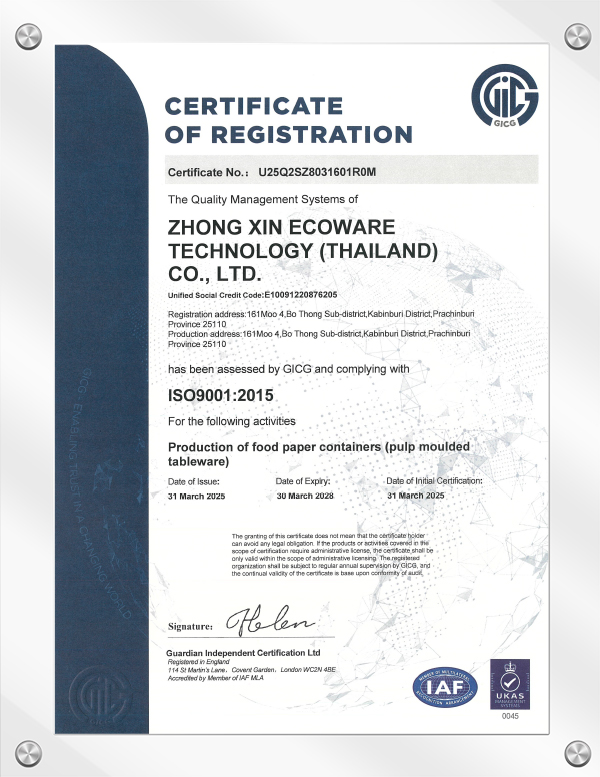
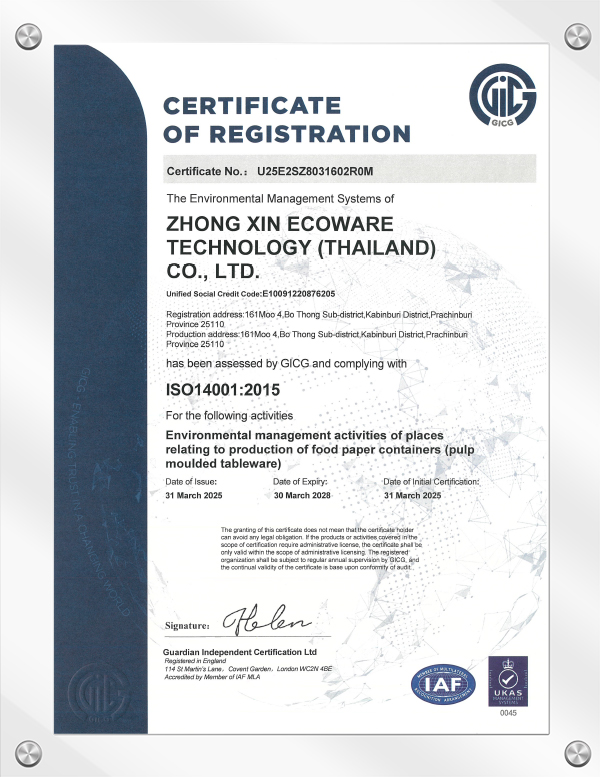
Zhong Xin Ecoware(Thailand) was registered on November 1, 2023, and officially began construction of the factory building in June 2024. At present, the first phase workshop of the factory has been fully completed and put into use. The second phase of the factory is being constructed intensively.
The landing and development of Zhong Xin in Thailand has brought a large amount of initial investment for land, factories, etc., and continuous operational investment for continuous equipment updates, technological upgrades, and capacity expansion.
Zhong Xin Ecoware(Thailand) has directly and indirectly created thousands of job opportunities, increased government revenue, promoted local economic development, cultivated local supply chains, provided systematic training for employees, improved the quality of local human capital, injected vitality into the local economy, enhanced industrial competitiveness, and ultimately improved residents' living standards.
Zhong Xin Ecoware(Thailand) actively collaborates with local pulp mills to explore new cooperation models for developing new products, improving production capacity and quality. At the same time, relying on Zhongxin's advanced production technology, process flow, management experience, and quality control system, it promotes the development of this industry in Thailand.

-
-
 +66-31240888
-
 161 Village No. 4, Bo Thong Subdistrict Kabin Buri District Prachinburi Province 25110
-
How Does Packaging Design Affect Tableware Shipping and Storage Costs
Nov 20,2026
-
What GSM Paper Bag Do You Need? 50, 60 and 110 g/m2 Explained
Nov 17,2026
-
Kraft SOS Bags vs Flat Merchandise Bags: Which for Takeaway and Retail
Nov 16,2026
-
Certifications and Compliance Documents for Bagasse and Molded-Fiber Packaging
Nov 14,2026
-
PFAS-Free Bagasse and Molded-Fiber Food Packaging
Nov 14,2026
-
How to Prove PFAS-Free Bagasse Tableware: Total Fluorine and Targeted PFAS
Nov 13,2026
-
Are Sugarcane-Based Packaging Claims Backed by Verifiable Certifications
Nov 13,2026
-
Are Bagasse Food Containers Safe for Hot Food and Takeout?
Nov 06,2026
-
Leakage and Heat Resistance: What Should Catering Buyers Test Before Ordering
Nov 06,2026
-
Can Compostable Packaging Go in the Compost Bin? Certification vs Facility Acceptance
Oct 31,2026
-
10-Inch Bagasse Plates: A Heavy-Duty Plate Sourcing Guide
Oct 31,2026
-
32oz Bagasse Bowls and PET Lids: A Sourcing Guide for Foodservice Buyers
Oct 31,2026
Copyright © 2025 Zhong Xin Ecoware Technology ( Thailand ) CO., LTD.
All Rights Reserved.

Biodegradable Disposable Bagasse Tableware Manufacturer