-
 [email protected]
-
 +66-31240888



 English
 Español
 ไทย
ไทยBagasse vs PLA vs Molded Fiber: What Distributors Should Stock in 2026
Quick Summary
Bagasse (sugarcane fiber) tableware is the safest core for most distributors stocking up for 2026: it is plant-based, industrially compostable where certified (EN 13432 / ASTM D6400 / BPI), produced without added fluorochemicals, and built for hot food service. PLA suits cold cups and cutlery but needs industrial composting; uncoated molded fiber excels in trays and clamshells. Below is a side-by-side comparison, a distributor stocking matrix, and the 2026 regulations driving demand.

Why This Comparison Matters in 2026
Distributors and foodservice wholesalers in the US and EU are being asked by their brand customers to prove three things at once: the material is certified compostable, it contains no PFAS, and supply is stable outside tariff-exposed sourcing routes.
Three facts explain the urgency:
- US state restrictions keep expanding. At least a dozen states now restrict PFAS in food packaging, with effective dates ranging from New York's ban (December 31, 2022) to Maine (May 25, 2026) and New Hampshire / New Mexico (January 1, 2027).
- EU PPWR (Regulation (EU) 2025/40) applies from August 12, 2026 — food-contact packaging placed on the EU market must stay under PFAS thresholds of 25 ppb (single PFAS), 250 ppb (sum of PFASs) and 50 ppm total fluorine including polymers.
- 100 ppm total organic fluorine is California's screening threshold for plant-fiber food packaging (AB 1200, in force since January 1, 2023) — the de facto reference many North American buyers apply even outside California.
(All three are public regulatory facts; verification steps and sourcing checks are covered in our PFAS & compostability verification checklist.)
Head-to-Head Comparison: Bagasse vs PLA vs Molded Fiber
| Dimension | Bagasse (Sugarcane Fiber) | PLA (Polylactic Acid) | Molded Fiber (Uncoated / Generic) |
|---|---|---|---|
| Raw material | Sugarcane bagasse, a renewable agricultural by-product | Plant starch (corn/sugarcane), bioplastic polymer | Recycled or virgin plant fiber (wood pulp, bamboo, etc.) |
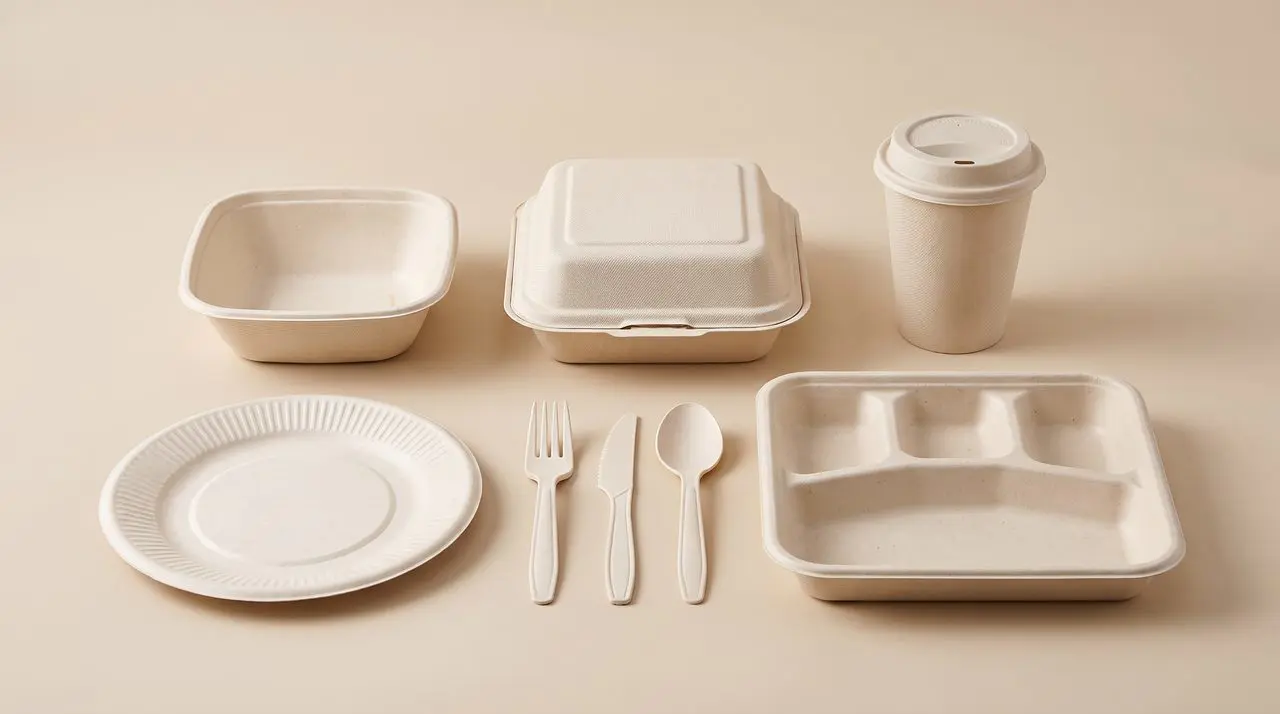
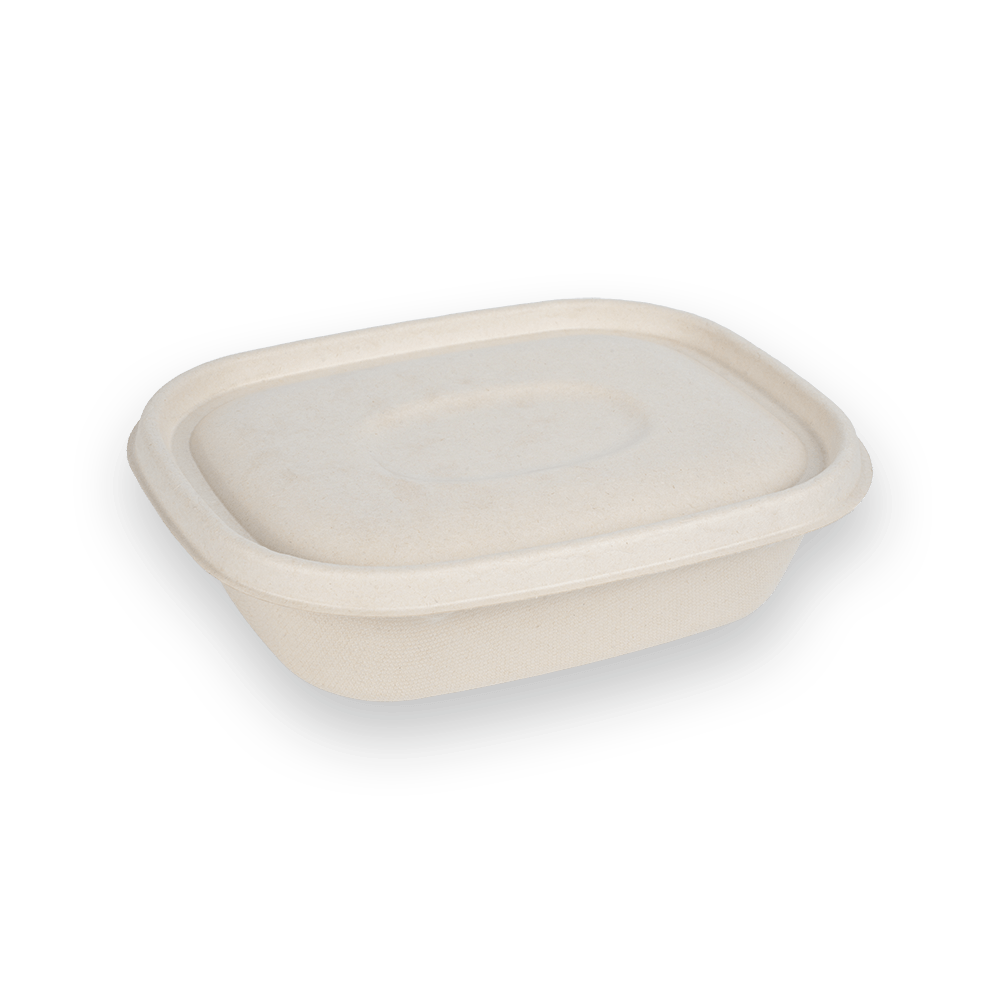
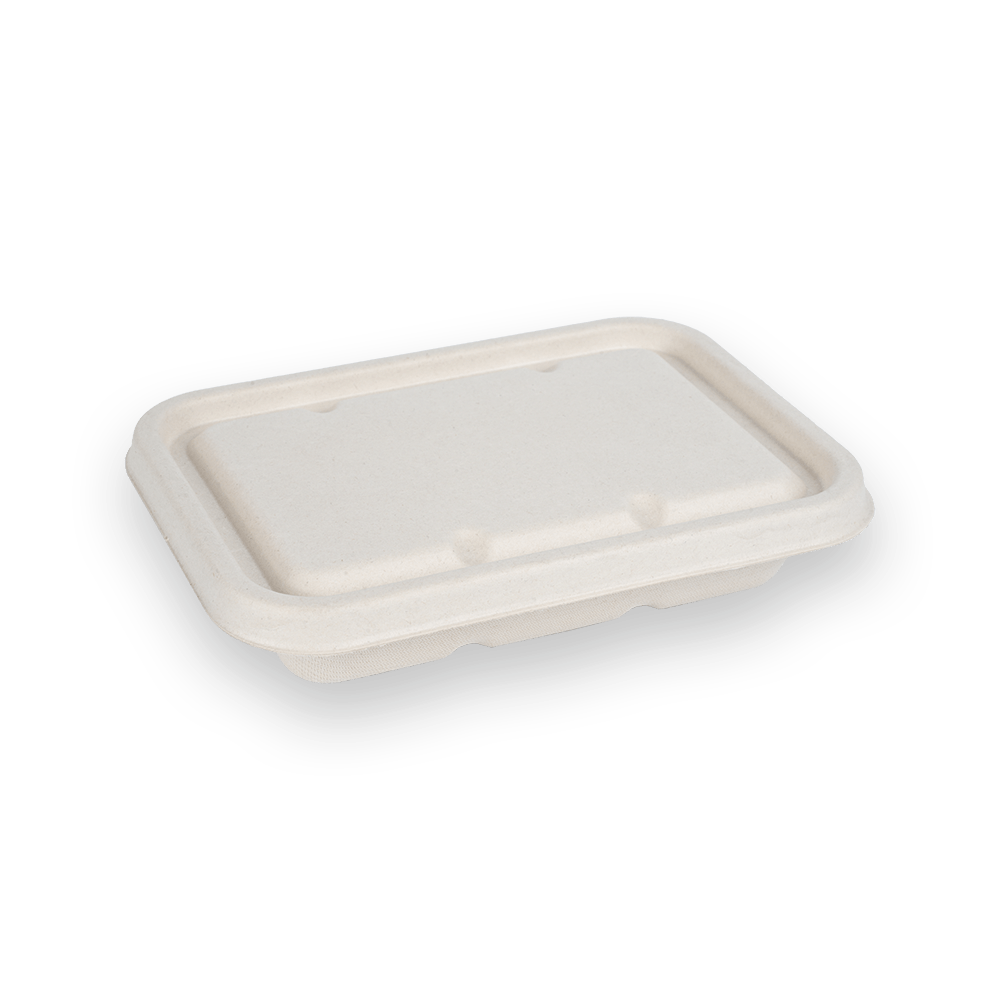
| Typical products | Plates, clamshells, bowls, trays, cutlery | Cold cups, deli containers, cutlery, straws | Trays, protective inserts, clamshells |
| Hot food suitability | Strong — handles hot, oily and saucy food; standard grades are made for hot fills up to 100 °C and hot oil up to 120 °C; microwave-safe for short reheating (confirm per SKU spec) | Limited — softens near 50–60 °C unless crystallized (cPLA) | Varies by fiber and wall thickness |
| Oil & grease resistance | Naturally grease-resistant, produced without fluorochemical coatings; PFAS / total-fluorine test reports available per SKU | Good by polymer nature | Depends on coating — uncoated grades may need barrier solutions |
| End-of-life | Industrially compostable; EN 13432 / ASTM D6400 certified options available | Industrial composting only (~58 °C); rarely breaks down in home or marine environments | Fiber grades can be compostable or recyclable depending on coating |
| Certification path | EN 13432, ASTM D6400, BPI, OK compost INDUSTRIAL — all verifiable in official registries | ASTM D6400 (PLA-specific), BPI for PLA items | Varies; coated versions may fail compostability |
| Regulatory fit for 2026 | Meets PFAS-restricted state laws and the EU PPWR direction without reformulation | Meets if no PFAS additives; end-of-life infrastructure is the weak point | Must verify no PFAS-based grease barrier |
| Sourcing angle | Thailand-based manufacturing offers a tariff-diversified supply route alongside China (US ADD/CVD duties apply to Chinese-origin molded fiber), with export logistics via Laem Chabang | Concentrated in few large producers; resin price volatility | Wide but quality varies significantly |
The 2026 Distributor Stocking Matrix
| Your buyer profile | Stock first | Why |
|---|---|---|
| US foodservice distributor (multi-state) | Bagasse plates, clamshells, bowls — PFAS-free certificates per SKU | Must satisfy the strictest state law in any state you ship to |
| EU private-label brand | Bagasse + cPLA cutlery, EN 13432 documentation pack | PPWR PFAS limits apply from August 12, 2026 |
| Quick-service restaurant chain | Bagasse clamshells & meal boxes, heat-tolerant grades | Hot/oily food performance + brand ESG targets |
| Regional grocer (meal-prep / deli) | Bagasse trays + PLA cold containers | Mixed hot/cold categories |
What Drives Demand After 2026
- EU — from August 12, 2026: under PPWR, food-contact packaging placed on the EU market must meet the PFAS thresholds (25 ppb / 250 ppb / 50 ppm). Buyers are re-auditing supplier documentation now, so expect documentation requests to reach you before the deadline does.
- US — through 2027: Maine's restriction took effect May 25, 2026; New Hampshire and New Mexico follow on January 1, 2027. A national distribution model effectively requires PFAS-free documentation across the catalog.
- Buyer behavior shift: procurement teams increasingly treat test reports with methods and detection limits — not email assurances — as the compliance artifact.
How to Choose a Bagasse Manufacturer (Fast Checklist)
- Ask for PFAS-free test reports per product family, with method and detection limit stated.
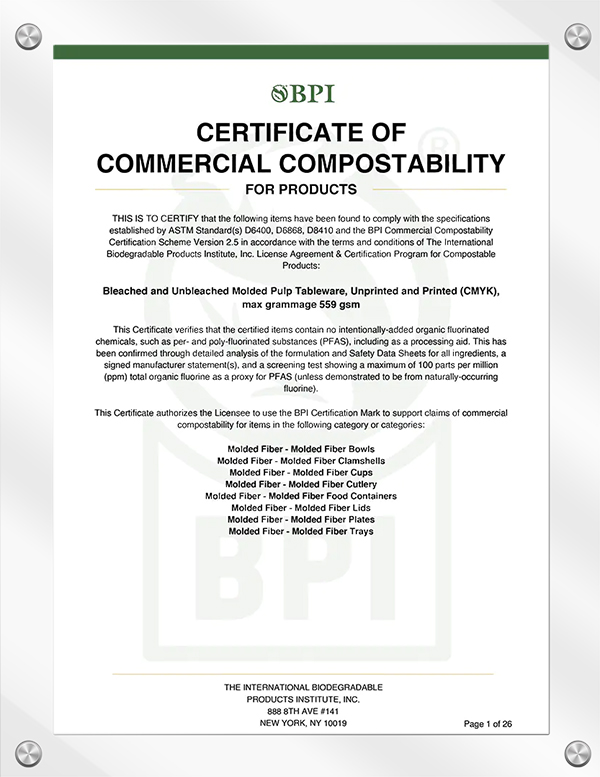
- Confirm compostability certificates (EN 13432 / ASTM D6400 / BPI) and validate them in the certifier's public registry — full steps in our verification checklist.
- Check MOQ, sample lead time and production lead time in writing — MOQs typically start from carton quantities for standard items and rise for printed or custom-mold products.
- Ask where the products are manufactured — Thailand-origin supply is increasingly used as a tariff-diversification line alongside China sourcing.
- Request spec sheets with dimensions, gram weight and case-pack data before RFQ.
FAQ
Is bagasse better than PLA for hot food?
Generally yes — bagasse is a fiber with natural heat and oil tolerance, while standard PLA softens at relatively low temperatures. Crystallized PLA (cPLA) cutlery is the common PLA fix for heat. For hot, oily dishes like burgers and curries, bagasse clamshells and plates are the default choice.
Is bagasse tableware really PFAS-free?
It is only if the manufacturer does not add fluorochemical grease barriers. Uncoated bagasse is naturally grease-resistant; the verification is a lab test report, not a claim. See our PFAS verification checklist for how to read the reports.
Can I mix bagasse and PLA in one order from one supplier?
Many importers do, but certificates differ: fiber items certify under fiber standards, PLA items under their own (for example, ASTM D6400 listings). Ask for per-SKU documentation and confirm which standards apply to each item, so your compost stream and labeling stay correct.
What documents should an EU buyer request under PPWR from August 2026?
PFAS test results against the 25 ppb / 250 ppb / 50 ppm thresholds, recyclability statements, and technical documentation from the packaging supplier. Non-EU suppliers selling into the EU must also work with an authorized representative for EPR registration.
Why source bagasse tableware from Thailand?
Thailand-origin manufacturing gives North American and European buyers a second sourcing route for supply-chain resilience and tariff diversification, alongside mature sugarcane-fiber processing and container logistics through Laem Chabang port. Zhong Xin Ecoware Technology (Thailand) Co., Ltd. supplies importers, distributors and private-label programs from its Thailand base.
Sources
- BPI Certified Products Directory
- U.S. FDA — Food Contact Substances program
- European Commission — packaging and PPWR context
- Maine DEP — Toxics in Food Packaging Program
- Standards referenced: ASTM D6400; EN 13432
About Zhong Xin Ecoware (Thailand)
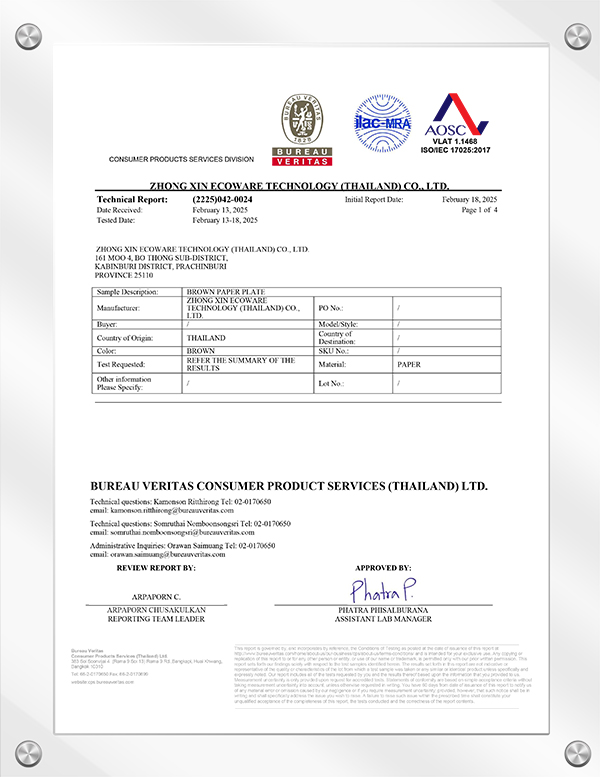
Zhong Xin Ecoware Technology (Thailand) Co., Ltd. manufactures molded plant-fiber (bagasse) foodservice packaging for B2B buyers in North America and Europe, supporting importers, distributors and private-label programs. Compostability and food-contact documentation — BPI listings, FDA / LFGB files and PFAS / total-fluorine test reports — is available for buyer review.
- Wholesale & OEM inquiries: info@fiber-product.com
- Website: www.zxpackingthailand.com
More for buyers:
- PFAS-Free & Compostability Verification: A Buyer's Checklist
- Bagasse Tableware Product Range
- MOQ, Samples & Lead Times
- Factory & Certifications
Last updated: September 19, 2026. Regulatory citations reflect public sources as of this date; we refresh this page as state and EU rules evolve.


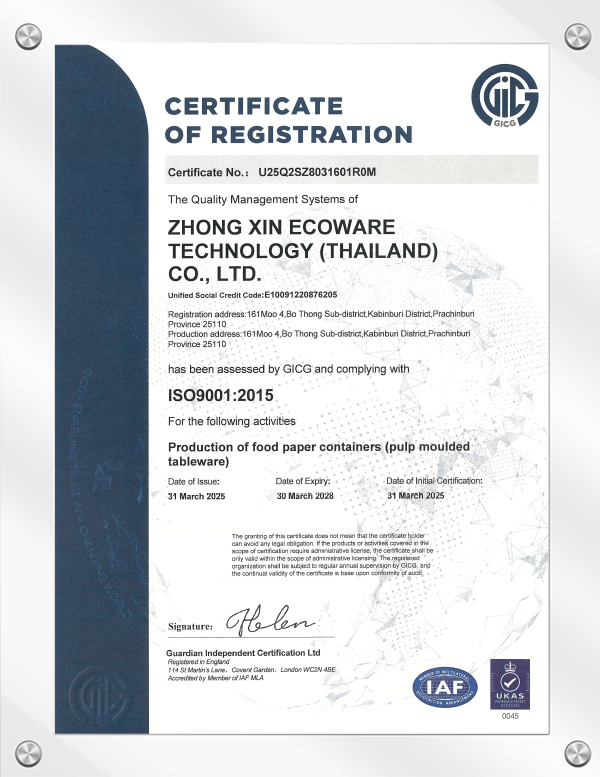
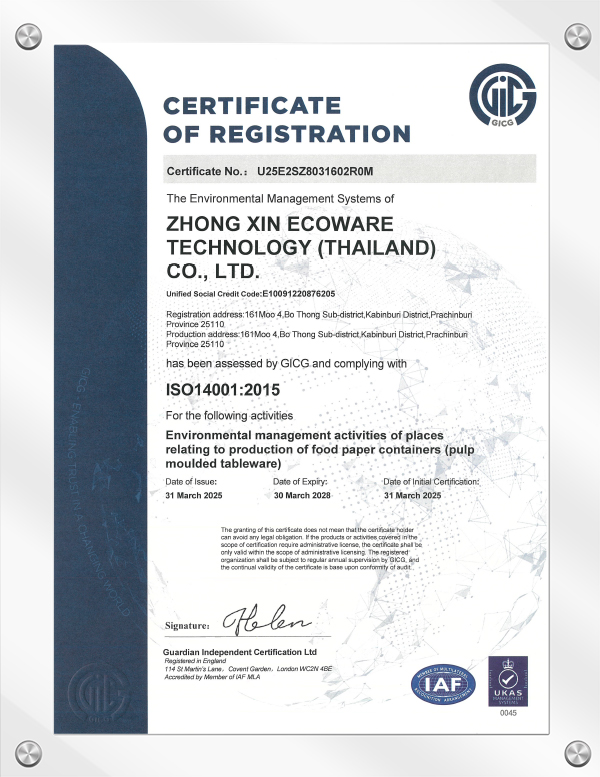
Zhong Xin Ecoware(Thailand) was registered on November 1, 2023, and officially began construction of the factory building in June 2024. At present, the first phase workshop of the factory has been fully completed and put into use. The second phase of the factory is being constructed intensively.
The landing and development of Zhong Xin in Thailand has brought a large amount of initial investment for land, factories, etc., and continuous operational investment for continuous equipment updates, technological upgrades, and capacity expansion.
Zhong Xin Ecoware(Thailand) has directly and indirectly created thousands of job opportunities, increased government revenue, promoted local economic development, cultivated local supply chains, provided systematic training for employees, improved the quality of local human capital, injected vitality into the local economy, enhanced industrial competitiveness, and ultimately improved residents' living standards.
Zhong Xin Ecoware(Thailand) actively collaborates with local pulp mills to explore new cooperation models for developing new products, improving production capacity and quality. At the same time, relying on Zhongxin's advanced production technology, process flow, management experience, and quality control system, it promotes the development of this industry in Thailand.

-
-
 +66-31240888
 -
 161 Village No. 4, Bo Thong Subdistrict Kabin Buri District Prachinburi Province 25110
-
Can Paper Packaging Meet Retail Shelf and Branding Requirements
Oct 23,2026
-
Bagasse Cups and Cup Lids: A Sourcing Guide for Foodservice and Takeaway Buyers
Oct 20,2026
-
How to Find Zhong Xin at the 140th Canton Fair: A Visitor Navigation Guide
Oct 16,2026
-
Thailand vs China Bagasse Tableware: 8 Comparisons Buyers Should Verify
Oct 16,2026
-
Will Takeout Containers Fit Your Existing Lids and Delivery Workflow
Oct 16,2026
-
What Is Bagasse Tableware? A 2026 Buyer Guide to Material, Performance and Documents
Oct 13,2026
-
Bagasse Tray Wholesale: How Bulk Buyers Cut Cost with Carton and Container Planning
Oct 09,2026
-
What Should a Bagasse Manufacturer Include in a Bulk Order Quote
Oct 09,2026
-
FOB, CIF or DDP? Incoterms for Bagasse Tableware Buyers Shipping from Thailand
Oct 06,2026
-
Packaging or Food Contact? Which EU Regime Applies to Bagasse Cups, Bowls, Plates and Cutlery
Oct 06,2026
-
Compostable Cutlery Sets for Private Label: 7 Sourcing Checks for Retail and Foodservice Buyers
Oct 06,2026
-
US vs EU Bagasse Tableware Imports: 8 Documentation and Compliance Checks Buyers Should Run
Oct 06,2026
Copyright © 2025 Zhong Xin Ecoware Technology ( Thailand ) CO., LTD.
All Rights Reserved.

Biodegradable Disposable Bagasse Tableware Manufacturer