-
 [email protected]
-
 +66-31240888



 English
 Español
 ไทย
Quality Control and Batch Traceability for Bagasse Tableware
Quality control is not a slogan for this factory. This page lists the management systems, the batch and inspection process, and the documents you can ask for before you sign, matching the way our foodservice and distributor buyers audit a molded-fiber plant.
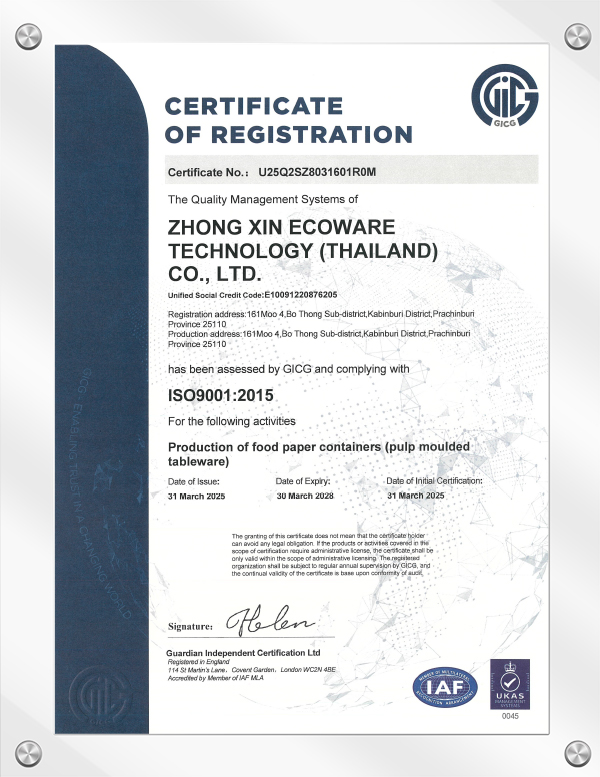
Short answer: the Thailand plant holds BRCGS Packaging Materials (12 021 71258 TMS and 12 021 71260 TMS, valid to 5 and 7 September 2027), ISO 9001:2015 (F06726Q01223R053, to 27 April 2029), ISO 22000 (F06726F00001R053, to 26 April 2029), ISO 14001 / ISO 45001 (to 27 April 2029) and FSC Chain-of-Custody (SCS-COC-702407, to 14 May 2030). Product-level documents such as BPI 10529982-1, EN 13432 7P2423 Ed. D and the PPWR report 178246344a 001 apply to the products and specifications listed, including products made in Thailand. AQL on bagasse tableware bulk orders is typically 2.5 / 4.0 / zero by defect class; confirm the acceptance criteria per SKU before shipment.
All certificates are managed centrally by the group and shared across its manufacturing sites. The Thailand plant is a group factory responsible for production. Product certificates describe the product and material tested; factory certificates name specific sites, so check the site named on your order against the certificate.
Management systems and documents
The factory rows below are the Thailand plant's own certificates as published on the group certificate register (2026). The group also holds equivalent certificates for its other sites. Factory-level certificates name specific sites; product-level certificates apply to the product families, grammages and colours listed in them.
| Type | Document | Number | Valid to | What it covers |
|---|---|---|---|---|
| Factory | BRCGS Packaging Materials — Thailand Plant 1 | 12 021 71258 TMS | 2027-09-05 | Packaging safety, hygiene, traceability and quality controls at the audited site |
| Factory | BRCGS Packaging Materials — Thailand Plant 2 | 12 021 71260 TMS | 2027-09-07 | Same scope for the second plant |
| Factory | ISO 9001:2015 — Thailand | F06726Q01223R053 | 2029-04-27 | Quality management system |
| Factory | ISO 22000:2018 — Thailand | F06726F00001R053 | 2029-04-26 | Food safety management system |
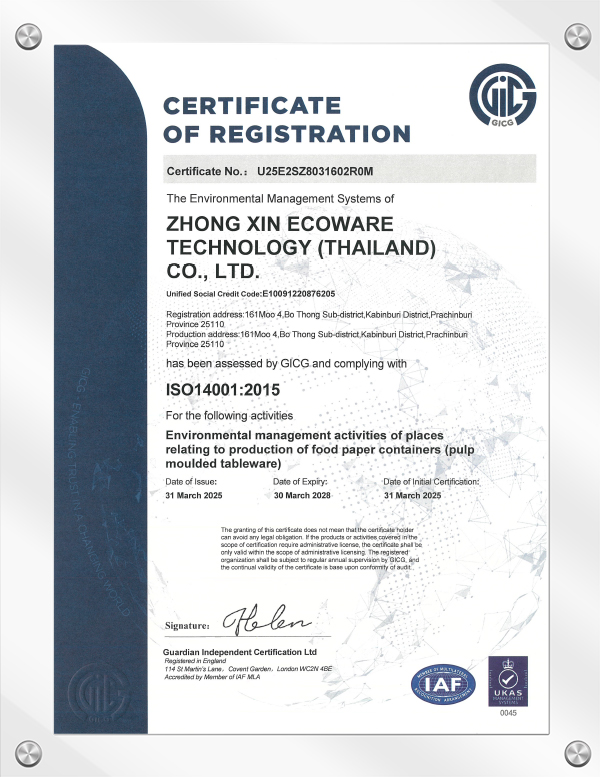
| Factory | ISO 14001 / ISO 45001 — Thailand | F06726E00591R053 / F06726S00442R053 | 2029-04-27 | Environment / occupational health and safety |
| Factory | FSC Chain-of-Custody — Thailand | SCS-COC-702407 | 2030-05-14 | Fiber sourcing and chain of custody |
| Product | BPI Certified Compostable | 10529982-1 | 2028-03-31 | Molded-fiber items; max 559 g/m2; no intentionally added PFAS; TOF ≤100 ppm |
| Product | EN 13432 (DIN CERTCO) | 7P2423 Ed. D | 2029-08-18 | Trays and plates; max 636 g/m2 |
| Product | PPWR (EU) 2025/40 report | 178246344a 001 | Report date | PFAS restriction PASS; heavy metals PASS; tested sample |
Current copies of all factory and product documents are available on request. Before you rely on any row in a customer declaration, confirm that your exact SKU, colour and coating fall inside the tested scope, and that the site on the factory-level certificate is the site that will make your order.


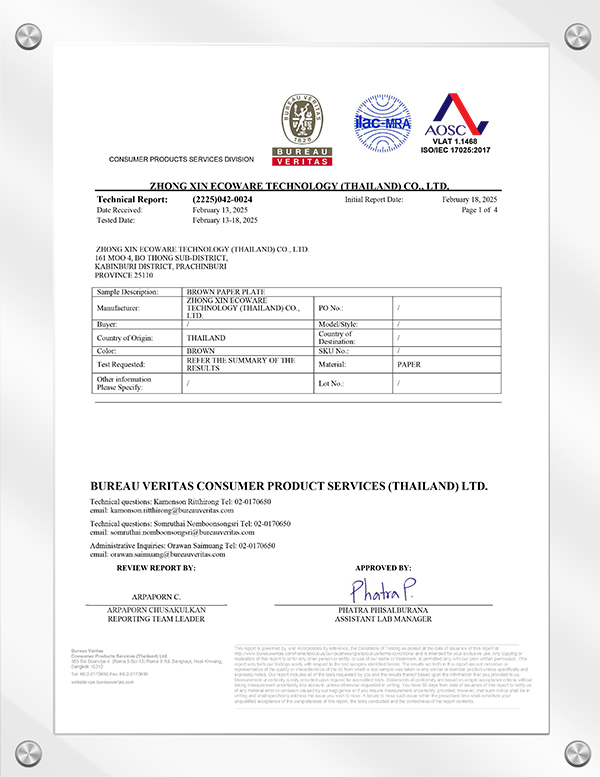
Thailand plant certificates on file (2026): BRCGS Packaging Materials 12 021 71258 TMS / 12 021 71260 TMS, ISO 9001 F06726Q01223R053 and ISO 22000 F06726F00001R053. Current copies are available on request.
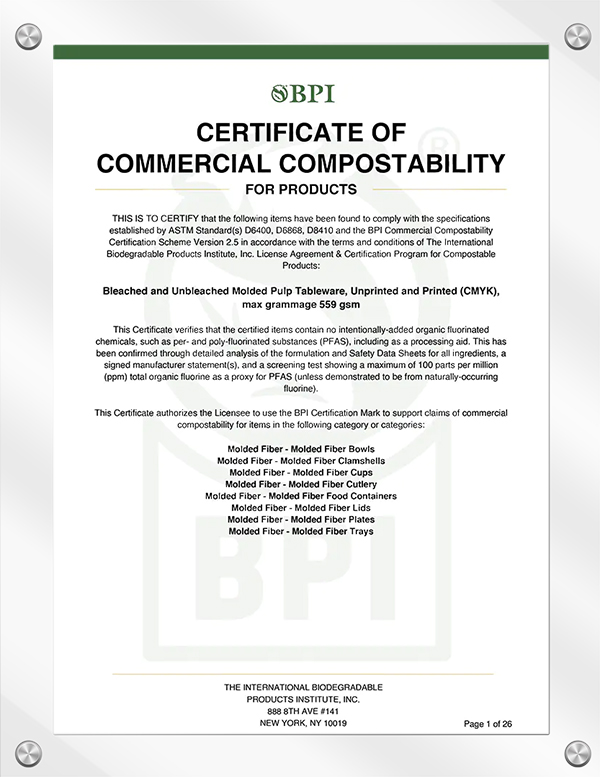
BPI Certificate of Commercial Compostability (cover page). The certified product scope and the no-intentionally-added-PFAS statement are listed in the table above.
How a molded-fiber order is inspected
Quality control on a bulk order runs through the same stages a buyer would audit: incoming material, first-article approval, in-line checks, final AQL inspection and packing. The exact limits are agreed per SKU in the quotation and the inspection contract.
| Stage | What is checked | Where it is recorded |
|---|---|---|
| Incoming material | Pulp grade, moisture, colour consistency, coating/lamination feedstock | Incoming inspection record per batch |
| First article | Dimensions, weight, grammage, colour, print alignment, against approved sample | First-article report signed before mass production |
| In-line | Mold wear, dimension drift, surface defects, stack-ability | Continuous line sampling |
| Final AQL | Sampling per the agreed AQL (typically 2.5 / 4.0 / zero by defect class) | Final inspection certificate |
| Packing | Count, carton weight, stacking strength, label, pallet pattern | Packing list / container-loading record |
AQL (Acceptance Quality Limit) is set in the contract before shipment, not after. Tell us the retailer, market and end-use, and we lock the acceptance criteria with the first-article approval — not at final inspection.
Batch traceability
Each production batch is traceable by a lot number that follows the pulp lot, the production line, the date and the inspection result. If you find a defect after arrival, quote the lot number and the shipping reference and we can pull the matching production and inspection records. The depth of traceability (by line, by shift, by pulp lot) is confirmed in the quality agreement.
If something goes wrong
Start with the lot number and a clear description of the defect with photos. We work through a documented complaint → investigation → corrective/preventive action loop, and where the batch is confirmed non-conforming we agree the remedy in the quality agreement. Because molded fiber is a physical process, we cannot comment on a claim without the lot number and sample evidence.
Quality documents to request before you buy
- Factory certificates (BRCGS, ISO 9001/22000/14001/45001, FSC) — confirm the site named on your order is on the certificate.
- Product certificates and reports (BPI, EN 13432, LFGB, PPWR/PFAS) — confirm your SKU, colour and coating are inside the tested scope.
- A first-article / pre-production sample against which mass production is checked.
- The AQL and inspection plan agreed before shipment.
- A batch-traceability statement that matches the lot structure you will quote later.
FAQ
Which quality certificates does the Thailand plant hold?
BRCGS Packaging Materials (12 021 71258 TMS and 12 021 71260 TMS, to 5 and 7 September 2027), ISO 9001:2015 (F06726Q01223R053, to 27 April 2029), ISO 22000 (F06726F00001R053, to 26 April 2029), ISO 14001 / ISO 45001 (to 27 April 2029) and FSC Chain-of-Custody (SCS-COC-702407, to 14 May 2030).
Do the product certificates also cover products made in Thailand?
Product-level certificates such as BPI 10529982-1, EN 13432 7P2423 Ed. D and the PPWR report describe the product and material tested, not the country of manufacture. Where specification, colour, coating and grammage match the tested item, the same document supports the product supplied from Thailand. Certificates are managed centrally by the group and shared across its manufacturing sites.
What AQL do you use?
Typically 2.5 / 4.0 / zero by defect class for bagasse tableware bulk orders. The exact acceptance criteria are agreed per SKU in the quotation and inspection contract before shipment — not decided at final inspection.
Can you trace a batch if there is a defect later?
Yes. Each production batch carries a lot number tied to the pulp lot, the production line, the date and the inspection result. Quote the lot number and shipping reference and we can pull the matching production and inspection records.
What does an audit of your plant cover?
We can host a factory audit or provide the same evidence package remotely: factory and product certificates, first-article and inspection records, batch-traceability statement, and the quality agreement. Values for these are provided against the site named on the audit scope.
Sources
- Certifications & Compliance Portfolio 2026 — Zhongxin group certificate register (accessed 2026-11-14)
- MOQ, mold, sample, lead time — Zhongxin group (accessed 2026-11-14)
- How to order from an Asian bagasse factory — Thailand plant (accessed 2026-11-14)
Zhong Xin Ecoware Technology (Thailand) Co., Ltd. supplies bagasse and molded-fiber food packaging to importers, distributors and foodservice brands. For a quality agreement, audit package or SKU-level certificate confirmation, email info@fiber-product.com or use the contact form. For the full certificate register, see our certifications and compliance documents page.
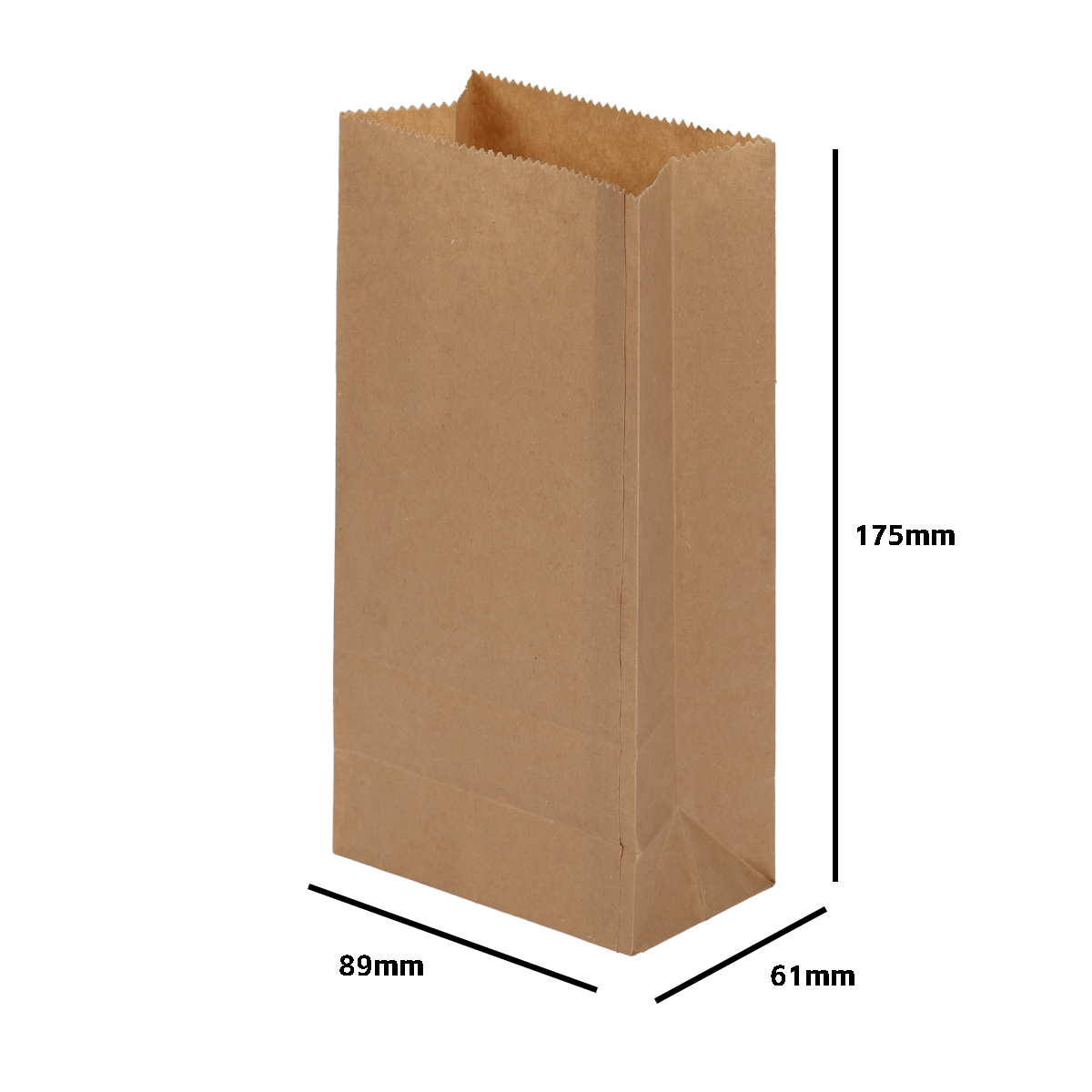
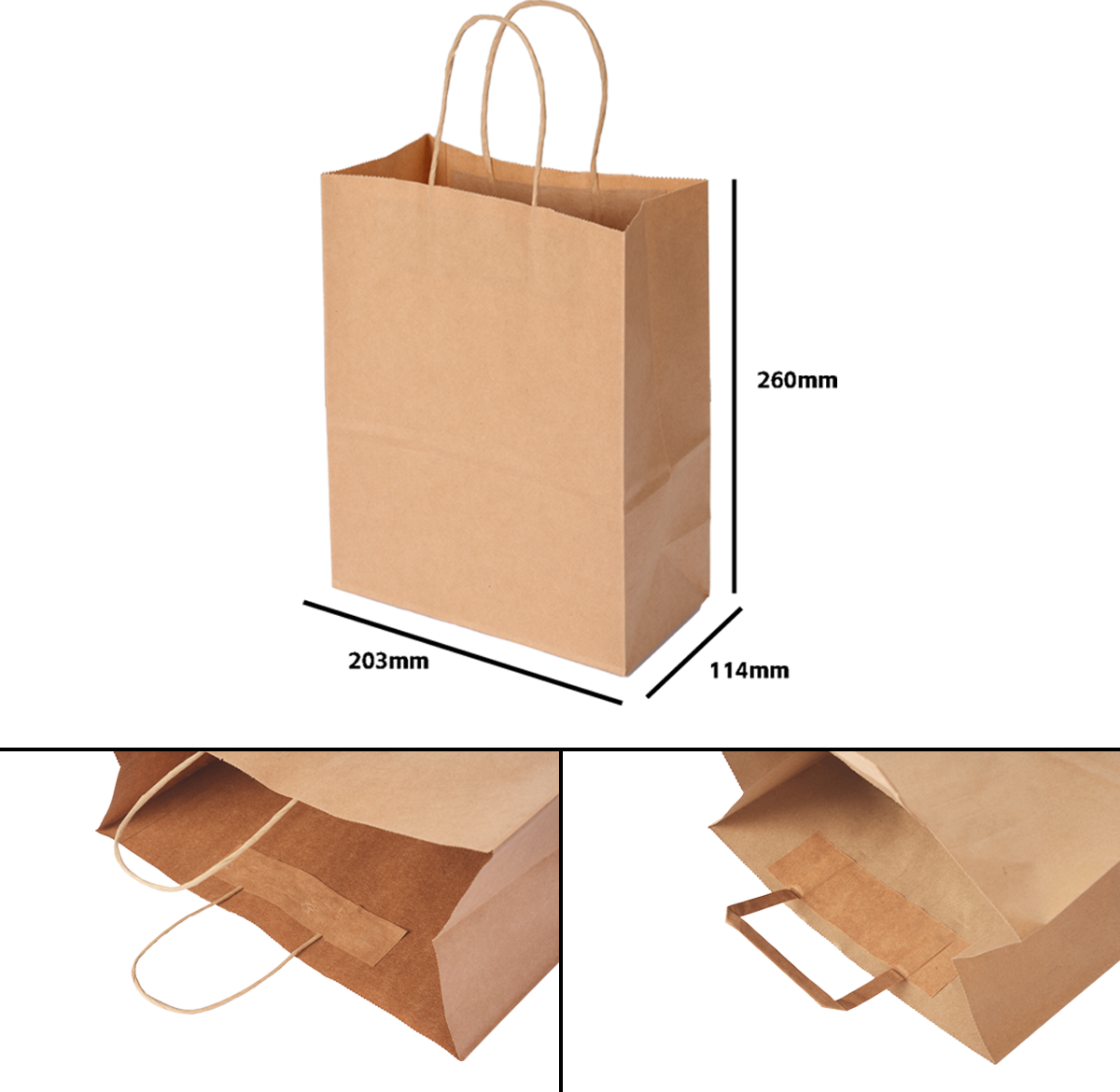
Zhong Xin Ecoware(Thailand) was registered on November 1, 2023, and officially began construction of the factory building in June 2024. At present, the first phase workshop of the factory has been fully completed and put into use. The second phase of the factory is being constructed intensively.
The landing and development of Zhong Xin in Thailand has brought a large amount of initial investment for land, factories, etc., and continuous operational investment for continuous equipment updates, technological upgrades, and capacity expansion.
Zhong Xin Ecoware(Thailand) has directly and indirectly created thousands of job opportunities, increased government revenue, promoted local economic development, cultivated local supply chains, provided systematic training for employees, improved the quality of local human capital, injected vitality into the local economy, enhanced industrial competitiveness, and ultimately improved residents' living standards.
Zhong Xin Ecoware(Thailand) actively collaborates with local pulp mills to explore new cooperation models for developing new products, improving production capacity and quality. At the same time, relying on Zhongxin's advanced production technology, process flow, management experience, and quality control system, it promotes the development of this industry in Thailand.

-
-
 +66-31240888
-
 161 Village No. 4, Bo Thong Subdistrict Kabin Buri District Prachinburi Province 25110
-
Quality Control and Batch Traceability for Bagasse Tableware
Nov 23,2026
-
EU Market: EN 13432, OK Compost, LFGB and PPWR for Bagasse Packaging
Nov 23,2026
-
How Does Packaging Design Affect Tableware Shipping and Storage Costs
Nov 20,2026
-
What GSM Paper Bag Do You Need? 50, 60 and 110 g/m2 Explained
Nov 17,2026
-
Kraft SOS Bags vs Flat Merchandise Bags: Which for Takeaway and Retail
Nov 16,2026
-
Certifications and Compliance Documents for Bagasse and Molded-Fiber Packaging
Nov 14,2026
-
PFAS-Free Bagasse and Molded-Fiber Food Packaging
Nov 14,2026
-
How to Prove PFAS-Free Bagasse Tableware: Total Fluorine and Targeted PFAS
Nov 13,2026
-
Are Sugarcane-Based Packaging Claims Backed by Verifiable Certifications
Nov 13,2026
-
Are Bagasse Food Containers Safe for Hot Food and Takeout?
Nov 06,2026
-
Leakage and Heat Resistance: What Should Catering Buyers Test Before Ordering
Nov 06,2026
-
Can Compostable Packaging Go in the Compost Bin? Certification vs Facility Acceptance
Oct 31,2026
Copyright © 2025 Zhong Xin Ecoware Technology ( Thailand ) CO., LTD.
All Rights Reserved.

Biodegradable Disposable Bagasse Tableware Manufacturer