-
 [email protected]
-
 +66-31240888



 English
 Español
 ไทย
ไทยHow long does it take for sugarcane bagasse plates to compost
What conditions are required?
Sugarcane bagasse plates are technically compostable, but the conditions matter enormously. The time varies from 2 weeks to more than 2 years, depending on where the plate ends up.

Industrial composting (the ideal scenario). In a commercial composting facility, the conditions are controlled: temperature 55–65°C, moisture 50–60%, constant aeration, and active microbial culture. Under these conditions, a 15–20 cm diameter bagasse plate breaks down into CO₂, water, and biomass within 30–60 days. The ASTM D6400 standard (US) and EN 13432 (Europe) certify products as compostable if at least 90% of the material degrades within 180 days in industrial composting. Most bagasse plates meet these standards. However, fewer than 5% of bagasse plates actually reach industrial composting facilities because many municipalities do not accept "compostable" plates in their composting stream (they prefer yard waste only). In practice, a bagasse plate sent to a landfill will not compost—landfills are dry, oxygen-poor environments designed to preserve waste, not break it down. Studies of landfill cores have found bagasse plates that were still identifiable after 5–10 years.
Home composting (backyard pile). This is more variable. A well-managed home compost pile (turned weekly, kept moist, hot summer temperatures) will break down a bagasse plate in 3–6 months. A passive pile (turned rarely, cool climate) may take 12–24 months. The thickness of the plate matters: a thick, deeply fluted plate (3–4 mm thickness in the base) takes longer than a thin, flat plate (1.5–2 mm). To speed home composting, tear or cut the plate into 3–5 cm pieces before adding to the pile—this increases the surface area for microbes. The plate should be buried in the active center of the pile, not on top, where it will dry out.
Contamination issues. If a bagasse plate is used with oily or fatty foods (cheese, meat, creamy sauces), the oil can coat the fiber and slow down composting because oil repels water that microbes need. Wiping off excess food scraps before composting helps. Also, plates that are printed with colored ink (especially metallic or heavy dye loads) may have the ink residue left after composting; most bagasse plates use water-based inks that break down, but some cheaper imports use solvent inks that persist as colored specks.
Do sugarcane bagasse plates get soggy or leak with hot, oily, or saucy foods?
This is the most practical concern for users. Bagasse plates are not plastic; they absorb moisture over time. Their performance varies significantly by food type and duration.
- Dry foods (sandwiches, cookies, crackers): Excellent performance. The plate's surface resists wicking of dry crumbs and oils for many hours (8–12+ hours). No structural change.
- Hot, less-oily foods (rice, steamed vegetables, plain pasta): Good for 30–60 minutes. The plate absorbs some steam from the food, becoming softer but not leaking. After 90 minutes, the portion under the food may feel damp to the touch on the underside, but water droplets do not form. A 2 mm thick plate will bow slightly (center rises 3–5 mm) after 30 minutes of hot rice. This bowing does not cause leakage.
- Wet, runny foods (soups, stews, curries with thin gravy): Not suitable. Bagasse plates are not coated with plastic or wax (coating would make them non-compostable). With a thin liquid, the plate begins wicking within 5–10 minutes. The liquid soaks through the fiber matrix, appearing as dark spots on the bottom. After 15–20 minutes, droplets form on the underside. After 30 minutes, the plate structure softens to the point that lifting it causes the center to sag and potentially spill. For soups, a bagasse bowl is better than a plate; even then, the safe time limit is about 30 minutes.
- Oily foods (fried items, cheese sauce, pizza with grease): Oils do not wet bagasse fibers the way water does. A plate with oily food (like french fries or pepperoni pizza) stays firm for 1–2 hours because the oil is repelled. However, if the oil is mixed with water (e.g., a creamy salad dressing), the water fraction causes softening. Some bagasse plates have a small amount (2–5%) of added sizing agent (a starch or cellulose derivative) to improve wet strength. These plates handle moderate oil for 2–3 hours.
Are there any safety concerns with chemicals in sugarcane bagasse plates?
Sugarcane bagasse plates are generally considered safe, but there are two areas of concern: residual processing chemicals and heavy metals from recycled content.
Processing residues. During bagasse pulping, some manufacturers use bleaching agents (hydrogen peroxide or chlorine dioxide) to whiten the fiber. Chlorine-based bleaching can produce trace amounts of organochlorines (AOX – adsorbable organic halides) in the finished product. Standards for food contact materials (EU 10/2011, US FDA 21 CFR 176.170) set limits: for AOX, less than 0.15 mg/g (0.015%). Reputable manufacturers test for AOX. Unbleached bagasse plates are light brown or gray and contain no bleaching residues. However, unbleached plates may have a mild grassy or earthy odor, which some users find unpleasant. This odor does not transfer to food unless the food is wet and left for over 2 hours.
Wet-strength additives. Some bagasse plates contain a small amount of a wet-strength resin (usually a modified polyamide or epichlorohydrin-based polymer, 0.5–1.5% by weight). These resins are FDA-approved for food contact. However, if the plate is used for very hot (above 100°C) or very acidic foods (pH below 3.5, like lemon juice or vinegar-based sauces), trace amounts of the resin could leach. Migration testing per FDA protocol shows leaching below 0.01 mg/cm² (well below the limit of 0.075 mg/cm²). For ordinary use, no safety issues are documented. The European Food Safety Authority (EFSA) has evaluated polyamide-epichlorohydrin resins and permits them at up to 1.5% in paper and board food contact materials.
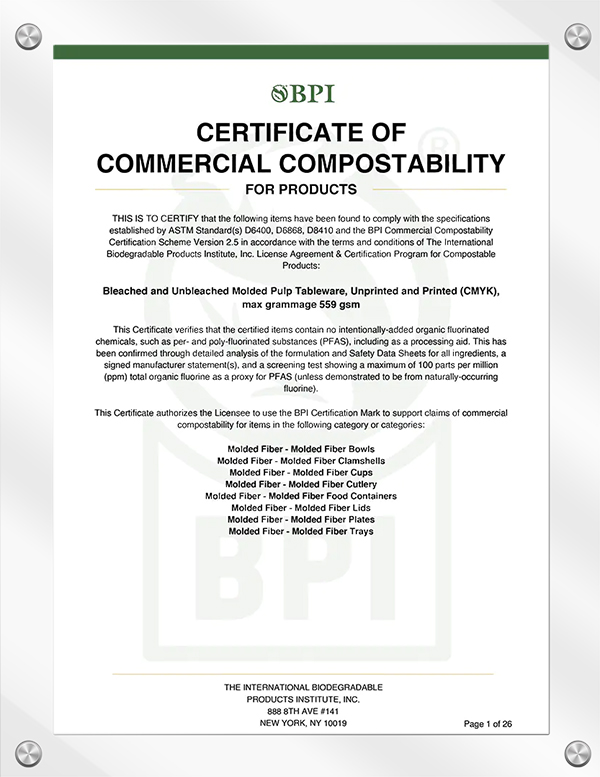
Heavy metals from recycled bagasse. Most bagasse plates use virgin bagasse (direct from sugar mills), not recycled paper. However, some manufacturers mix in recycled paper pulp (10–30%) to lower costs. Recycled paper can contain ink residues with trace heavy metals (lead, cadmium, mercury). In a 2018 study of 30 bagasse plate samples from Asia, 4 samples (13%) had detectable lead above the EU limit of 0.5 mg/kg, likely from recycled content. To avoid this, look for plates labeled "virgin bagasse" or "no recycled fiber." Plates certified by the Biodegradable Products Institute (BPI) or TÜV Austria undergo heavy metals testing as part of certification. For casual use (once a week), the exposure risk is low; for daily use (e.g., a food truck using the same plates for every order), choosing certified plates reduces risk.
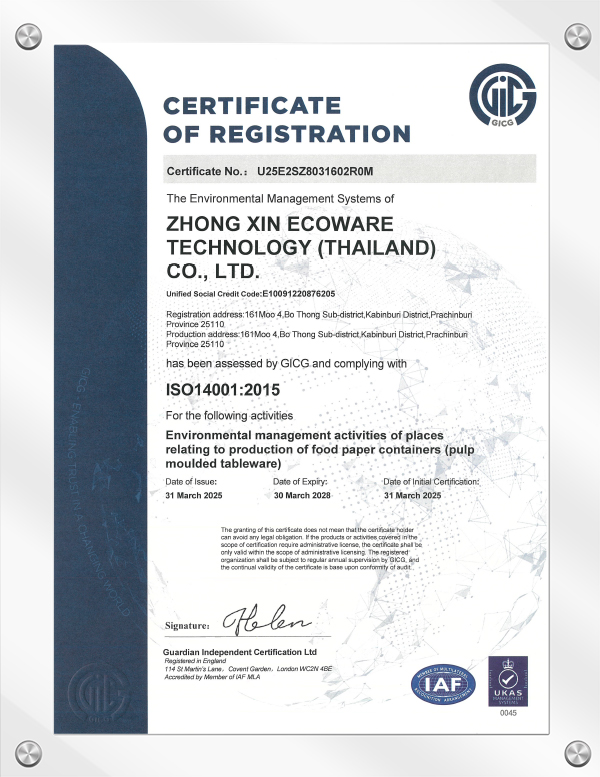
Zhong Xin Ecoware Technology (Thailand) Co., Ltd. supplies bagasse and molded fiber food packaging to importers, distributors and foodservice brands. For MOQ, pricing, samples and lead time, email info@fiber-product.com or use the contact form.


Zhong Xin Ecoware(Thailand) was registered on November 1, 2023, and officially began construction of the factory building in June 2024. At present, the first phase workshop of the factory has been fully completed and put into use. The second phase of the factory is being constructed intensively.
The landing and development of Zhong Xin in Thailand has brought a large amount of initial investment for land, factories, etc., and continuous operational investment for continuous equipment updates, technological upgrades, and capacity expansion.
Zhong Xin Ecoware(Thailand) has directly and indirectly created thousands of job opportunities, increased government revenue, promoted local economic development, cultivated local supply chains, provided systematic training for employees, improved the quality of local human capital, injected vitality into the local economy, enhanced industrial competitiveness, and ultimately improved residents' living standards.
Zhong Xin Ecoware(Thailand) actively collaborates with local pulp mills to explore new cooperation models for developing new products, improving production capacity and quality. At the same time, relying on Zhongxin's advanced production technology, process flow, management experience, and quality control system, it promotes the development of this industry in Thailand.

-
-
 +66-31240888
 -
 161 Village No. 4, Bo Thong Subdistrict Kabin Buri District Prachinburi Province 25110
-
How to Find Zhong Xin at the 140th Canton Fair: A Visitor Navigation Guide
Oct 16,2026
-
Thailand vs China Bagasse Tableware: 8 Comparisons Buyers Should Verify
Oct 16,2026
-
Will Takeout Containers Fit Your Existing Lids and Delivery Workflow
Oct 16,2026
-
What Is Bagasse Tableware? A 2026 Buyer Guide to Material, Performance and Documents
Oct 13,2026
-
Bagasse Tray Wholesale: How Bulk Buyers Cut Cost with Carton and Container Planning
Oct 09,2026
-
What Should a Bagasse Manufacturer Include in a Bulk Order Quote
Oct 09,2026
-
FOB, CIF or DDP? Incoterms for Bagasse Tableware Buyers Shipping from Thailand
Oct 06,2026
-
Packaging or Food Contact? Which EU Regime Applies to Bagasse Cups, Bowls, Plates and Cutlery
Oct 06,2026
-
Compostable Cutlery Sets for Private Label: 7 Sourcing Checks for Retail and Foodservice Buyers
Oct 06,2026
-
US vs EU Bagasse Tableware Imports: 8 Documentation and Compliance Checks Buyers Should Run
Oct 06,2026
-
How to Prepare a Bagasse Tableware Import: 10 Readiness Checks for US and EU Buyers
Oct 06,2026
-
Beyond Plates: Which Foods Suit Bagasse Tableware
Oct 02,2026
Copyright © 2025 Zhong Xin Ecoware Technology ( Thailand ) CO., LTD.
All Rights Reserved.

Biodegradable Disposable Bagasse Tableware Manufacturer