-
 [email protected]
-
 +66-31240888



 English
 Español
 ไทย
ไทยEU PPWR 2026: 7 Key Obligations for Food Packaging Buyers
EU PPWR Compliance Guide 2026: Why Sugarcane Bagasse Food Containers Are the Lowest-Risk Packaging Choice
Why Source from Zhong Xin Ecoware?
Zhong Xin Ecoware supplies international packaging groups and serves end-use applications for leading foodservice, retail, and supermarket brands.
- China and Thailand production bases
- Nearly 200,000 tons of combined planned and operating capacity
- Thailand base fully operational with 75,000 tons of capacity
- Products exported to 80+ countries and regions
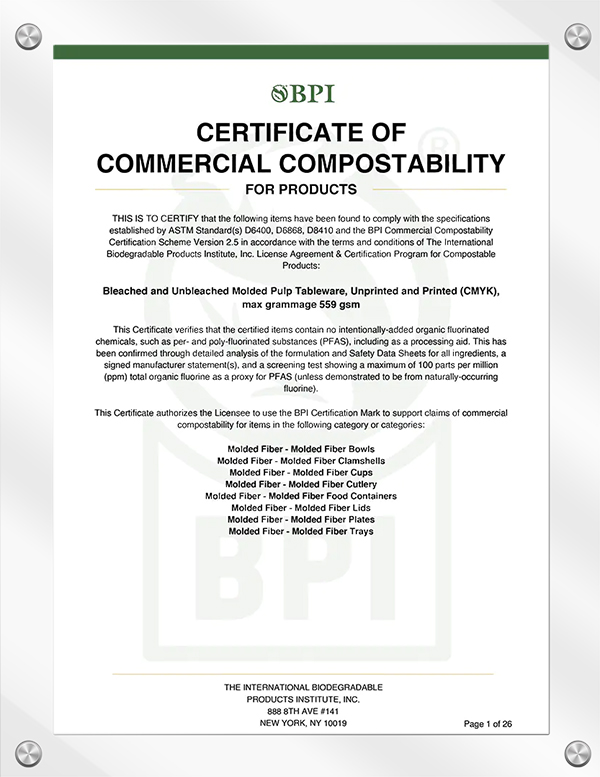
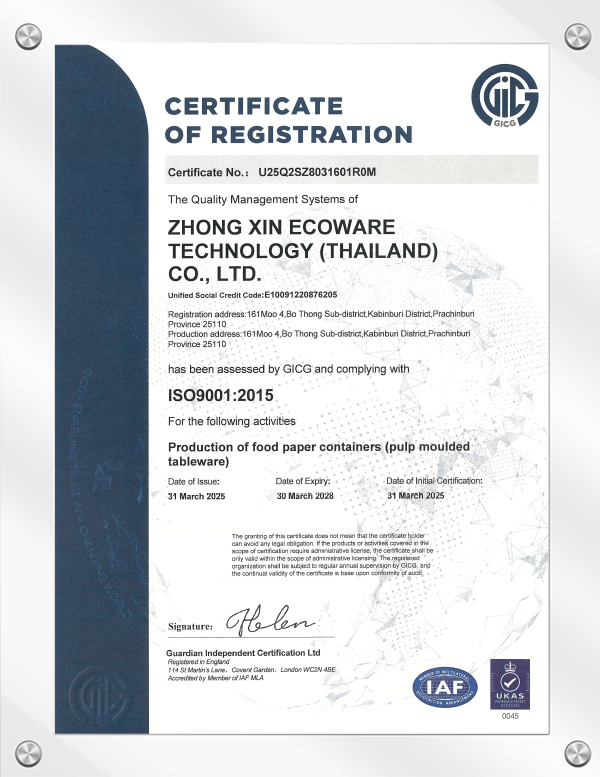
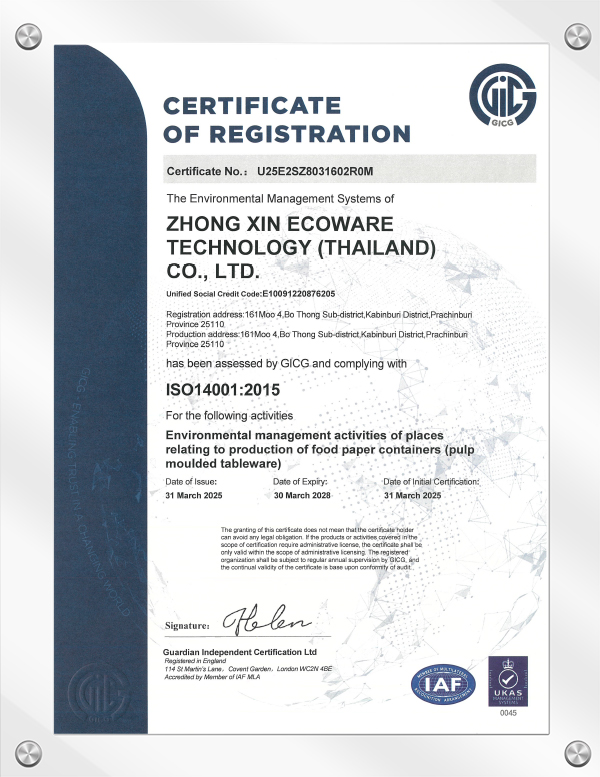
- FDA, EU, LFGB, BfR, BRC, BSCI, ISO9001, BPI, OK COMPOST HOME, ABA
- Serving global packaging groups and end-use brands across foodservice and retail
- 115 patents in molded pulp packaging and related technologies
- MOQ from 100,000 pieces
- PFAS-free and compostable packaging options for US and EU markets

What Is the EU PPWR?
On August 12, 2026, the European Union will fully enforce the Packaging and Packaging Waste Regulation (PPWR) – Regulation (EU) 2025/40, replacing the previous Packaging Directive 94/62/EC that governed the market for nearly three decades.
Under PPWR, all food service packaging placed on the EU market must comply with:
- PFAS restrictions
- Heavy metal limits
- Recyclability requirements
- Technical documentation obligations
- Declaration of Conformity (DoC) requirements
Manufacturers must be able to provide compliance documents within 10 calendar days upon request.
This is not a recommendation. PPWR is a directly applicable EU regulation enforced across all 27 member states without national transition legislation.
For food packaging importers, distributors, and procurement teams serving the European market, PPWR will directly determine whether products can enter the EU supply chain.

7 PPWR Requirements Every Packaging Buyer Should Review
The following requirements are based on Regulation (EU) 2025/40 and the European Commission Guidance Document C(2026)2151, published in March 2026.
1. PFAS Restrictions Take Effect Immediately
PFAS limits for food-contact packaging become enforceable on August 12, 2026.
The critical compliance date is the date the packaging is placed on the EU market, not the manufacturing date.
This means packaging shipped into the EU after August 12 must comply, even if it was produced months earlier.
The European Commission has clearly stated that there is no stock exhaustion period for PFAS-containing packaging.
Buyer Action
Request:
- PFAS-free declaration
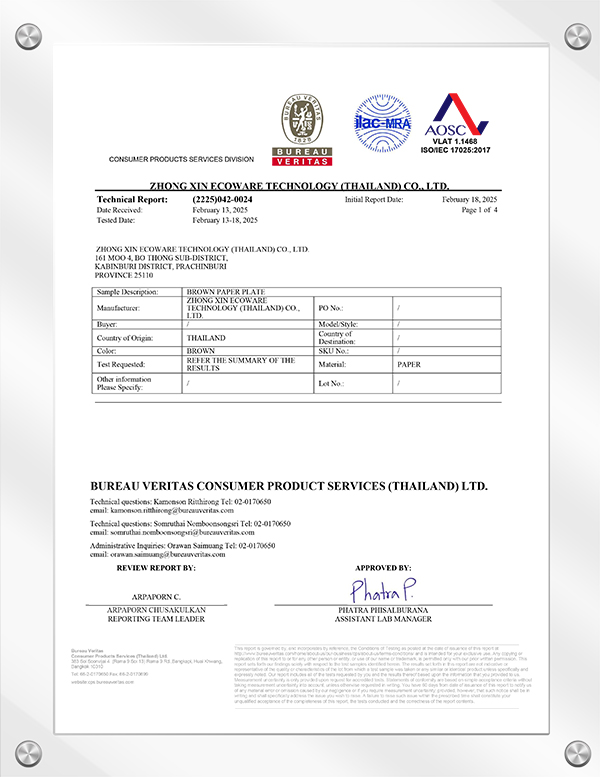
- Third-party laboratory reports
- Food-contact compliance certificates
2. Heavy Metal Content Must Not Exceed 100 mg/kg
The combined concentration of:
- Lead (Pb)
- Cadmium (Cd)
- Mercury (Hg)
- Hexavalent Chromium (Cr6+)
must remain below 100 mg/kg.
Although this requirement existed under previous legislation, PPWR significantly increases enforcement and market surveillance.
Buyer Action
Request a heavy metal test report issued within the last 12 months and verify it covers the actual manufacturing facility.
3. Declaration of Conformity (DoC) Must Be Available Within 10 Days
A Declaration of Conformity (DoC) is the official statement that packaging complies with PPWR requirements.
Key obligations include:
- Prepared according to PPWR Annex VII
- Available before market placement
- Provided within 10 calendar days when requested
- Retained for at least 5 years after the final market placement
- Available in the language required by the destination member state
Important Distinction
Under PPWR:
- Manufacturer = responsible for technical compliance, DoC, and technical documentation
- Producer = responsible for EPR registration and waste management fees
For many imports from China, the supplier acts as the manufacturer while the EU importer becomes the producer.
This explains why many European buyers are urgently requesting compliance documentation from suppliers.
4. Technical Documentation (TD) Is the Core Compliance Evidence
Technical Documentation supports the Declaration of Conformity and serves as the primary compliance evidence package.
A complete TD should include:
- Packaging description and intended use
- Material specifications
- Design and manufacturing drawings
- PFAS test reports
- Heavy metal test reports
- Food-contact safety reports
- Compostability certifications
- Risk assessments
- Applicable standards list
- Bill of Materials (BOM)
- Supplier declarations
- Certification documents such as:
-
- BPI
-
- OK Compost
-
- BRC
If a supplier cannot provide a complete TD package, buyers often face significant internal compliance costs or are forced to switch suppliers.

5. Recyclability Requirements Become Stricter by 2030
| Timeline | Requirement |
|---|---|
| August 12, 2026 | Compliance with EN 13430:2004 |
| January 1, 2030 | Packaging must achieve Recyclability Grade A, B, or C (minimum 70%) |
| January 1, 2038 | Only Grade A or B packaging can remain on the market |
According to the European Commission’s March 2026 guidance, packaging containing less than 5% plastic is exempt from several restrictions under Annex V.
Because sugarcane bagasse tableware contains 0% plastic, it avoids some of the most demanding plastic packaging obligations.
6. Recycled Plastic Content Requirements Apply Only to Plastic Packaging
Starting in 2030:
- Sensitive-contact plastic packaging must contain at least 10% PCR content
- The requirement increases to 25% by 2040
These obligations apply only to packaging containing 5% or more plastic.
What This Means for Buyers
Pure sugarcane bagasse products:
- 0% plastic
- No PCR tracking requirements
- No recycled plastic verification costs
By contrast, PLA-coated paper and PE-coated paper packaging require additional compliance management and documentation.
7. Packaging Minimization Rules Start in 2030
PPWR requires packaging weight and volume to be reduced to the minimum necessary for functionality.
Examples of restricted practices include:
- False bottoms
- Excessive double walls
- Unnecessary packaging volume
For e-commerce packaging, empty space ratios must remain below 50%.
Because molded fiber food containers are manufactured as a single-piece structure, they naturally align with packaging reduction objectives.

Sugarcane Bagasse vs. PLA vs. Plastic Packaging Under PPWR
| PPWR Requirement | Sugarcane Bagasse Tableware | PLA-Coated Paper | PE-Coated Paper | Plastic (PP/PET) |
|---|---|---|---|---|
| PFAS Compliance | Naturally PFAS-free | Coating verification required | Coating verification required | Potential PFAS concerns |
| Heavy Metals | Easy compliance | Usually compliant | Usually compliant | Additive risks |
| DoC & TD | Simple documentation | More complex | More complex | Complex plus PCR tracking |
| Recyclability | Expected A/B grades | Uncertain | Potential C/D grades | Polymer dependent |
| Plastic Restrictions | Exempt (0% plastic) | Possible exposure | Included | Fully included |
| PCR Requirements | Not applicable | Mandatory verification | Mandatory verification | Mandatory verification |
| Packaging Reduction | Naturally compliant | Added coating weight | Added coating weight | Often requires thicker walls |
For procurement teams, the compliance advantage of sugarcane bagasse packaging is structural rather than engineering-based.
Most requirements are satisfied through material selection rather than additional testing, redesign, or recycled-content management.
Why 2026 Is the Best Time to Shift Toward Sugarcane Bagasse Packaging
The Compliance Window Is Closing
European importers are already requesting PPWR documentation for shipments scheduled after August 2026.
Waiting until customers demand documentation may leave insufficient time to prepare.
Lower Compliance Costs
Compared with coated paper or plastic packaging, sugarcane bagasse packaging offers:
- Simpler DoC preparation
- Simpler Technical Documentation
- No PCR management
- No coating compliance verification
- Reduced recyclability assessment complexity

Supplier Qualification Lists Are Forming
Many EU buyers are actively building approved supplier lists based on PPWR readiness.
Suppliers capable of delivering complete compliance documentation are moving onto preferred vendor lists, while non-compliant suppliers are being removed.
Once procurement systems are updated, supplier replacement becomes significantly more difficult.
90-Day PPWR Action Plan for Packaging Buyers
Weeks 1–2: Audit Existing Packaging
- List all packaging SKUs exported to Europe
- Identify PFAS-containing products
- Identify coated paper and composite packaging
- Flag packaging containing 5% or more plastic
- Request DoC and TD documentation from suppliers
Weeks 3–4: Close Documentation Gaps
- Verify completeness of supplier documents
- Set deadlines for missing documentation
- Confirm PFAS-free claims with laboratory reports
- Review heavy metal test validity
Weeks 5–8: Replace High-Risk Packaging
- Transition away from PFAS-containing packaging
- Evaluate plastic-content thresholds
- Begin qualification testing for alternative packaging
Weeks 9–12: Final Compliance Verification
- Complete conformity assessments
- Archive final DoC and TD packages
- Confirm importer access to documentation
- Prepare for future recyclability and labeling deadlines

Frequently Asked Questions
Does PPWR Apply to Packaging Manufactured Outside the EU?
Yes.
PPWR regulates packaging placed on the EU market, regardless of where it is manufactured. Chinese, Southeast Asian, and other international suppliers must comply when exporting packaging into Europe.
Is There a Transition Period for PFAS Requirements?
No.
The European Commission’s March 2026 guidance explicitly confirms that there is no stock depletion period or grace period for PFAS restrictions.
What Happens If DoC or TD Cannot Be Provided Within 10 Days?
Potential consequences include:
- Customs detention
- Market withdrawal
- Product recalls
- Sales restrictions
- Regulatory penalties
In practice, many buyers simply move to alternative suppliers.
Does Sugarcane Bagasse Tableware Contain Plastic?
Pure sugarcane bagasse tableware contains 0% plastic and is made entirely from plant fiber.
As a result, it avoids many obligations associated with plastic packaging, including recycled-content requirements and certain plastic-specific restrictions.
How Does Dual Manufacturing in China and Thailand Help PPWR Compliance?
A dual-source supply chain helps buyers:
- Reduce tariff exposure
- Minimize geopolitical supply disruption risks
- Maintain sourcing flexibility
- Access consistent PPWR documentation across production locations
Final Thoughts
The enforcement of EU PPWR 2026 marks the most significant packaging compliance shift in Europe in decades.
For food packaging buyers, the challenge is no longer simply finding sustainable packaging—it is finding packaging that can pass compliance audits quickly and cost-effectively.
Because sugarcane bagasse food containers are naturally PFAS-free, plastic-free, and supported by straightforward documentation requirements, they have become one of the lowest-risk packaging solutions for companies preparing for the new PPWR era.
FAQ
When does the EU PPWR apply to food packaging?
The EU Packaging and Packaging Waste Regulation (PPWR) entered into force in February 2025, with staged requirements. PFAS restrictions in food-contact packaging apply from August 12, 2026.
Does PPWR ban all PFAS in food packaging?
No. PPWR sets PFAS concentration limits for food-contact packaging: 25 ppb for aqueous food contact, 250 ppb for fatty food contact and 50 ppm for total fluorine, measured on the material in dry state.
What documents must suppliers provide under PPWR?
Buyers should request a Declaration of Conformity (DoC) within 10 days, technical documentation covering materials and test reports, and heavy metal content evidence below 100 mg/kg.
Are bagasse food containers affected by PPWR recyclability rules?
PPWR requires recyclability assessment for packaging placed on the EU market. Fiber-based packaging such as bagasse tableware should be assessed against the applicable criteria and documented accordingly.
Get a Quote from Zhong Xin Ecoware
Zhong Xin Ecoware Technology (Thailand) Co., Ltd. supplies bagasse and molded fiber food packaging to importers, distributors and foodservice brands. For MOQ, pricing, samples and lead time, contact the sales team through the contact page.
Related resources: Certifications | Dual-source supply | OEM/ODM guide
Zhong Xin Ecoware Technology (Thailand) Co., Ltd. supplies bagasse and molded fiber food packaging to importers, distributors and foodservice brands. For MOQ, pricing, samples and lead time, email info@fiber-product.com or use the contact form.



Zhong Xin Ecoware(Thailand) was registered on November 1, 2023, and officially began construction of the factory building in June 2024. At present, the first phase workshop of the factory has been fully completed and put into use. The second phase of the factory is being constructed intensively.
The landing and development of Zhong Xin in Thailand has brought a large amount of initial investment for land, factories, etc., and continuous operational investment for continuous equipment updates, technological upgrades, and capacity expansion.
Zhong Xin Ecoware(Thailand) has directly and indirectly created thousands of job opportunities, increased government revenue, promoted local economic development, cultivated local supply chains, provided systematic training for employees, improved the quality of local human capital, injected vitality into the local economy, enhanced industrial competitiveness, and ultimately improved residents' living standards.
Zhong Xin Ecoware(Thailand) actively collaborates with local pulp mills to explore new cooperation models for developing new products, improving production capacity and quality. At the same time, relying on Zhongxin's advanced production technology, process flow, management experience, and quality control system, it promotes the development of this industry in Thailand.

-
-
 +66-31240888
 -
 161 Village No. 4, Bo Thong Subdistrict Kabin Buri District Prachinburi Province 25110
-
New Bagasse Tableware Lineup for 2026: What Is New and Where to See It
Sep 28,2026
-
How to Select Bagasse Clamshells for Burgers, Rice Meals and Fried Food
Sep 28,2026
-
Microwave Reheating: Is a Bagasse Lunch Box Suitable
Sep 25,2026
-
9 Inch Pizza Plates and Bagasse Pizza Boards: A Sourcing Guide for US and Canadian Distributors
Sep 19,2026
-
PFAS-Free & Compostability Verification: A Buyer's Checklist for Bagasse and Molded Fiber Packaging
Sep 19,2026
-
Bagasse vs PLA vs Molded Fiber: What Distributors Should Stock in 2026
Sep 19,2026
-
Can Sugarcane Plates Handle Hot, Greasy Foods
Sep 18,2026
-
Bagasse Tableware RFQ Template: Get a Comparable Thailand Factory Quote
Sep 14,2026
-
Are Takeaway Food Containers Ready for Saucy Meals
Sep 11,2026
-
7-Inch vs 9-Inch Bagasse Plates: Carton and 20GP Guide
Sep 07,2026
-
Will Bagasse Pulp Trays Sag Under Heavy Meals
Sep 04,2026
-
Zhongxin Packaging at the 140th Canton Fair 2026: Booths and Buyer Meeting Guide
Sep 02,2026
Copyright © 2025 Zhong Xin Ecoware Technology ( Thailand ) CO., LTD.
All Rights Reserved.

Biodegradable Disposable Bagasse Tableware Manufacturer