-
 [email protected]
-
 +66-31240888



 English
 Español
 ไทย
ไทย7-Inch vs 9-Inch Bagasse Plates: Carton and 20GP Guide
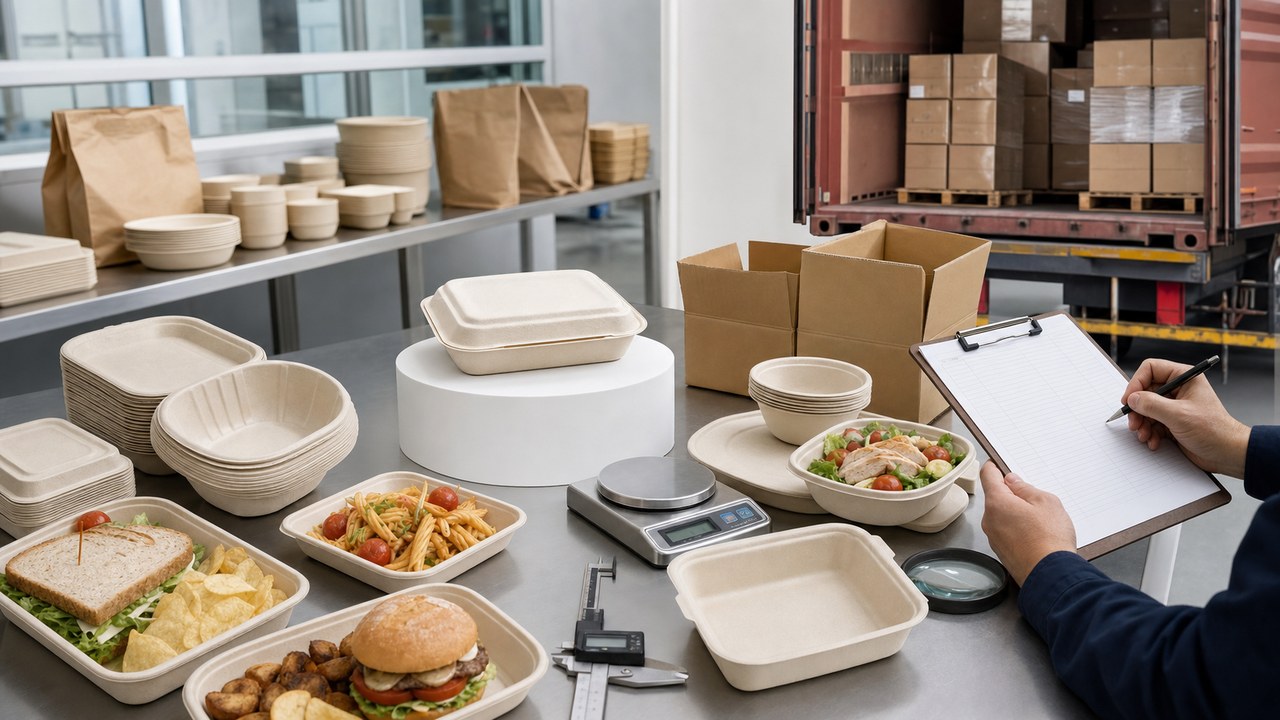 Choosing between 7-inch and 9-inch bagasse plates involves more than comparing diameter. Buyers should also check the model, plate depth, unit weight, case pack, carton dimensions and intended food portion. This guide compares Zhongxin's YPL070 and YP090 reference specifications and explains how those differences affect sampling, quotation and container planning.
What is the difference between a 7-inch and a 9-inch bagasse plate?
A 7-inch bagasse plate is normally the starting size for desserts, side dishes, tastings and smaller portions, while a 9-inch bagasse plate provides more area for main meals. The correct choice depends on the actual food portion, food weight, sauce level, rim design and stacking requirement, so buyers should test production samples with their own menu.
The two Zhongxin reference models below are not the same plate scaled up. YPL070 has a rippled edge and a listed depth of 15 mm; YP090 is a standard round plate with a listed depth of 19.6 mm. A quotation should therefore identify the model code as well as the nominal diameter.
| Comparison item | YPL070 7-inch rippled-edge plate | YP090 9-inch round plate |
|---|---|---|
| Published product diameter and depth | Ø182 × 15 mm | Ø225 × 19.6 mm |
| Published unit weight | 9 g | 15 g |
| Published inner pack | 125 pieces | 125 pieces |
| Published packs per carton | 8 | 4 |
| Published pieces per carton | 1,000 | 500 |
| Published carton size | 36 × 29.5 × 36 cm | 32 × 23.5 × 46 cm |
| Calculated external carton volume | 0.038232 m³ | 0.034592 m³ |
| Typical starting use, subject to food testing | Dessert, side dish, snack or tasting portion | Main dish, catering meal or larger serving |
Sources: Zhongxin's published specifications for the YPL070 7-inch rippled-edge plate and YP090 9-inch round plate. Product availability, packing and Thailand production status must be confirmed in the quotation for the exact order.
Which plate uses less shipping volume per piece?
The YPL070 7-inch plate uses less calculated carton volume per piece because its published carton contains twice as many units. Dividing carton volume by case quantity gives approximately 0.000038232 m³ per YPL070 plate and 0.000069184 m³ per YP090 plate.
This calculation compares external carton volume, not freight price. A freight quote may also depend on route, chargeable volume, container utilization, pallets, protective material, handling fees and the Incoterms rule named in the sales contract. Buyers comparing FOB, CIF or DDP offers should use the same product model, packing specification and delivery point; the bagasse packaging cost and Incoterms guide explains those quotation differences.
How much space do 100,000 plates require?
Using the published case packs, 100,000 YPL070 plates require 100 cartons, while 100,000 YP090 plates require 200 cartons. The calculation is straightforward:
| Order line | Quantity | Pieces per carton | Cartons | Carton volume | Calculated carton-volume total |
|---|---|---|---|---|---|
| YPL070 7-inch plate | 100,000 | 1,000 | 100 | 0.038232 m³ | 3.8232 m³ |
| YP090 9-inch plate | 100,000 | 500 | 200 | 0.034592 m³ | 6.9184 m³ |
| Mixed order total | 200,000 | — | 300 | — | 10.7416 m³ |
The net product mass calculated from the published unit weights is 900 kg for 100,000 YPL070 plates and 1,500 kg for 100,000 YP090 plates. The combined 2,400 kg is not the shipment gross weight because cartons, bags, labels, pallets and protective material have not been included. Freight booking should use the final packing list and verified gross weight.
Will 100,000 pieces of each size fit in one 20GP container?
The mixed example occupies 10.7416 m³ when the two published external carton volumes are simply added. Hapag-Lloyd lists one example of a 20-foot standard container at 5,900 × 2,352 × 2,395 mm internally with 33.2 m³ capacity, while warning that specifications vary by container manufacturer. On volume alone, the 100,000-plus-100,000 example is below that nominal capacity.
That comparison does not prove the final load quantity. Cartons cannot fill every part of a corrugated container interior, and the usable result changes with carton orientation, door clearance, pallets, bracing, moisture protection and the exact equipment supplied by the carrier. The factory or forwarder should issue a carton-by-carton loading plan before booking.
Buyers can verify the carrier reference on Hapag-Lloyd's official 20-foot standard container specification. For a broader method, use Zhongxin Thailand's guide on verifying carton strength and container loading.
What should a plate RFQ include?
A useful bagasse plate RFQ names the SKU, dimensions, unit weight, pack count, carton size, quantity, destination and required documents. Writing only “7-inch and 9-inch plates” leaves the supplier to guess the shape, depth, rim and packing format.
Use this RFQ checklist for each line item:
- Product code and product name, such as YPL070 or YP090.
- Diameter, depth and acceptable dimensional tolerance.
- Target unit weight and acceptable weight tolerance.
- White or natural color, plus any coating, printing or embossing request.
- Pieces per bag, bags per carton and pieces per carton.
- Confirmed external carton dimensions, net weight and gross weight.
- First-order quantity and estimated annual quantity for each SKU.
- Destination country, delivery location and requested Incoterms rule.
- Required food-contact, PFAS-related or compostability documents for the exact SKU and market.
- Sample quantity, test plan, desired shipment date and mixed-load requirement.
Zhongxin Thailand's bagasse factory ordering guide covers MOQ, samples, production timeline, AQL and payment terms in more detail.
What should buyers test before approving 7-inch or 9-inch plates?
Buyers should test the actual menu and distribution conditions rather than approve a plate by diameter alone. A sample test should record portion weight, food temperature, oil or sauce exposure time, rim deflection, bottom sag, stacking stability and any leakage or surface change.
For transport packaging, test the complete packaged product, not an empty carton. The International Safe Transit Association describes its 1-Series as screening tests and its 3-Series as general simulations of transport hazards; test selection should match the distribution environment. Buyers can review the official ISTA test-procedure categories and agree the appropriate protocol with a qualified laboratory or packaging engineer.
Which documents should be checked for the exact plate model?
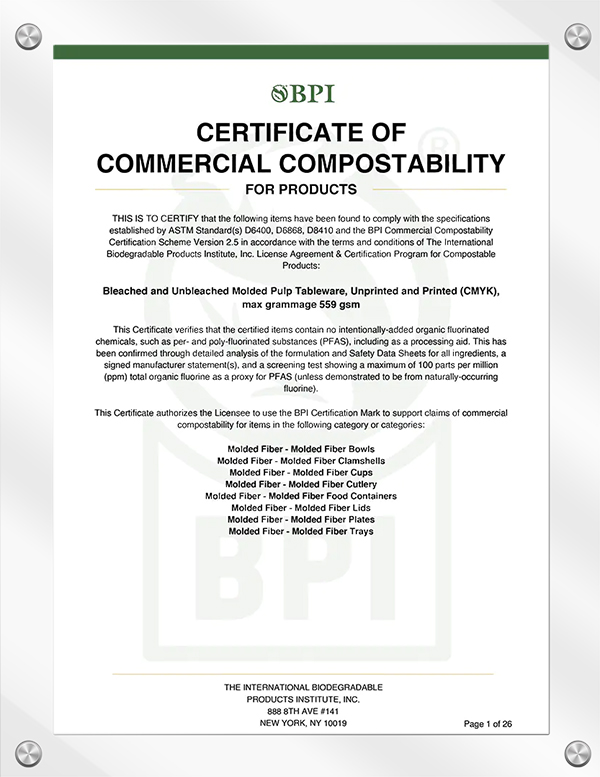
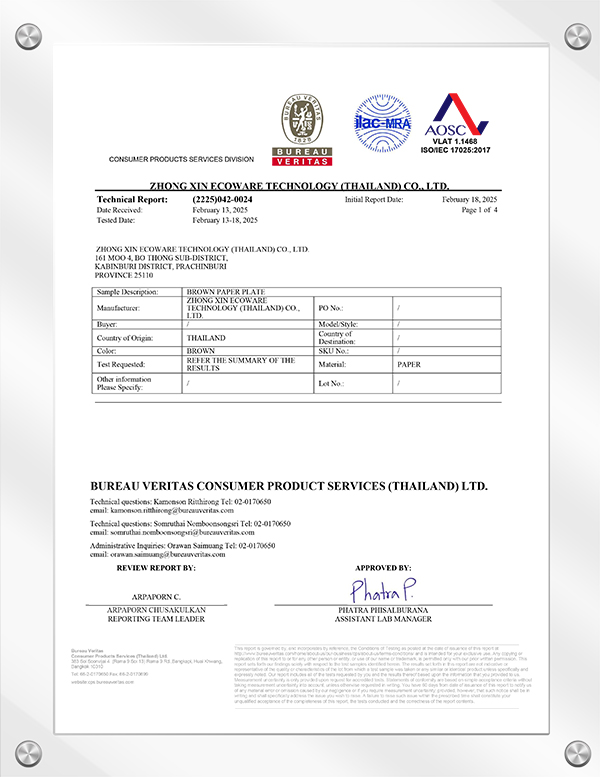
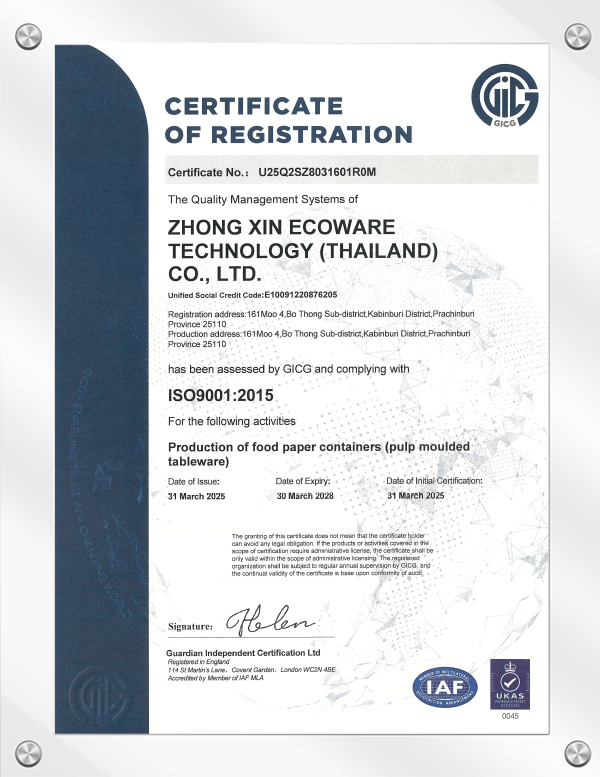
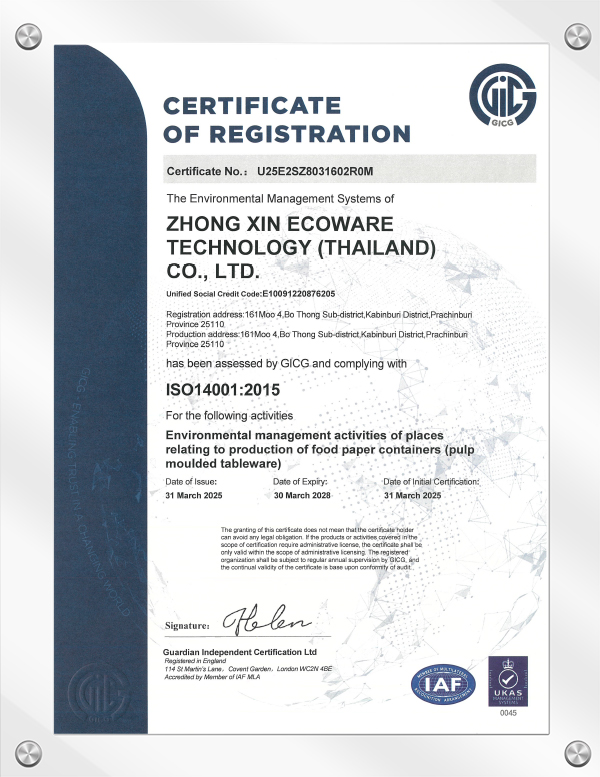
Certificate names on a supplier profile do not prove that every plate model, material, color, coating or factory is covered. The buyer should request the current document, verify the certificate holder and validity, and confirm that the ordered SKU and destination-market claim fall within scope.
Food-contact compliance, PFAS-related evidence and compostability support are separate checks. Use the bagasse packaging certification guide by market to build the document request, then match every document to the model listed in the purchase order.
Frequently asked questions about 7-inch and 9-inch bagasse plates
Is every 7-inch bagasse plate packed 1,000 pieces per carton?
No. The 1,000-piece case pack in this guide belongs to the published YPL070 specification. Another 7-inch mold, rim style, weight, retail pack or private-label format may use a different case quantity and carton size.
Is every 9-inch bagasse plate packed 500 pieces per carton?
No. The 500-piece case pack belongs to the published YP090 specification. Deep plates and compartment plates can have different weights, nesting efficiency and carton dimensions even when their nominal diameter is 9 inches.
Can 7-inch and 9-inch plates be combined in one order?
A mixed-SKU shipment may be possible, but the supplier must confirm MOQ by model, production scheduling, case packs, carton marks and final container utilization. Ask for a line-by-line quotation and a consolidated packing list.
How many 7-inch or 9-inch plates fit in a 20GP container?
There is no reliable universal count. Start with confirmed pieces per carton and external carton dimensions, then build a physical loading plan using the actual container dimensions, carton orientation, pallets or floor loading, bracing and gross weight. Do not estimate the purchase order by dividing 33.2 m³ by a carton volume and treating the result as guaranteed.
Should a buyer approve the lower-cost plate without a food test?
No. Unit price does not show whether the plate fits the meal, remains stable for the required holding time or survives distribution. Compare samples against the same written test conditions before approving a bulk order.
Request a model-specific quotation from the Thailand team
Review the current biodegradable plate range, then send Zhong Xin Ecoware Technology (Thailand) the model codes, order quantity by SKU, destination, packing preference and document requirements. The Thailand team can confirm product availability, samples, MOQ, production timeline, final carton data and the commercial quotation through the quotation contact form.
Editorial and calculation notes
- Product figures are taken from Zhongxin's published YPL070 and YP090 product pages accessed in September 2026.
- Carton volume equals published external carton length × width × height after conversion from centimetres to metres.
- The worked example assumes 100,000 pieces of each named model and the published case packs. It is not a freight booking, production commitment or guaranteed loading plan.
- Hapag-Lloyd states that container specifications can vary by manufacturer; final equipment data must be checked with the carrier or forwarder.


Zhong Xin Ecoware(Thailand) was registered on November 1, 2023, and officially began construction of the factory building in June 2024. At present, the first phase workshop of the factory has been fully completed and put into use. The second phase of the factory is being constructed intensively.
The landing and development of Zhong Xin in Thailand has brought a large amount of initial investment for land, factories, etc., and continuous operational investment for continuous equipment updates, technological upgrades, and capacity expansion.
Zhong Xin Ecoware(Thailand) has directly and indirectly created thousands of job opportunities, increased government revenue, promoted local economic development, cultivated local supply chains, provided systematic training for employees, improved the quality of local human capital, injected vitality into the local economy, enhanced industrial competitiveness, and ultimately improved residents' living standards.
Zhong Xin Ecoware(Thailand) actively collaborates with local pulp mills to explore new cooperation models for developing new products, improving production capacity and quality. At the same time, relying on Zhongxin's advanced production technology, process flow, management experience, and quality control system, it promotes the development of this industry in Thailand.

-
-
 +66-31240888
 -
 161 Village No. 4, Bo Thong Subdistrict Kabin Buri District Prachinburi Province 25110
-
Can Paper Packaging Meet Retail Shelf and Branding Requirements
Oct 23,2026
-
Bagasse Cups and Cup Lids: A Sourcing Guide for Foodservice and Takeaway Buyers
Oct 20,2026
-
How to Find Zhong Xin at the 140th Canton Fair: A Visitor Navigation Guide
Oct 16,2026
-
Thailand vs China Bagasse Tableware: 8 Comparisons Buyers Should Verify
Oct 16,2026
-
Will Takeout Containers Fit Your Existing Lids and Delivery Workflow
Oct 16,2026
-
What Is Bagasse Tableware? A 2026 Buyer Guide to Material, Performance and Documents
Oct 13,2026
-
Bagasse Tray Wholesale: How Bulk Buyers Cut Cost with Carton and Container Planning
Oct 09,2026
-
What Should a Bagasse Manufacturer Include in a Bulk Order Quote
Oct 09,2026
-
FOB, CIF or DDP? Incoterms for Bagasse Tableware Buyers Shipping from Thailand
Oct 06,2026
-
Packaging or Food Contact? Which EU Regime Applies to Bagasse Cups, Bowls, Plates and Cutlery
Oct 06,2026
-
Compostable Cutlery Sets for Private Label: 7 Sourcing Checks for Retail and Foodservice Buyers
Oct 06,2026
-
US vs EU Bagasse Tableware Imports: 8 Documentation and Compliance Checks Buyers Should Run
Oct 06,2026
Copyright © 2025 Zhong Xin Ecoware Technology ( Thailand ) CO., LTD.
All Rights Reserved.

Biodegradable Disposable Bagasse Tableware Manufacturer