-
 [email protected]
-
 +66-31240888



 English
 Español
 ไทย
ไทยBagasse Packaging Certifications by Market: A 2026 Compliance Guide for Importers
A bagasse food container does not have one universal certificate. A usable compliance file must match the destination market, the exact SKU or certified product family, the material and color, any coating or printing, the manufacturing site, the intended food, and the time and temperature of contact. Food-contact compliance, compostability certification, PFAS testing and factory-system certification answer different questions.
The most important 2026 change is in the European Union. From 12 August 2026, the EU Packaging and Packaging Waste Regulation applies three PFAS concentration limits to food-contact packaging. U.S. and Canadian buyers face a different evidence structure, while Australia, Japan, China and the United Kingdom each require their own market review.
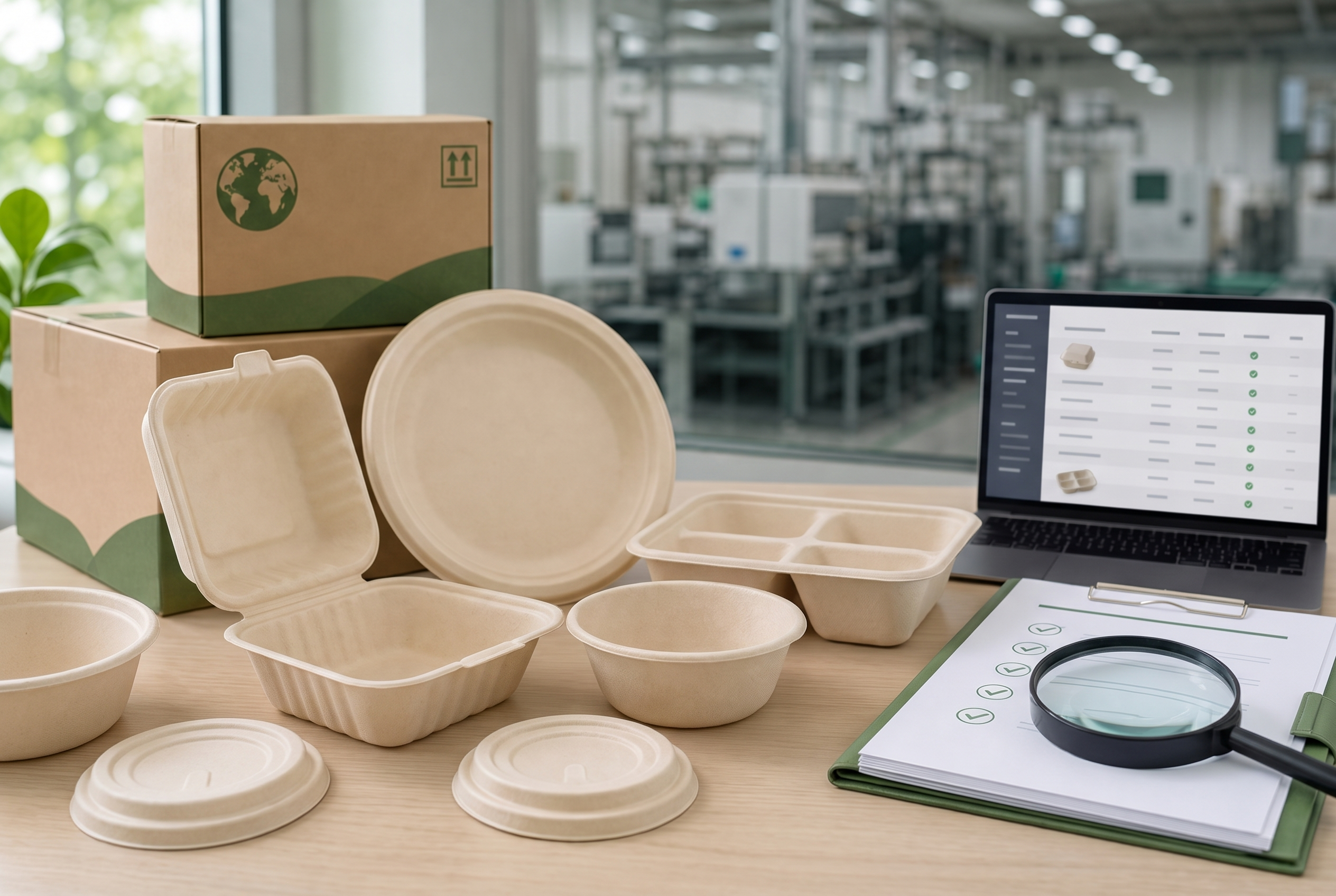
Which bagasse packaging documents should buyers request in each market?
The table below is a purchasing map, not a substitute for advice on a specific product. A coated bowl, an uncoated plate and a printed retail pack may have different requirements even when all three use sugarcane fiber.
| Destination | Food-contact evidence to map | Compostability evidence | 2026 issue to check |
|---|---|---|---|
| United States | Identify the FDA regulatory basis for every relevant component and intended use. An effective Food Contact Notification is specific to the named manufacturer or supplier, use and limitations. | Confirm the exact item or SKU in the BPI catalog. A normal BPI listing supports commercial compostability; home compostability requires the separate home indication. | State PFAS rules differ. Washington and Maine are examples of states with plant-fiber food-packaging requirements. |
| European Union | Apply Regulation (EC) No 1935/2004 and food-contact GMP. Apply Regulation (EU) No 10/2011 to plastic materials or plastic layers, not automatically to plain molded fiber. Check national paper and board rules where relevant. | Use EN 13432-based certification for an industrial-compostability claim where required by the buyer or claim scheme. Treat food safety and compostability as separate approvals. | PPWR PFAS limits have applied since 12 August 2026. The test file must address the regulation’s three thresholds. |
| Great Britain | Check the assimilated food-contact framework and any plastic-layer requirements. Review Northern Ireland separately because applicable EU rules may differ from Great Britain. | Define the exact environmental claim and verify the issuing body’s scope. | Do not assume every bagasse item is outside Plastic Packaging Tax; determine whether the component is predominantly plastic by weight. |
| Canada | Demonstrate compliance with Food and Drug Regulations section B.23.001 for the intended use. A Health Canada letter of no objection may support review but premarket assessment is generally voluntary. | BPI may support a compostability claim, but local claim and collection requirements still need review. | CFIA does not pre-approve every food package. Do not ask for a generic “CFIA certificate.” |
| Australia and New Zealand | Under FSANZ Standard 3.2.2, packaging must be fit for its intended purpose and unlikely to contaminate food. Match testing to food type, temperature and use. | AS 4736 supports commercial composting; AS 5810 supports home composting under the Australasian Bioplastics Association scheme. | Industrial and home compostability are separate scopes. |
| Japan | Check the Food Sanitation Act specifications and the complete bill of materials. Japan’s positive-list system applies to synthetic resins, including relevant coatings or layers. | Use only the claim and standard accepted for the intended Japanese channel; do not apply a single JIS number as a universal rule for all fiber products. | The synthetic-resin positive-list transition ended on 31 May 2025. |
| China | For molded-pulp food-contact articles, map GB 4806.8-2022 and the applicable general, additive, coating, plastic or composite standards. | Compostability evidence is separate from food-contact compliance and depends on the claim and procurement specification. | An SGS test report is evidence from a laboratory, not a replacement for the applicable GB standard. |
Official references for the table include the FDA Food Contact Substance inventory, BPI certified-product guidance, European Commission food-contact legislation, Health Canada packaging guidance, Food Standards Australia New Zealand, the Japanese positive-list page, and China’s national food-safety standards directory.
What changed for PFAS in EU food-contact packaging in August 2026?
The EU Packaging and Packaging Waste Regulation, Regulation (EU) 2025/40, sets three PFAS limits for food-contact packaging placed on the EU market from 12 August 2026:
- 25 ppb for any PFAS measured by targeted PFAS analysis, with polymeric PFAS excluded from that quantification;
- 250 ppb for the sum of PFAS measured by targeted analysis, where applicable after degradation of precursors, with polymeric PFAS excluded; and
- 50 ppm for PFAS including polymeric PFAS.
These figures come from Article 5(5) of the PPWR. The European Commission’s June 2026 PPWR guidance states that there is no harmonised EU test method for PFAS in food-contact packaging and recommends a stepwise enforcement approach. The first step measures total fluorine; if total fluorine is below 50 mg/kg, the guidance says the sample may be considered compliant at that step. Higher results require further analysis to distinguish organic fluorine and assess the targeted thresholds.
A supplier statement that says only “PFAS-free” is therefore not enough for an EU purchase decision. The buyer should request the tested SKU or specimen description, material and coating, sampling date, laboratory, test methods, reporting limits and numerical results. A total-fluorine screen and a targeted PFAS analysis are related pieces of evidence, not interchangeable labels.
For a broader explanation of available documents, see the Zhong Xin Ecoware Thailand certification and document center.
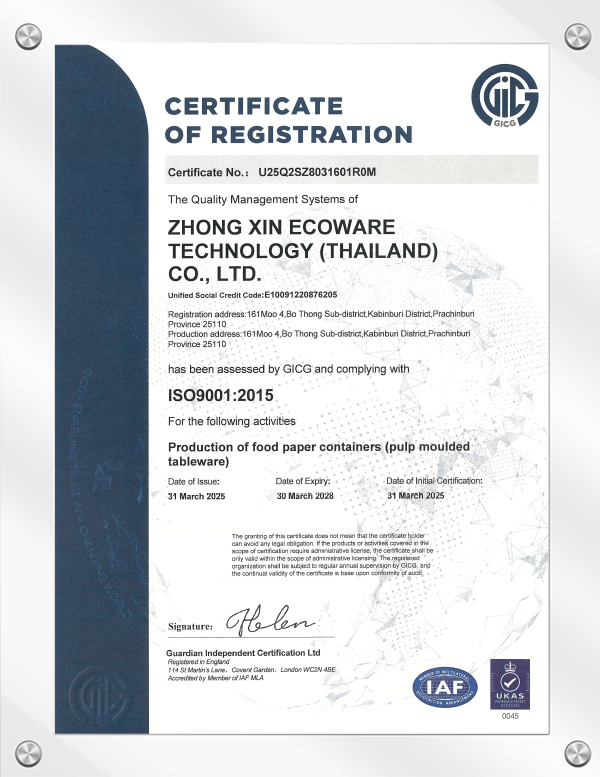
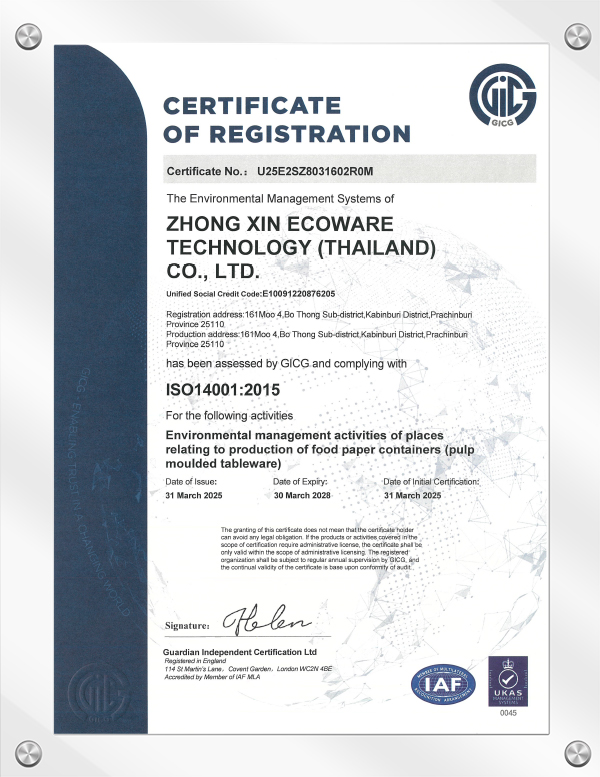
Examples of certification and compliance documents shown on the company website
The images below are document examples currently displayed on the Zhong Xin Ecoware Thailand Honour page. They are not a substitute for registry verification. Before approval, buyers should confirm the issuing body, certificate or report number, legal entity, manufacturing site, validity date, standard, product family and exact SKU coverage.
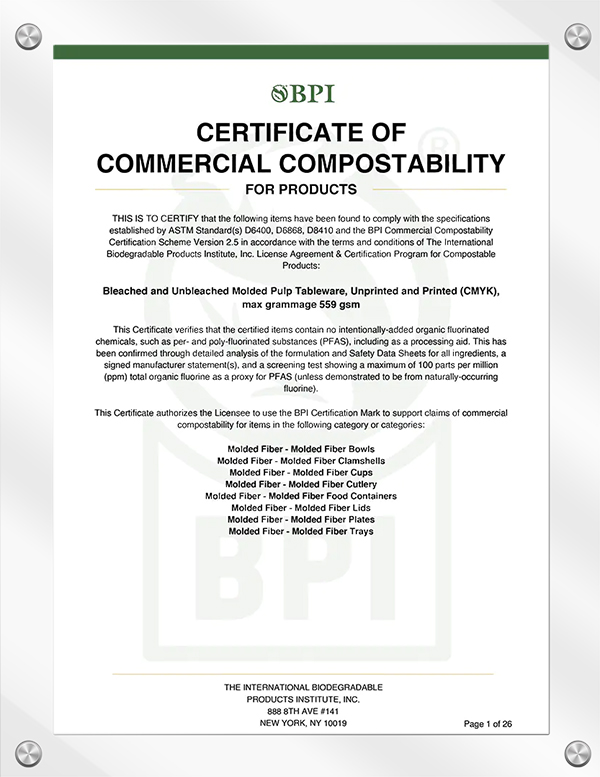
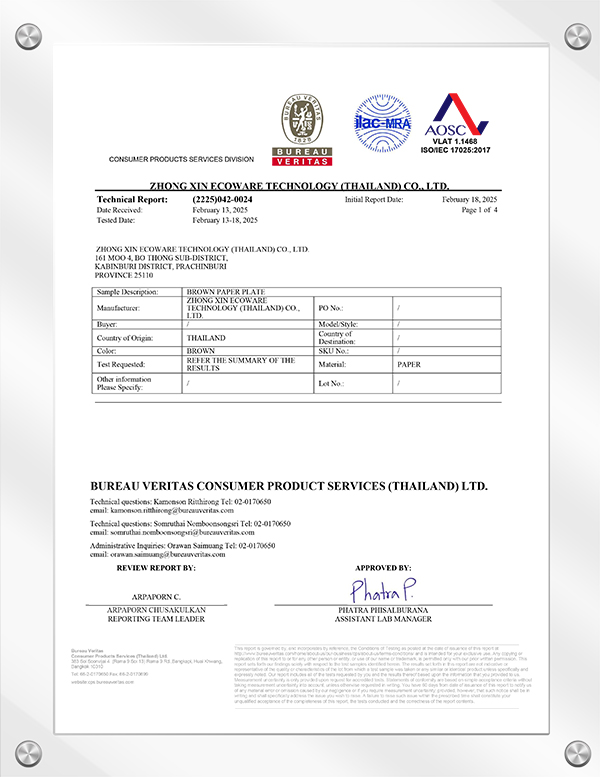
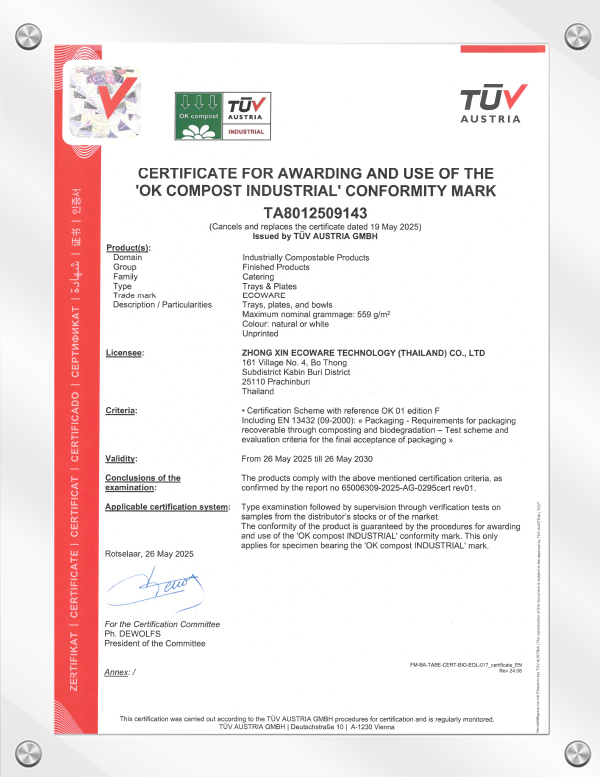
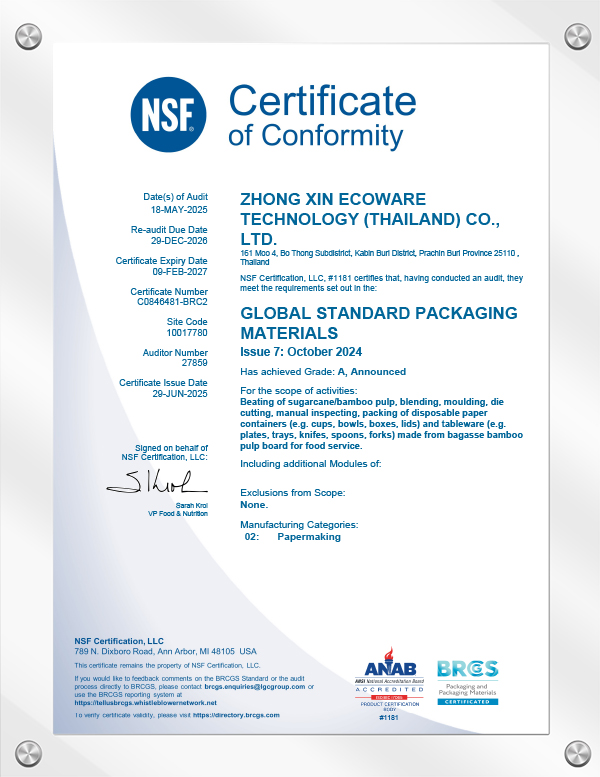
Does “FDA compliant” mean that a bagasse container is FDA-certified?
No. FDA regulates food-contact substances and their intended uses; it does not provide a universal finished-product certificate called “FDA certification” for every bagasse tray or clamshell. The FDA explains that a Food Contact Substance is a component used in a food-contact material, while the finished tray or container is a food-contact article. An effective Food Contact Notification is limited to the named manufacturer or supplier and the stated conditions of use.
A U.S. buyer should ask the supplier to identify the legal basis for the pulp, processing aids, grease or water barrier, colorants, coatings, adhesives and inks that are relevant to the ordered construction. The file should also state the food type and conditions of use. The official starting points are the FDA’s packaging and food-contact substances page and inventory of effective Food Contact Substance Notifications.
The correct purchasing question is not “Do you have FDA?” It is: “What is the FDA compliance basis for this exact construction under our intended food and temperature conditions?”
Does BPI certification prove food-contact safety?
No. BPI certification addresses compostability, not food-contact safety. BPI uses ASTM D6400 as the base standard for its commercial-compostability program and can use ASTM D6868 or D8410 for eligible items. The separate food-contact file still has to support the product’s intended use.
The BPI product catalog lists certified items down to the item number. Only products with the home-compostability indication have the additional home scope. A company name in the catalog does not mean every product made by that company is certified.
This SKU-level rule can be checked directly for Zhong Xin Thailand. The official BPI company listing for Zhong Xin Ecoware Technology (Thailand) Co., Ltd. contains itemised product records, including product names, SKUs, colors and other listed attributes. Buyers should match the ordered code and construction against that catalog entry rather than relying on a certificate screenshot.
The FTC also requires compostable marketing claims to be backed by competent and reliable scientific evidence. Its Green Guides summary says a compostable claim should be qualified if the item cannot be composted at home or if suitable municipal or institutional facilities are not available to a substantial majority of consumers.
What is the difference between biodegradable, industrially compostable and home compostable?
“Biodegradable” does not define one disposal environment, time limit or pass/fail test. “Industrially compostable” refers to controlled commercial conditions. “Home compostable” refers to lower and more variable conditions in a managed home compost system. A product certified for industrial composting should not be marketed as home compostable unless the home scope is also present.
The distinction is visible across certification systems. BPI separates commercial-only from commercial-and-home certification. In Australia, the Australasian Bioplastics Association uses AS 4736 for commercial composting and AS 5810 for home composting. TÜV Austria also treats OK compost INDUSTRIAL and OK compost HOME as separate certification scopes.
For more detail on claim terminology, read Is Bagasse Compostable? A Complete Guide to Sugarcane Tableware Composting and BPI, FDA, LFGB and EN 13432 Explained for Buyers.
Which five document types do packaging buyers most often confuse?
| Document type | What it can support | What it does not prove by itself |
|---|---|---|
| Food-contact declaration or regulatory assessment | Suitability of the stated construction for specified foods and conditions of use | Compostability, factory quality systems or every unlisted formulation |
| Compostability certificate | Conformity of listed products or product families to the stated commercial or home-compostability scheme | Food-contact safety or compliance with every market’s PFAS law |
| PFAS laboratory report | Results for the tested specimen, method, reporting limits and date | Every SKU, future production or a different coating/formulation |
| BRCGS or ISO certificate | The named site’s audited management-system scope and validity | Product-level food-contact or compostability approval |
| FSC chain-of-custody certificate | Traceability controls for certified forest-based material within the stated scope | Food-contact safety, compostability or PFAS compliance |
Raw-material evidence and finished-product evidence must also be separated. A pulp, coating or resin certificate does not automatically cover the finished bowl after forming, additives, printing and packing. The finished article may require its own assessment, and the certificate scheme may allow only the products shown on an approved worksheet or registry.
What are the five most common certificate failures in bagasse packaging procurement?
1. The document cannot be verified
A scan without a certificate number, issuing body, legal entity, site, scope and validity date is not enough for approval. Search the official registry or ask the issuing body to confirm the record.
2. The supplier is listed, but the ordered SKU is not
Company-level presence is a screening signal. Product certification may be limited by item number, shape, grammage, color, coating, printing or brand. Match all available fields to the purchase specification.
3. A raw-material certificate is presented as a finished-product certificate
The finished bagasse article may contain processing aids, barrier chemistry, ink, adhesive or a laminated lid. Each relevant component and the final construction need an evidence path.
4. “FDA” is used as a logo instead of a regulatory explanation
A credible U.S. file identifies the applicable regulation, notification or other legal basis, the supplier where required, and the food type and conditions of use. A one-page “FDA certificate” with no regulatory basis should be treated as an unanswered question.
5. “PFAS-free” has no method or result
A useful PFAS report identifies the sample, laboratory, date, method, reporting limits and numerical result. For the EU, buyers must review the report against all relevant PPWR thresholds rather than accepting a binary marketing phrase.
How can an importer verify a supplier’s compliance pack before discussing price?
Use the same sequence for every supplier:
- Freeze the product specification: SKU, dimensions, unit weight, color, coating, printing, pack format and manufacturing site.
- Record the destination, intended food, contact time, temperature, heating or freezing conditions and environmental claims.
- Build a document matrix with one row for each legal requirement, certification or customer specification.
- Request complete documents, including certificate numbers, report pages, scope, issue and expiry dates, and the tested sample description.
- Search official registries. For BPI, search the item number in the BPI catalog. For factory-system records, use the issuing scheme’s official directory.
- Mark each record as matched, partially matched, expired, unverified or not applicable. Do not convert a gap into an assumption.
- Put the approved construction and required documents into the purchase order and quality agreement. Require notice before any pulp, additive, coating, ink, factory or process change.
The official-registry verification guide provides a related checklist. After compliance scope is fixed, use the bagasse packaging cost and MOQ guide to compare quotations on the same specification and Incoterm.
What should a compliance section in a bagasse packaging RFQ contain?
A quote-ready RFQ should contain these fields:
| RFQ field | Information to provide or request |
|---|---|
| Destination | Country, state or province, sales channel and customer program |
| Product identity | Supplier SKU, buyer SKU, drawing revision, dimensions and unit weight |
| Construction | Fiber source, bleached or natural color, additives, coating, lamination, ink and adhesive |
| Intended use | Food type, contact time, hot fill, microwave, oven, freezer and storage conditions |
| Claims | Food-contact suitable, commercially compostable, home compostable, PFAS statement or other claim |
| Required documents | Regulatory declaration, test report, certificate, official registry record and customer-specific form |
| PFAS evidence | Tested sample, method, analyte list, reporting limits, numerical results, laboratory and report date |
| Manufacturing scope | Legal entity, factory address, production line where relevant and change-control commitment |
Buyers can review available sizes and packing data in the Zhong Xin Thailand bagasse product catalog and then follow the MOQ, samples, lead-time and AQL ordering guide. The Thailand factory page provides the manufacturing location and contact route.
Frequently asked questions about bagasse packaging certificates
Can one certificate cover every bagasse SKU from a factory?
Not automatically. Some schemes allow defined product families, but the certificate, approved worksheet or registry controls the scope. Match the ordered SKU, material, color, coating, printing and manufacturing entity to the listed record.
Is a test report the same as a certificate?
No. A laboratory report records results for tested samples under named methods. A certificate states that a certification body has evaluated a defined scope against its scheme. Buyers may need both.
Does BPI certification mean a bagasse item is home compostable?
Only if the BPI catalog marks the item for home compostability. A standard BPI commercial listing supports commercial compostability, not automatic home compostability.
Is EU 10/2011 the main rule for every bagasse plate?
No. Regulation (EU) No 10/2011 is specific to plastic materials and plastic layers. Regulation (EC) No 1935/2004 supplies the general EU food-contact framework. Plain fiber, coatings, laminates and national paper rules must be mapped according to the actual construction and destination.
What should an EU PFAS report show after 12 August 2026?
The file should identify the sample and construction, test date, laboratory, methods, reporting limits and numerical results relevant to the PPWR thresholds. A report that measures only total fluorine should not be described as a targeted PFAS analysis.
What should a Canadian buyer ask for instead of a “CFIA certificate”?
Ask for the compliance basis under section B.23.001 for the intended use, supporting migration or chemical-safety information, and any applicable Health Canada letter of no objection. Health Canada states that its packaging premarket assessment is generally voluntary and that CFIA no longer pre-registers packaging materials.
The purchasing rule: verify scope before comparing price
The lowest unit price is not comparable when the compliance scope is different. One quote may cover an uncoated stock SKU with a current registry listing; another may include a coated private-label product, new testing and destination-specific documents. Normalize the product specification, compliance pack, carton loading and Incoterm before selecting the supplier.
Zhong Xin Ecoware Technology (Thailand) Co., Ltd. appears in the official BPI catalog with itemised product records. Buyers can request the document pack available for a proposed SKU and check whether each record matches the order. Send the destination market, intended food and temperature, required claim, SKU list, quantity and packaging format through the Zhong Xin Thailand website before requesting a final quotation.
Official sources
- U.S. FDA: Packaging & Food Contact Substances
- U.S. FDA: Inventory of Effective Food Contact Substance Notifications
- U.S. FTC: Environmental Claims and Compostable Claims
- BPI: Compostability Certification
- BPI: Find Certified Products
- EU: Regulation (EC) No 1935/2004 and food-contact legislation
- EU: Regulation (EU) No 10/2011 on plastic food-contact materials
- EU: Regulation (EU) 2025/40 on packaging and packaging waste
- European Commission: 2026 PPWR guidance
- UK Food Standards Agency: Food-contact framework guidance
- GOV.UK: Scope of Plastic Packaging Tax
- Health Canada: Packaging Materials
- Food Standards Australia New Zealand: Food Packaging
- Australasian Bioplastics Association
- Consumer Affairs Agency of Japan: Food-contact Positive List
- China National Health Commission: Food-safety Standards Directory
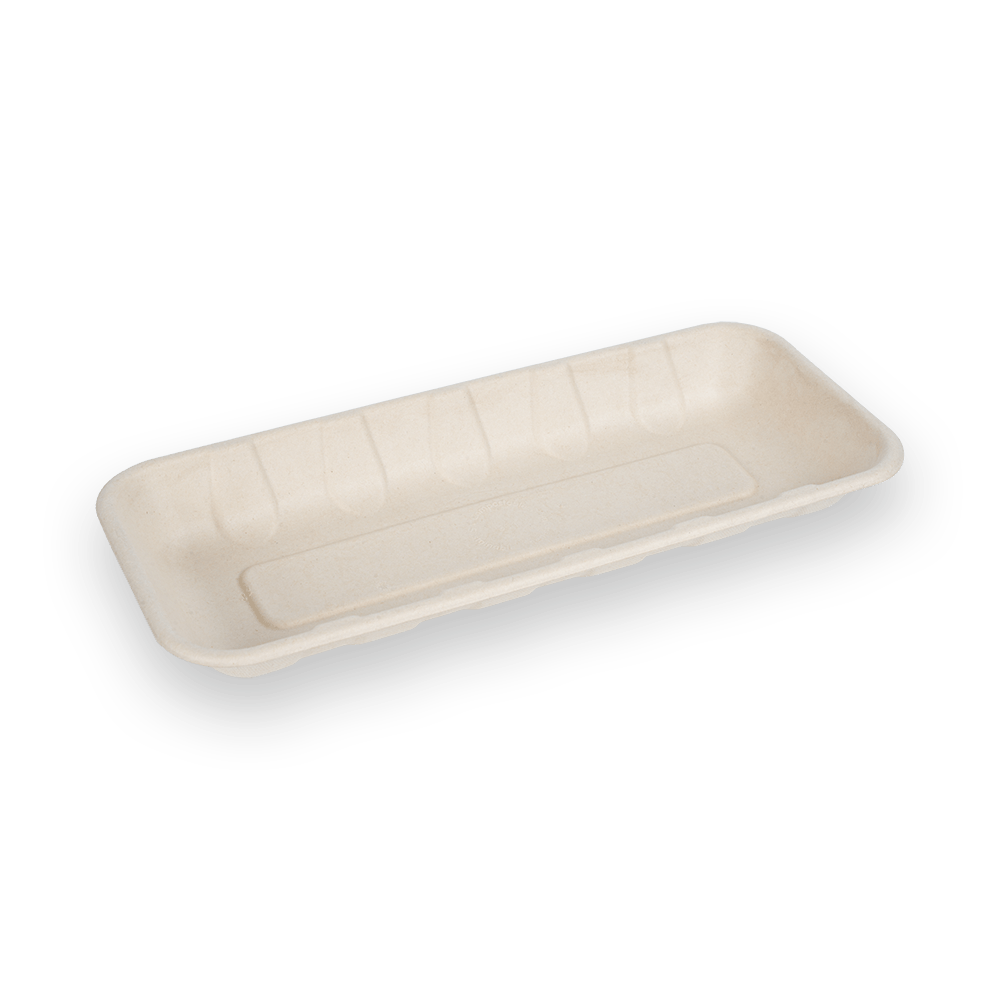


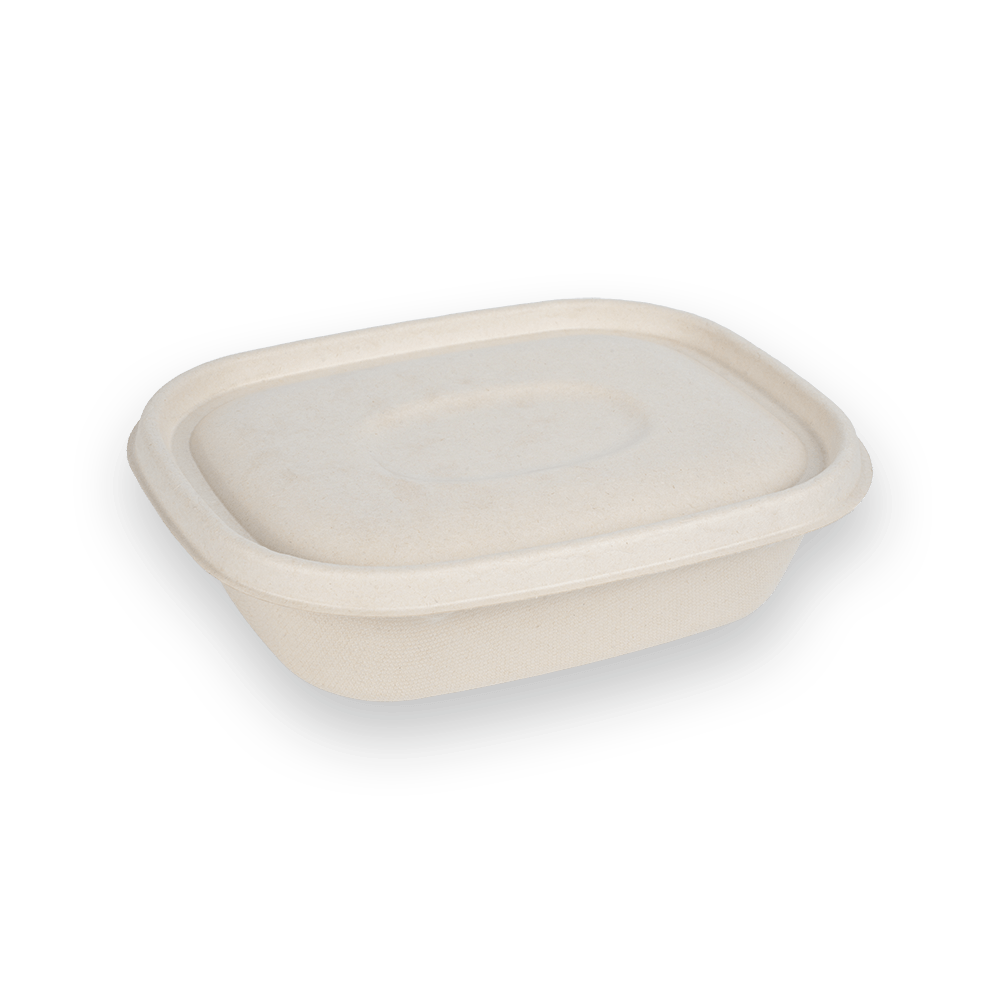
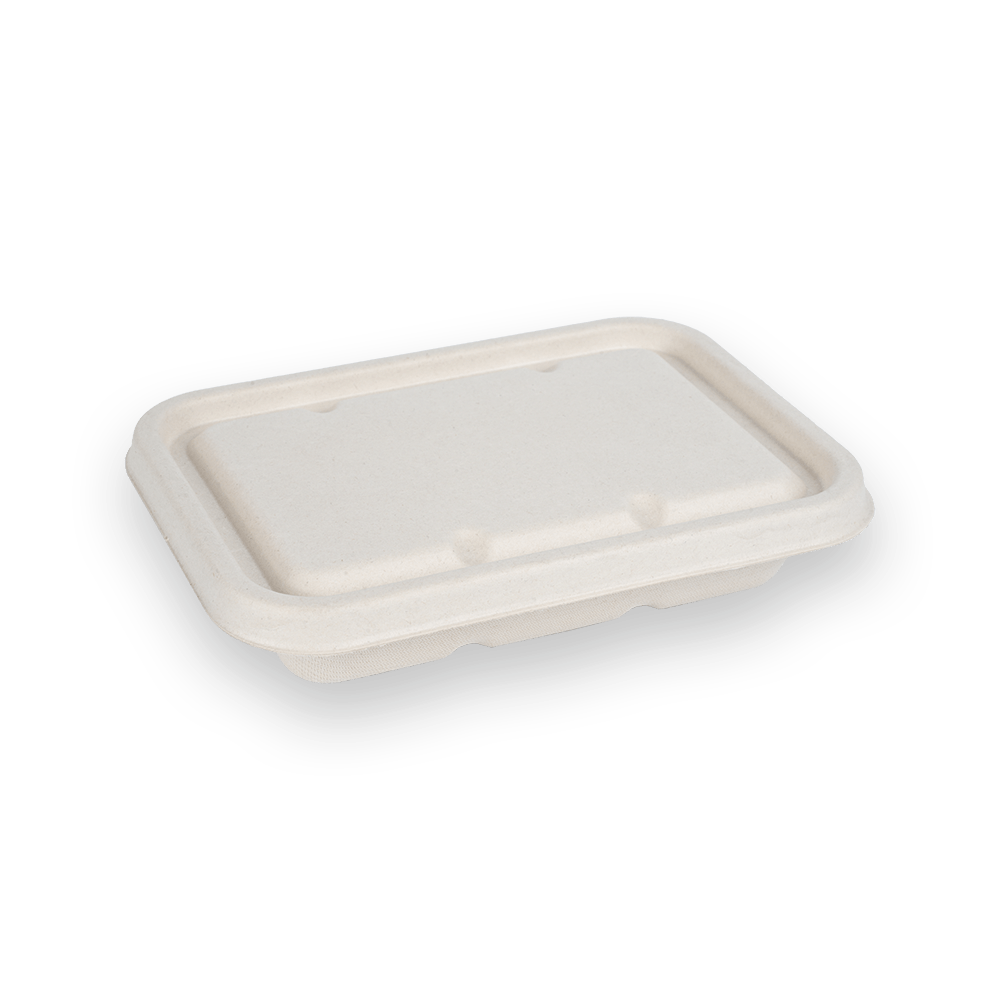

Zhong Xin Ecoware(Thailand) was registered on November 1, 2023, and officially began construction of the factory building in June 2024. At present, the first phase workshop of the factory has been fully completed and put into use. The second phase of the factory is being constructed intensively.
The landing and development of Zhong Xin in Thailand has brought a large amount of initial investment for land, factories, etc., and continuous operational investment for continuous equipment updates, technological upgrades, and capacity expansion.
Zhong Xin Ecoware(Thailand) has directly and indirectly created thousands of job opportunities, increased government revenue, promoted local economic development, cultivated local supply chains, provided systematic training for employees, improved the quality of local human capital, injected vitality into the local economy, enhanced industrial competitiveness, and ultimately improved residents' living standards.
Zhong Xin Ecoware(Thailand) actively collaborates with local pulp mills to explore new cooperation models for developing new products, improving production capacity and quality. At the same time, relying on Zhongxin's advanced production technology, process flow, management experience, and quality control system, it promotes the development of this industry in Thailand.



-
-
 +66-31240888
 -
 161 Village No. 4, Bo Thong Subdistrict Kabin Buri District Prachinburi Province 25110
-
How to Find Zhong Xin at the 140th Canton Fair: A Visitor Navigation Guide
Oct 16,2026
-
Thailand vs China Bagasse Tableware: 8 Comparisons Buyers Should Verify
Oct 16,2026
-
Will Takeout Containers Fit Your Existing Lids and Delivery Workflow
Oct 16,2026
-
What Is Bagasse Tableware? A 2026 Buyer Guide to Material, Performance and Documents
Oct 13,2026
-
Bagasse Tray Wholesale: How Bulk Buyers Cut Cost with Carton and Container Planning
Oct 09,2026
-
What Should a Bagasse Manufacturer Include in a Bulk Order Quote
Oct 09,2026
-
FOB, CIF or DDP? Incoterms for Bagasse Tableware Buyers Shipping from Thailand
Oct 06,2026
-
Packaging or Food Contact? Which EU Regime Applies to Bagasse Cups, Bowls, Plates and Cutlery
Oct 06,2026
-
Compostable Cutlery Sets for Private Label: 7 Sourcing Checks for Retail and Foodservice Buyers
Oct 06,2026
-
US vs EU Bagasse Tableware Imports: 8 Documentation and Compliance Checks Buyers Should Run
Oct 06,2026
-
How to Prepare a Bagasse Tableware Import: 10 Readiness Checks for US and EU Buyers
Oct 06,2026
-
Beyond Plates: Which Foods Suit Bagasse Tableware
Oct 02,2026
Copyright © 2025 Zhong Xin Ecoware Technology ( Thailand ) CO., LTD.
All Rights Reserved.

Biodegradable Disposable Bagasse Tableware Manufacturer