-
 [email protected]
-
 +66-31240888



 English
 Español
 ไทย
ไทยMolded Pulp Factory Audit Checklist: 12 Checks for Global Buyers
Molded Pulp Factory Audit Checklist: 12 Checks for Global Buyers

A molded pulp packaging factory audit should answer one practical question: can this supplier make the same product, at the required quality and volume, after the first purchase order is signed? For global buyers, a clean showroom and a certificate folder are not enough. The audit needs to connect raw material, equipment, process control, testing, documents, capacity and shipment execution.
Zhong Xin Ecoware’s factory page describes China and Thailand production bases, automated production lines, quality control, packaging options, R&D and mold support. Buyers sourcing bagasse tableware, food packaging or molded fiber packaging can use the 12 checks below as a pre-order audit framework.
12 Factory Audit Checks for Molded Pulp Packaging
| No. | Audit Check | What to Ask | Procurement Risk Controlled |
|---|---|---|---|
| 1 | Raw material source | Where does bagasse or pulp come from, and how are incoming batches recorded? | Material instability and undocumented origin. |
| 2 | Pulping equipment | Can the factory show pulp preparation, mixing and additive-control procedures? | Inconsistent oil, water or strength performance. |
| 3 | Forming equipment | How many forming lines and cavities are available for the audited product family? | Overstated production capacity. |
| 4 | Mold maintenance | How are molds cleaned, stored, repaired and replaced? | Dimensional drift, poor lid fit and surface defects. |
| 5 | Temperature and pressure control | Are process parameters recorded by line, shift and SKU? | Unstable wall thickness, deformation and weak stacking. |
| 6 | In-line QC | What checks happen during production, not only after packing? | Late discovery of defects and high scrap rate. |
| 7 | Laboratory testing | Can the lab test moisture, weight, compression, leakage or application performance? | Unverified product claims. |
| 8 | Traceability system | Can finished cartons link back to production batch and material batch? | Weak recall and complaint investigation. |
| 9 | Nonconforming product control | Where are rejected products stored and how are they documented? | Defective goods mixed into shipment. |
| 10 | Certificate scope | Do certificates match factory, product family, material and destination market? | Using generic or mismatched documents. |
| 11 | Daily capacity | What is audited daily output for the target SKU, not only total factory capacity? | Missed launch dates and partial shipments. |
| 12 | Warehouse and loading | How are cartons stored, protected, counted and loaded into containers? | Carton damage, moisture issues and loading delays. |
Check the Certificate Scope, Not Only the Certificate Name
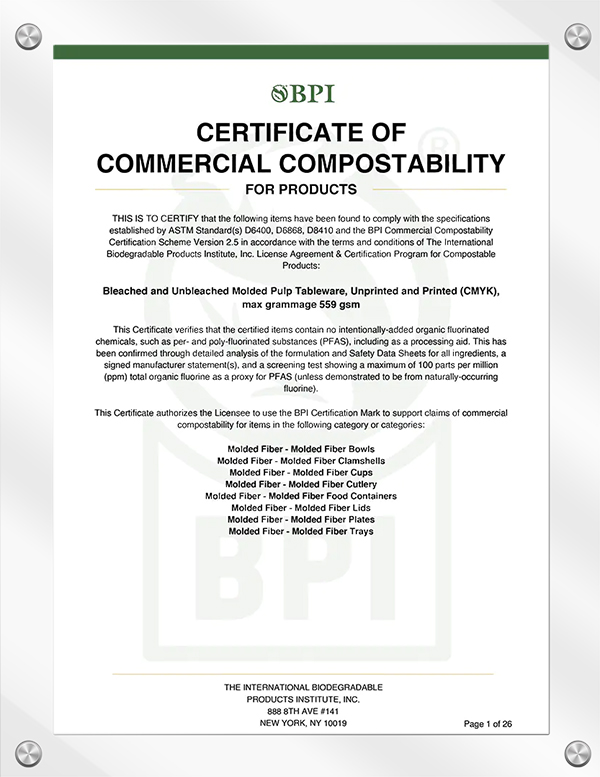
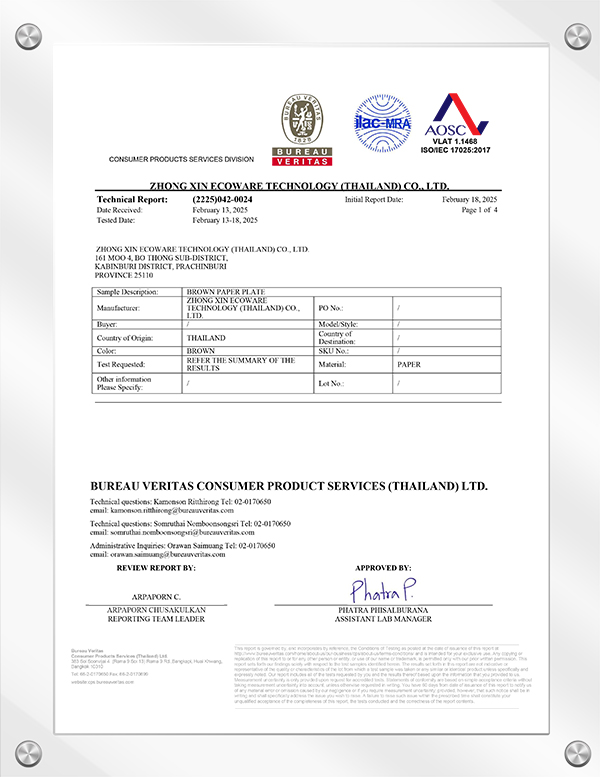
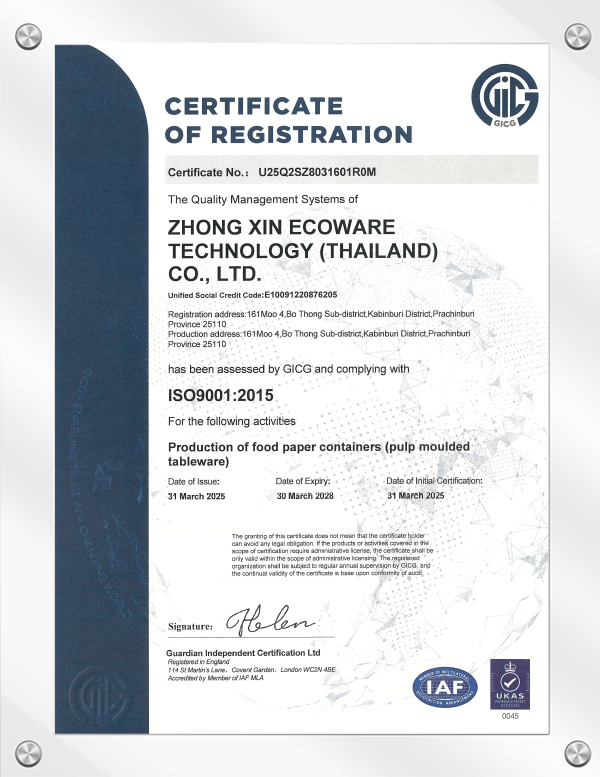
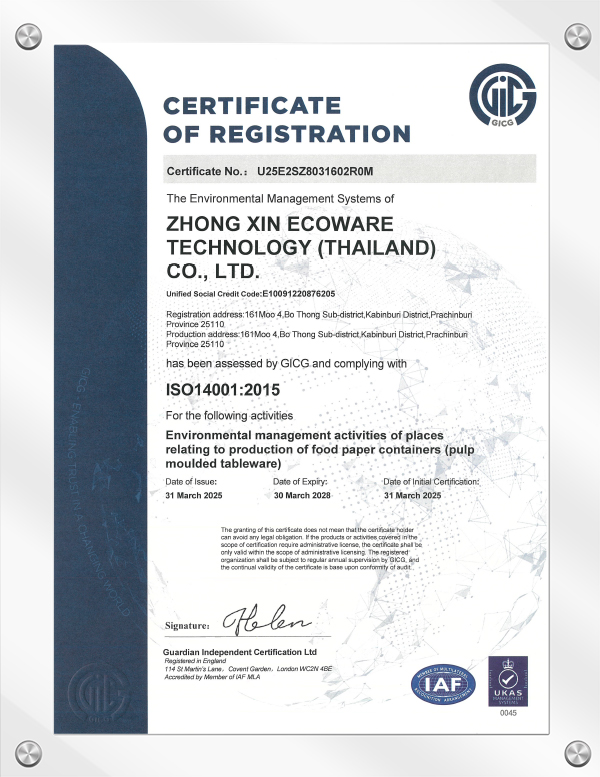
Certificates are useful only when buyers understand their scope. Zhong Xin Ecoware’s certifications page lists documents related to BPI, food-contact review, PFAS-related testing, BRCGS Packaging Materials, EN 13432 / OK compost, ISO systems and other buyer files. During an audit, buyers should confirm which documents apply to the exact item, factory, material color, mold and destination market.
Third-party testing bodies such as SGS food-contact material services can support food-contact testing for global markets, but a test report is still a document snapshot. Buyers should connect test reports with production traceability and change-control rules.
Factory Audit Evidence Buyers Should Collect
- Product specification sheet for each audited SKU.
- Sample approval record and retained sample photos.
- Material batch records and incoming inspection records.
- In-line QC forms and final inspection reports.
- Mold maintenance records for the target product family.
- Certificate copies with scope, issue date and product-family match.
- Warehouse photos, carton specification and container loading plan.
When to Audit On Site and When to Start Remotely
For early supplier screening, buyers can start with a remote document and video review. For large private-label orders, annual programs, high-risk claims or urgent customer launches, on-site or third-party audits are more useful. The goal is to verify that OEM/ODM customization support and bulk production controls are real before tooling or mass production begins.
Before a factory audit, send Zhong Xin Ecoware the product type, order size, market, compliance requirement and launch timeline through the contact page so the right factory, product family and document scope can be prepared.
FAQ
What should overseas buyers check during a molded pulp packaging factory audit?
Buyers should check raw material source, pulping and forming equipment, mold maintenance, process control, in-line QC, laboratory testing, traceability, nonconforming product management, certificate scope, daily capacity, warehouse control and container loading ability.
Can a bagasse packaging factory provide PFAS-free and food-contact documents?
A qualified supplier should explain which PFAS-related reports and food-contact files are available by SKU and product family. For the U.S., buyers can review FDA food-contact resources; for Europe, buyers can review the European Commission food-contact materials page.
Does BPI certification replace a factory audit?
No. BPI certification supports compostability claims for listed products, but it does not replace a factory audit of production control, quality management, traceability and shipment readiness. Buyers should verify relevant listings in the BPI official directory and still audit operational controls.
Is the same audit checklist useful for US distributors, QSR chains and supermarket deli buyers?
Yes, but the emphasis changes. Distributors focus on repeat supply and container loading, QSR chains focus on specification consistency and change control, and supermarket deli buyers focus on food-contact documents, carton data and application-specific performance.
Get a Quote from Zhong Xin Ecoware
Zhong Xin Ecoware Technology (Thailand) Co., Ltd. supplies bagasse and molded fiber food packaging to importers, distributors and foodservice brands. For MOQ, pricing, samples and lead time, contact the sales team through the contact page.
Related resources: Certifications | Dual-source supply | OEM/ODM guide
Zhong Xin Ecoware Technology (Thailand) Co., Ltd. supplies bagasse and molded fiber food packaging to importers, distributors and foodservice brands. For MOQ, pricing, samples and lead time, email info@fiber-product.com or use the contact form.



Zhong Xin Ecoware(Thailand) was registered on November 1, 2023, and officially began construction of the factory building in June 2024. At present, the first phase workshop of the factory has been fully completed and put into use. The second phase of the factory is being constructed intensively.
The landing and development of Zhong Xin in Thailand has brought a large amount of initial investment for land, factories, etc., and continuous operational investment for continuous equipment updates, technological upgrades, and capacity expansion.
Zhong Xin Ecoware(Thailand) has directly and indirectly created thousands of job opportunities, increased government revenue, promoted local economic development, cultivated local supply chains, provided systematic training for employees, improved the quality of local human capital, injected vitality into the local economy, enhanced industrial competitiveness, and ultimately improved residents' living standards.
Zhong Xin Ecoware(Thailand) actively collaborates with local pulp mills to explore new cooperation models for developing new products, improving production capacity and quality. At the same time, relying on Zhongxin's advanced production technology, process flow, management experience, and quality control system, it promotes the development of this industry in Thailand.

-
-
 +66-31240888
 -
 161 Village No. 4, Bo Thong Subdistrict Kabin Buri District Prachinburi Province 25110
-
New Bagasse Tableware Lineup for 2026: What Is New and Where to See It
Sep 28,2026
-
How to Select Bagasse Clamshells for Burgers, Rice Meals and Fried Food
Sep 28,2026
-
Microwave Reheating: Is a Bagasse Lunch Box Suitable
Sep 25,2026
-
9 Inch Pizza Plates and Bagasse Pizza Boards: A Sourcing Guide for US and Canadian Distributors
Sep 19,2026
-
PFAS-Free & Compostability Verification: A Buyer's Checklist for Bagasse and Molded Fiber Packaging
Sep 19,2026
-
Bagasse vs PLA vs Molded Fiber: What Distributors Should Stock in 2026
Sep 19,2026
-
Can Sugarcane Plates Handle Hot, Greasy Foods
Sep 18,2026
-
Bagasse Tableware RFQ Template: Get a Comparable Thailand Factory Quote
Sep 14,2026
-
Are Takeaway Food Containers Ready for Saucy Meals
Sep 11,2026
-
7-Inch vs 9-Inch Bagasse Plates: Carton and 20GP Guide
Sep 07,2026
-
Will Bagasse Pulp Trays Sag Under Heavy Meals
Sep 04,2026
-
Zhongxin Packaging at the 140th Canton Fair 2026: Booths and Buyer Meeting Guide
Sep 02,2026
Copyright © 2025 Zhong Xin Ecoware Technology ( Thailand ) CO., LTD.
All Rights Reserved.

Biodegradable Disposable Bagasse Tableware Manufacturer